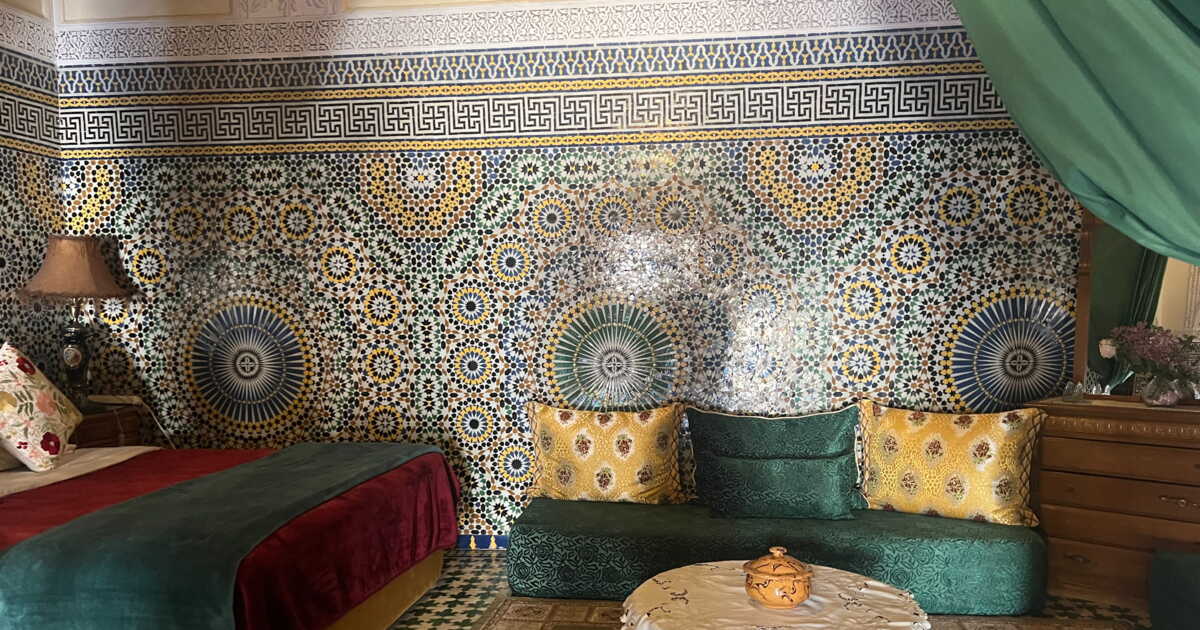
With each hard strike, a shard of enamel erupts before falling back onto the floor already covered by a fine white dust. The workshop resounds to the rhythm of hammer blows. Several Moroccan artisans, called maâlems, lean over dozens of small pieces of colored faience. “Everything is made by hand. We never use machines”, explains Mohammed Thifa, president of a Fez-based Craft Cooperative.
Clay, Earthenware and Kiln: The Stages of Building Moroccan Zellige
To create these faïences, the raw material lies a few meters away. In a corner of the workshop, blocks of gray clay wait to be transformed. This earth comes from Mount Zalagh, which overlooks Fez. No chemical products, the artisan assures. Only a natural clay renowned for its solidity.
The blocks are first crushed before being dipped into a basin filled with water where the clay slowly absorbs moisture. Then the maâlem himself descends into the basin and kneads the material until a perfectly homogeneous dough is obtained. Once this dough is obtained, it is spread out in the sun to remove the excess water.
That is when the potter’s work begins. Sitting in front of his wheel, the artisan powers the wheel with his foot while guiding the earth between his hands. Tajines, plates, candlesticks or large platters seem to appear naturally. “After twenty years in the trade, you know all the measurements by eye” smiles Ahmed.
The freshly shaped pieces dry for several more days before their first firing. At 1,200 degrees, the clay definitively changes its nature. When taken out of the kiln, it takes on the light shade that the artisans simply call “the biscuit.” Solid, ready to be decorated.
“We assemble all the pieces upside down”
Once the pieces come out of the kiln, another craft begins. On the ceramic’s matte surface, geometric motifs gradually appear thanks to the paints of the artisans. The pigments used are natural and are simply mixed with water before being coated with a glaze. A second firing, this time at 900 degrees, permanently fixes the colors. In Fez, five colors (blue, green, yellow, white, black) have for centuries composed the traditional zellige palette. “Red and purple arrived much later” recalls an artisan.
In another room of the workshop, a louder metallic clatter immediately catches the eye. A man sits on a small stool. In his left hand, he holds a glazed tile. In his right, a heavy hammer with a blade. A few seconds suffice to transform a ceramic square into a star, a diamond or a shape whose name belongs only to the vocabulary of the maâlems.
The Zellige and UNESCO: A Heritage Still Pending
Zellige is a source of tension between Morocco and Algeria. In 2022, the presence of motifs inspired by zellige art on training jerseys for the Algerian national team had fueled tensions. Since then, Algeria has submitted a request to inscribe “The Art of Architectural Ornamentation in Zellidje” on UNESCO’s intangible heritage list.
In November 2025, the Moroccan Ministry of Youth, Culture and Communication officially launched the candidacy project for “the art of zellige of Fez and Tetouan.” The stated objective is to have a centuries-old know‑how recognized, based on the manual cutting of tiles, the assembly of geometric motifs and the learning from master craftsmen (Maâlems).
This candidacy particularly highlights the continuity of the artisanal tradition, still alive in the workshops of Fez and Tetouan, where techniques are transmitted both within families and in specialized training institutions.
“A clean, well beveled cut is necessary”, explains the artisan without taking his eyes off his work. At his feet, hundreds of fragments accumulate. A few meters away, several artisans work directly on the ground. They do not look at the decorated face of the tiles. Here, all pieces are laid… upside down.
The color disappears against the floor and the final drawing remains invisible. “We work blindly”, sums up Mohammed Thifa. “We assemble all the pieces upside down.” They know the exact position of each element, memorize the colors, the angles and the symmetries without ever seeing the pattern appear.
When the puzzle is complete, a mortar is poured over the whole to bind all the pieces together. Wrought-iron rods reinforce the structure, then fiber and resin help ensure its strength. They will have to wait another one to two weeks for everything to dry. Then, the artisans turn the work over and reveal a perfectly symmetrical mosaic.
Zellige: A Protective Barrier That Adorns Building Walls
In the labyrinth of Fez’s narrow lanes, zellige appears in medersas (schools), mosques or even fountains. The thousands of cut fragments are architectural elements. “Zellige is not merely decoration” explains Mustapha Jlok, director of heritage at the Moroccan Ministry of Culture, as he stops before a plinth (the lower part of the walls) covered with geometric patterns. “Its primary role is to protect the walls.”
Indeed, the mosaics covering the lower parts of buildings are not there solely for decoration. They form a protective skin for load-bearing walls, often built of sun-dried earth (pisé), which poorly withstand humidity. The ablution rooms, pools and fountains expose buildings to water daily. Zellige forms a waterproof barrier that preserves the structures.
In Fez’s medersas, the geometric panels run along the interior façades before giving way to carved plaster, cedar wood and inscribed calligraphy.