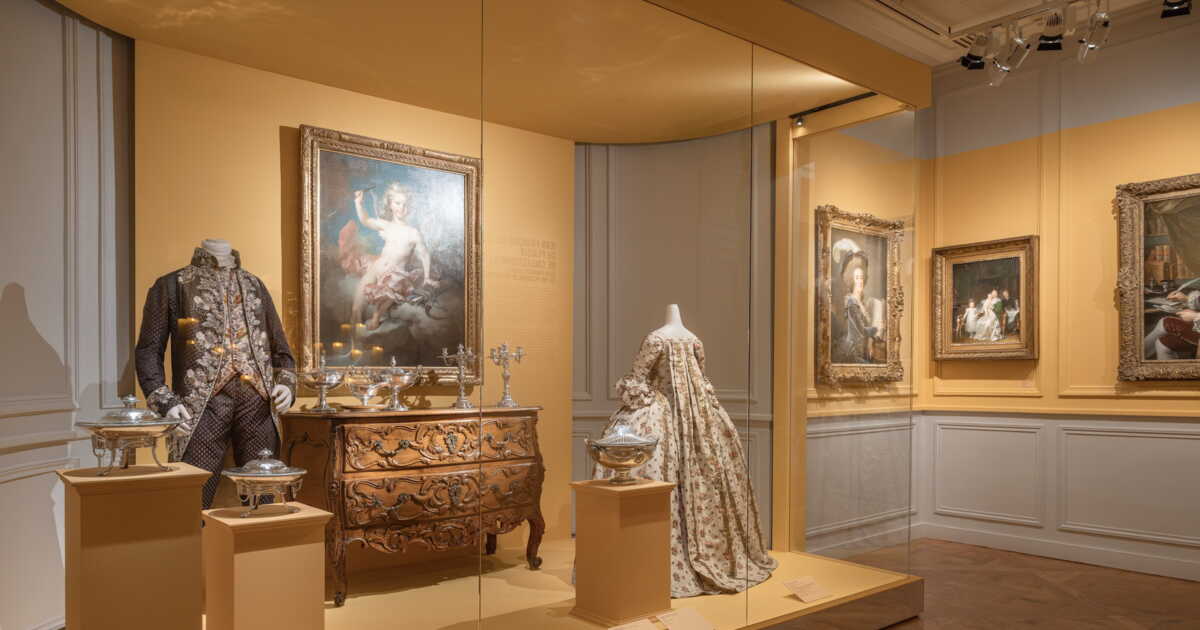
On the occasion of its centenary, Maison Fragonard, the emblematic French family perfumery, presents for the first time in Paris a portion of its patrimonial collections. Until January 10, 2027, the historic salons of the Monnaie de Paris host more than 250 works and objects bearing witness to the eighteenth-century art of living.
Paintings, costumes, jewelry and perfumery objects mingle along a route that also appeals to the sense of smell, thanks to the recreation of several ancient fragrances. But how did this Grasse-based company become over generations an important collector of artworks and historical objects? Charlotte Urbain, cultural director of Maison Fragonard and curator of the exhibition, tells us this family story and sheds light on the uses of perfume through the centuries.
How did Maison Fragonard develop over time?
Charlotte Urbain: The house was founded in 1926 in Grasse by Eugène Fuchs. It is a family business, today led by the fourth generation. It grew over the decades and experienced particularly strong expansion in the last twenty years, thanks to the remarkable work of Agnès, Anne and Françoise Costa, the founder’s great-granddaughters. When they took over the company after their father, they wished to develop an entire universe around the brand. The house thus possesses an olfactory identity clearly associated with orange blossom.
Today, Fragonard comprises three manufacturing plants, in Grasse and Èze, where we produce our perfumes, soaps and cosmetics, but also about twenty shops across France and an online store. It is this set of commercial activities that allows us to fund acquisitions, exhibitions and our patrimonial and museum work.
How did this collection come together over generations?
It is worth recalling first that the house’s name pays homage to the painter Jean-Honoré Fragonard, born in Grasse in 1732. When Eugène Fuchs founded the perfume house, he chose this name in reference to the artist from the town.
The collection began with the acquisition of a painting, The Sacrifice of the Rose, by Jean-Honoré Fragonard. This work was purchased by François Costa, Eugène Fuchs’s son-in-law and the grandfather of Anne, Agnès and Françoise Costa. It was from there that the desire to collect works of art was born.
The collections then grew considerably thanks to Jean-François Costa, François’s son, who became passionate about the eighteenth-century French era, notably for silverware and Provençal furniture. He gradually began collecting artworks, but also objects related to perfumery. He notably acquired a complete collection of flasks at Carthage and antiquities. His idea was to display these objects in the company’s factories to complement the visit with a historical approach to perfume, from Antiquity to the present day.
Today, the collection is organized around three major组 that we have brought together for the first time in this exhibition. The first brings together paintings and drawings by three Grasse-based artists: Jean-Honoré Fragonard, Marguerite Gérard and Jean-Baptiste Mallet. The second is devoted to eighteenth-century perfumery objects. It is not solely about bottles, as we also present pomanders and other objects. We also hold a collection of more technical perfumery devices, notably distillation apparatuses.
Finally, the third group concerns textiles. It is mainly thanks to Hélène Costa, wife of Jean-François, who developed a passion for Provençal costumes. She began collecting them for herself, before expanding this collection with the opening of the Grasse Costume and Jewelry Museum in 1997.
In the eighteenth century, what was perfume used for?
Perfume was used for everything! It was truly part of daily savoir-vivre. Perfumery objects were often very imposing and ostentatious. Burners, pomanders and perfume fountains were placed on fireplaces or tables, serving as decorative objects. Perfumery touched every moment of daily life: during dressing, but also during social gatherings and receptions.
At that time, perfumery was mainly reserved for the bourgeoisie. People perfumed their linen, their interiors, but also their own bodies and their wigs. It was necessary in particular to mask unpleasant body odors, at a time when hygiene habits were very different from ours. Perfume therefore held an important place in daily life, as well as in social representation.
Were perfumes presented in liquid form already?
Not only. There were many forms of perfumery: powders, ointments, fumigations or preparations obtained by maceration. In fact, the word “perfume” comes from Latin and points to the idea of “by means of smoke.” Fumigation was therefore also a way to perfume oneself.
We also used vinaigrettes, small bottles containing a strongly scented liquid based on vinegar and aromatic substances. These preparations were particularly used to revive people who felt poorly. Women could inhale them when they felt faint, for example due to a corset that was too tight. The sharp, acidic smell of vinegar, combined with the aromatic ingredients, was supposed to help them regain their senses. This is one of the types of preparations we reconstructed for the exhibition so that the public could discover it.

Were the ingredients used in the eighteenth century very different from those found in contemporary perfumes?
In recreating five ancient perfumes for the exhibition, based on eighteenth-century recipes, we found that the same ingredients appeared repeatedly. They mainly consisted of aromatic plants, such as thyme, rosemary and lavender, but also spices, notably clove and cinnamon. Resins and gums, such as benzoin and storax, as well as flowers, were used. Rose, jasmine, tuberose and orange blossom were among the major ones.
Today, the perfumer’s palette is much broader, especially because synthetic materials have been added to natural ones. Tastes have also evolved. Today, there is a vogue for gourmand perfumes. In recent years, sweet and fruity fragrances have been particularly popular. In a world that remains volatile and marked by crises, the public seems to seek these regressive scents.
More broadly, our habits have changed a great deal in a century. A perfume created in 1926 is not necessarily used in the same way in 2026. We now scent our soaps, shower gels, shampoos and most hygiene products. The odors surrounding us and our expectations are no longer the same. They also vary by culture and by country.
Was it difficult to recreate eighteenth-century fragrances from the old recipes?
Yes, because the recipes we found were not detailed at all. It is therefore a matter of interpretation, a creation that comes close to what the reality must have been. Since we do not have the exact quantities for each ingredient, it is very difficult to know whether the perfumes we produced truly resemble those of the era.
Among the exhibition objects, which one touches you most?
It isn’t necessarily the most beautiful objects, but they are the bergamotes. These are small boxes made from the fruit’s rinds, crafted with a Grasse craftsmanship now lost. Bergamot is a magnificent citrus, whose essential oil is used in perfumery. Its scent is exceptionally pleasant.
These small boxes, very popular in the past, were used to store sweets, scented powders, jewelry or ribbons. They were often given as love gifts and decorated with affectionate little messages. I find their meaning very lovely, as does their use.