Summary
-
Origins of Leap Castle’s Sinister Reputation
-
A Dungeon and the Bones
-
“We Are Not Alone,” Says the Lord
-
The Ravens’ Cry Brings Me Back to Life
I am someone who tends to be fairly rational. In the X-Files series, I feel closer to Dana Scully, the FBI scientist who always has a logical explanation at the ready, than to Fox Mulder, who believes in paranormal phenomena with all his heart.
But some reports—whether about a supposedly haunted plantation in Louisiana or ghost-hunting expeditions in Île-de-France—have taught me to pause my Cartesian mind. So, when GEO invited me to go explore a ruin self-proclaimed as “the most haunted castle in Ireland,” I packed my bags and let myself be carried away. Sometimes, the truth lies elsewhere…
Origins of Leap Castle’s Sinister Reputation
To reach this strange place, you have to venture deep into the Irish countryside, wandering Offaly’s lanes, halfway between Dublin and Galway, and show some nerve. The roads are treacherous, concealing false flat stretches and perpendicular turns. The light of this autumn afternoon lengthens the shadows. One might almost expect a puca to rise from every glowing hedgerow, that little demon who can assume the form of a black horse, a deer or a fox to play tricks on the farmers.
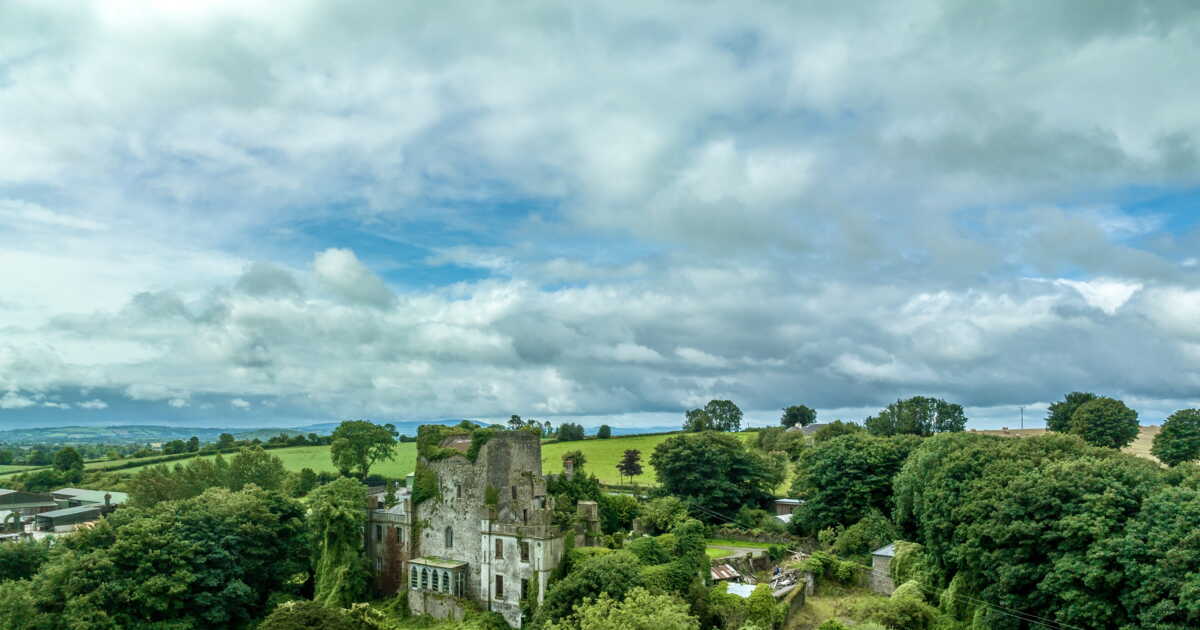
In this frontier between reality and imagination, from the narrow R421 road between the towns of Roscrea and Birr, Leap Castle suddenly looms on the summit of a hill, its cadaverous silhouette rising. The castle’s dark reputation echoes across the southern half of the country. To occupy the last stretch, I replay its macabre history in my mind.
People say it sits on a site where secret initiation rites were once held. They also say its unusual name, “leap,” derives from a deadly challenge. In the 15th century, two O’Bannon brothers supposedly tested who would lead the clan: they leaped from a promontory, and the survivor is said to have built a fortified stronghold right where the loser breathed his last.
The O’Bannon лords were vassals of another clan, the O’Carrolls, who later seized Leap Castle after years of brutal conflicts. Brutal and torn by internal strife, the O’Carrolls cast the castle into horror. They are blamed for the massacre of around forty members of a rival family, the MacMahon. Invited to a reconciliation banquet, they were poisoned, run through, and cast into the oubliettes.
A Dungeon and the Bones
After the castle fire in 1922, restoration work cleared access to a dungeon and unearthed the bones of around a hundred bodies. Enough to fill three wagons. With my mind darkened by these thoughts, I almost forget that I have arrived. I risk crossing the wrought-iron gate marking the entrance, passing the keepers’ cottage, and stealthily driving my vehicle down the path.
Even though I am expected, I feel unwelcome. The trees are tall, the wind whistles in concert with a swarm of screeching ravens. Facing the low sky, my gaze climbs to blind windows, battlements worn by time encircling a not-so-inviting keep. There is a distinct sense of being watched from above.
On the door, a skull-shaped knocker topped with a wireless bell, fixed to double-faced tape. I knock. I am invited in. The heavy door swings open to a large vaulted room, furnished in an anarchic fashion: trinkets, chairs upholstered in medieval style, mementos from distant journeys. Hunting trophies, tapestries, and shields line up beneath the beams supporting the high ceiling. The waning daylight struggles to filter through the few ground-floor windows.
On the mantelpiece, an authentic reduced head seems to watch from the depths, the wall opposite adorned with masks of the commedia dell’arte. The dying embers in the fireplace aren’t enough to banish the thrill that runs down my spine. Seated before the glass door overlooking pastures where cattle moo, the owner Sean Ryan greets me more than he welcomes me.

Long white hair spilling from a wool hat, a stern figure, pale, piercing eyes, he is at first gruff, even downright surly. One could think the spirit of the place has rubbed off on him. Reluctantly, he shares a little more about “his” castle. He bought these ruins, unoccupied for six decades, in 1991. Year after year, he has developed a small part, leaving the rest to brambles and ravens.
Have been seen, heard… or felt
Glowing orbs, in the Bloody Chapel, fragments of the soul of a priest murdered by his brother.
“The Thing”, a humanoid silhouette exuding a smell of sulfur and decay.
The specter of the Lady in Red, wandering the corridors with the blade with which she ended her life.
The tormented soul of Captain Darby, seeking his war treasure everywhere.
Voices speaking Gaelic, attributed to the spirits of the MacMahon murdered within these walls.
The Spirit of the Ogre, a humanoid entity with distorted features, said to have been summoned during an occult rite.
“We Are Not Alone,” Says the Lord
The brave septuagenarian doesn’t much appreciate journalists who, in search of juicy stories, bother him too often. But he has learned to deal with it: tourists also knock at his door first to meet his spectral roommates rather than to learn the place’s history. The money left by visitors on the table helps fund the work. After all, this allure of the supernatural is part of the site’s destiny.
The gothic novelist Mildred Darby, the last resident of the castle before its fire, used to host séances and black magic there, a pastime much enjoyed by the upper classes of the era. She claimed to regularly encounter specters in the corridors, notably the one she called “The Thing” in The Occult Review, in 1908, where she wrote:
Her dull eyes, which seemed half decayed and had an incredibly repugnant look, fixed mine, and the horrible odor that had previously offended my nostrils, a hundred times more intense, rose to my face, filling me with mortal nausea.
From those old sightings to the numerous articles, podcasts, and YouTube videos that flourish today, there is but a step. Sean Ryan even rents the place out for the night to groups of paranormal investigators hoping to capture, with their high-tech tools, some echoes of the beyond.
But does he believe in these famous ghosts? “I live here with my wife, it’s our home and we feel comfortable… But clearly, we are not alone”, he says with a shrug, as if these spirits are part of the backdrop, as much as the battlements and embrasures appear to be.
I sometimes hear, on the ground floor, a gathering of people, like a banquet. They talk but I don’t really understand them; it’s Old Gaelic or Old English.
He also recounts spotting whispers whose source remains elusive. And then there are lights, like fireflies, halos, flashes. Nothing extraordinary, downplays our host, who explains that he grew up, like many Irish, in a world where the supernatural is part of daily life, where people avoid certain spots—hedges, stone circles in fields—to avoid disturbing beings that might dwell there.
The spirits trapped in the walls of this castle are victims of the old clans, not criminals. We cohabit, that’s all. We leave them alone, they leave us alone.
As I burn with both fear and a desire to confront these specters, the owner tells me about the time he played the whistle across the country, and even in France. And he treats me to a demonstration, singing a Celtic ballad on his tin whistle that makes the bowels of the castle tremble.

The Ravens’ Cry Brings Me Back to Life
A group of Americans has just emerged from a corridor, flashlight in hand. Of Irish descent, they live in Saint Augustine, Florida, a city where ghost stories are legion. It is now my turn to visit the site. They hand me the torch and I gather my wits, while Sean Ryan gives me one last pragmatic piece of advice:
When you come down from the Bloody Chapel, be sure to close the latch properly. I don’t want pigeons to bother us.
Noted. The Bloody Chapel… the most sinister room in the building. On the death of the clan patriarch, in 1532, a succession dispute erupted between his two sons. While the elder, Thaddeus, a priest by profession, was conducting the service in the chapel, eerily located on the top floor of the keep, his brother Teige the Blind stabbed him in the chest, leaving him to die on the altar before the rest of the family.
I begin by taking, in near-total darkness, a very narrow staircase. I sweep the walls with my torch as I move through a stone passage worn smooth by the backs and hands of thousands who pressed through. A first room opens to the left. From the eastern window, two stone rings can be seen in the field below. The ceiling is lined with cobwebs.

To the north, a stairway descends into the oubliette where so many souls have been lost. I do not know if it is my imagination, but a heavy sadness washes over me. As if the memory of the events, ingrained in the walls, envelops me in melancholy. I take a few photos to capture the anguish gripping me.
That is when I distinctly feel something brush against the back of my neck. The Dana Scully in me would rather attribute this to the autumn wind rushing into the room than to accuse Thaddeus’ specter. Or perhaps it is simply my imagination? Probably a bit of all three.
Do you want to scare yourself?
Open Monday to Saturday, from 10 a.m. to 5 p.m. Just send an email to [email protected], or call (353868690547). No entry fee; you leave what you want as you depart. The owner’s mood is not guaranteed.
➤ Article published in GEO HS magazine no. 131, “Journeys into Lands of Mystery,” February–March 2026.
➤ Are you already loyal to GEO’s content? Then to miss nothing, explore our subscription plans to receive GEO at home every month with ease.