At the heart of the Congo Basin, one of the planet’s largest intact tropical forests, many regions still elude the attention of travelers. In the eastern part of the Republic of the Congo (not to be confused with the DRC), Odzala-Kokoua National Park unfolds a mosaic of ecosystems where dense forests give way to swamps, savannas, and rivers. Founded in 1935, it ranks among Africa’s oldest national parks and shelters an outstanding biodiversity.
To explore this natural sanctuary, we followed the itinerary proposed by Kamba Africa through the agency Privileges Voyages, designed for very small groups, traveling through three lodges with distinct atmospheres: Ngaga, Lango, and Mboko. These three camps are the only privately owned tourist concessions allowed inside the national park. Created to minimize the impact on this exceptional environment, the stays also help finance research and conservation programs conducted with scientists and local communities.
During several days, we explored these wild landscapes alongside trackers and guides, discovering iconic fauna—from plains gorillas to forest elephants—within a territory where tourism remains closely linked to nature protection.
Ngaga, in the intimacy of the Western lowland gorillas
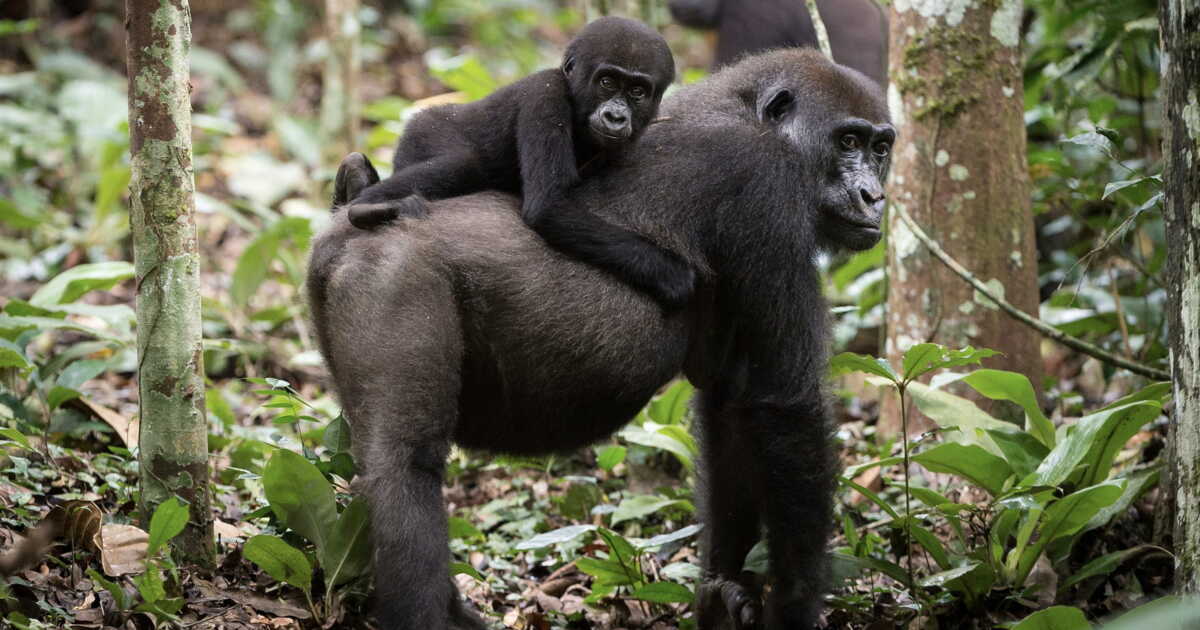
It is at the end of a dirt road, after several hours’ drive from a small airstrip, that Ngaga emerges into the heart of the forest. The lodge comprises just six comfortable wooden bungalows scattered beneath the canopy, spaced far enough to feel as if you are alone in the world. From the terrace of the main pavilion, the sounds of the forest replace any sense of human presence: birdsong or the rustle of leaves mark the days, while monkeys sometimes cross the treetops above the visitors. It is also the only one of the three lodges entirely devoted to observing the Western lowland gorillas.
This lodge grew from a meeting between scientific research and conservation. At its origin lies the research station established at Ngaga by primatologist Magdalena Bermejo, who has studied for years the populations of Western lowland gorillas in the region. On discovering this work, Sabine Plattner, founder of Kamba Africa, chose to support the research and to transform the former scientific camp into a lodge that allows visitors to approach these great apes while financing conservation efforts, research, and support for local communities.
At Ngaga, the main objective is therefore clear: to follow the Western lowland gorillas on two treks. Guided by local trackers who know every corner of the forest, visitors move slowly beneath the trees, searching for signs left by the animals. A broken branch, tracks on the ground, or remnants of a meal can reveal their passage.
Here, the encounter is made possible through a long habituation process carried out over several years by scientists and trackers. The three gorilla families that visitors may observe have gradually learned to tolerate human presence, without their behavior being altered. This approach allows gorilla studies while minimizing disruption.
“This is probably the most privileged place for Western lowland gorillas”, explains Nicolas Lenz, a 32-year-old French naturalist guide. The stand of marantaceae surrounding Ngaga provides a particularly favorable habitat. These abundant plants supply much of their diet with leaves, fruits, and mineral-rich roots. They also offer ideal sites for building their nests each night. This abundance partly explains the high gorilla density observed in this area, with up to five individuals per square kilometer according to estimates.
To approach them, trackers use a surprising method developed by Magdalena Bermejo. They wield pruning shears to cut leaves as they move through the vegetation. This cue lets the gorillas understand that a peaceful presence is approaching, helping prevent them from being startled by a group that might suddenly burst into their environment. A gentler alternative to machete use, which helps preserve the calm of animals long threatened by hunting.
View this post on InstagramLango, the realm of baïs and forest elephants
A radical shift in atmosphere as you reach Lango. Here, the forest opens up to reveal a vast mosaic of landscapes: open swamps, flooded forests, savannas, and dry forest patches.
The arrival sets the tone. After a kayak crossing and a trek through tropical forest and swamps, the six spectacular bungalows rise on stilts along the vast baï (a large swampy clearing rich in minerals located at the heart of Africa’s Central African rainforest), which has earned the site its fame. Connected by wooden walkways, they overlook this flooded clearing where animals come daily to feed, offering an exceptional window onto wildlife. From the restaurant or the lodge terrace, it is not uncommon to observe forest elephants, buffaloes, sitatungas, and numerous birds, sometimes just a few tens of meters from the guests.
One of the standout experiences offered here is the baï walk: a trek through water, sometimes up to the waist, in the heart of the wetlands. An activity unusual for a classic African safari where observation usually happens from a vehicle. Here, guests walk through the marshes on foot, guided by the rangers, to understand how this unique ecosystem functions.
“The lodge sits at the heart of a mosaic of connected habitats”, explains Nicolas Lenz. These connections are ensured in particular by the famous “elephant boulevards”, trails carved over the years by the repeated passage of pachyderms. These corridors clear the vegetation and enable other species to access certain zones.
Forest elephants are the masters of the place. Odzala-Kokoua National Park is said to shelter between 10,000 and 12,000 of them. Their presence literally shapes the landscape, as they disperse seeds, modify vegetation, and create passages used by other animals. To begin with, the numerous forest buffalos frequent open areas, while the red river pigs (bush pigs) play a crucial role in the ecosystem by turning over soils and aiding the decomposition of resources.
With luck, visitors may also glimpse the bongo, a large antelope particularly suited to swampy terrains. “It’s one of the most colorful antelopes in the world, and the largest and heaviest of all African forest antelopes, yet extremely difficult to spot”, notes the guide.
Bird lovers are not left out: the park is home to between 400 and 500 species, including the Gabonese gray parrot, long a victim of international trafficking due to its remarkable mimicry and communicative abilities.
Mboko, between river, forest, and unexpected encounters
Final stop of the journey: Mboko. Located at the crossroads of savanna and forest, along a tributary of the Lékoli River, it offers a unique setting to discover the park’s varied landscapes. The lodge provides comfortable wooden-and-fabric tents with a view of the river. From the main pavilion facing the savanna, guests can again enjoy close proximity to wildlife, with hyenas sometimes visible from the terrace.
Here, water becomes the connective thread of exploration. Indeed, from Mboko depart kayaking and boat excursions, a tranquil way to observe the landscapes and the abundant wildlife from a different vantage point.
The river also holds surprises. In certain areas, forest hippos seek refuge in small pools right in the heart of the forest. “When conditions are favorable, you can go to the riverbank and watch them”, says Nicolas Lenz. It’s a rare scene because, unlike their river-dwelling cousins, these hippos spend a significant portion of time in a forest environment.
At Mboko, some observations require mainly patience. Chimpanzees frequent the lodge’s surroundings, but spotting them is another story. Much more agile than gorillas, they race through the forest, avoiding human presence. Guides listen for their vocalizations to anticipate their movements, with no guarantee of joining them before they vanish into the dense undergrowth.
The forest also shelters species whose discretion is their best defense. This is the case of the African golden cat, a feline so elusive that even guides rarely see it. “Their biology is to remain unseen”, sums up Nicolas Lenz. Otters also inhabit the park’s rivers, but their appearances remain equally unpredictable.
Across Ngaga, Lango, and Mboko, Kamba Africa thus offers three entry doors to the same territory: the Congo Basin. An exploration that reveals how, in this still-preserved corner of Central Africa, travel is less about ticking off a list of animals and more about learning to observe an entire ecosystem.
Informations pratiques
Gorilla Safari by Kamba in the Republic of the Congo
- 10 days / 8 nights
- Flights Paris / Brazzaville / Paris in economy class
- Brazzaville / Mboko / Brazzaville by private plane
- 8 nights’ accommodation: 1 night at Hilton Brazzaville, 3 nights at Ngaga Lodge, 2 nights at Lango Lodge, and 2 nights at Mboko Lodge
- Park entries and 2 gorilla permits per person
- All activities: cruise at Mboko Camp, kayak safari, daily guided hikes, meeting with communities…
- Meals and drinks (wines, beers, and spirits)
- All ground transfers between airports and lodges
- Guided visit of Brazzaville before boarding the plane
- Airport assistance
Informations et réservation :
Privilèges Voyages
46 avenue Marceau – 75008 Paris
01 47 20 04 76

Amara Nambinga