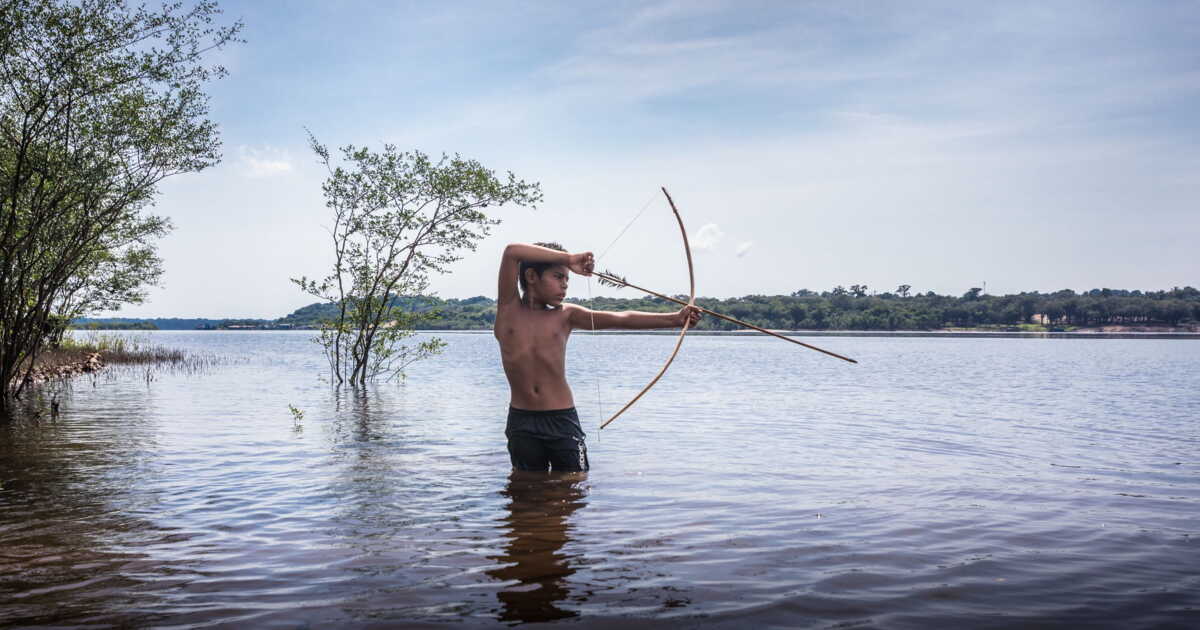
José Pancracio Da Silva glides silently along the Cuieiras River toward a corner he knows well, about a thirty-minute canoe ride from his village, Nova Esperança. Even before touching his net, he sits up, closes his eyes for a moment… When José fishes, he does not simply cast his trap into the water and wait for needlefish and nanacaras to bite. He first asks, in a whisper, for permission from the dono da água, the master of the water. A few words whispered in a mysterious language, almost a prayer. It is an ancient ritual, but also a pact: to accept that he is neither owner nor conqueror here, only invited. Take his share, no more. It is 5:30 in the morning and night still lingers. The air clings to the skin, heavy and humid, like steam rising from the forest’s belly. Around him, the Anavilhanas, 400 protected islands spread over 3,500 square kilometers in the heart of the Brazilian Amazon, sleep half-awake.
Ils nous ont aidés pour ce reportage
The Heliconia Amazonia Turismo agency, based in Manaus and run by two French people, offers tailor-made waterway tours in the heart of the Brazilian Amazon.
From the great city of Manaus, 80 kilometers downstream, one must take a full day by boat to reach this river archipelago, the second largest in the world (after Mariuá’s, 300 kilometers away), while going upstream along the Rio Negro. In the dark, mirror-smooth waters, the last stars and the first birds are reflected. The Amazon’s main tributary owes its mysterious brown to tannins and humic acids released by the forest’s fallen leaves, a tea-like tint, nearly transparent at shallow depths. This acidity, the lack of sediments, and the seemingly bare water offer an unexpected comfort to the inhabitants of the Anavilhanas, where mosquitoes do not thrive in these waters.
Howler monkeys, blue macaws and pink dolphins
But the river’s miracle does not end there: it hosts a teeming fauna—piranhas, peculiar matamata turtles (Chelus fimbriata) that look like a pile of leaves, howler monkeys, blue macaws, jaguars, and even the famous botos (Inia geoffrensis), the pink Amazon dolphins, lively, tireless playmates who sometimes cross the boundary between species to swim with humans. Indigenous peoples, particularly the Barés and the Tatuyos, were pushed to these shores by history, necessity, and the dream of a better life. In T-shirt and shorts for some, with ritual paintings and a traditional feathered headdress for others, the inhabitants live to the rhythm of this capricious river, whose water level—ranging from 13 to 21 meters high—continually redraws the geography by surfacing ephemeral islands in the dry season. They view it not as an obstacle but as a master whose secret language they have learned.
At 64 years old, the fisherman José Pancracio Da Silva is the chief of the Barés. His people once lived in the São Gabriel da Cachoeira region, 800 kilometers upstream from the Rio Negro. But one day resources began to run short. “We were looking for where to live,” he recalls. “The water guided us.” He first arrived here in 1990 by pirogue with his wife, their children, his in-laws, and a few dreams. Then he brought the others. Today, 169 people live in Nova Esperança, in wooden or sheet-metal houses with palm-thatched roofs, built on stilts to adapt to fluctuating waters. The village, accessible only by river, has a brick primary school where teachers from Manaus teach in Portuguese. Nova Esperança also hosts various community spaces and a workshop for marquetry and wood carving, with patterns inspired by jungle creatures—stinging rays, bottlenose dolphins, and pirarucus (the Amazon’s giant fish) finely depicted.
A sacred jaguar, shot with regret
José is keen to transmit the animist beliefs of the Barés, even if, quite unwillingly, his eldest son and a number of community members have been converted to evangelical Protestantism, like about a quarter of the country’s population, by Brazilian and American missionaries. His brother-in-law, Lindoso Da Silva Garedo, 52, hunts under the auspices of the dono da floresta, the spirit of the forest. From May to August, for the Barés, it is bird, monkey, paca (giant rodents), and deer hunting season; the rest of the year they fish. It is a way to let the forest regenerate and wildlife recover. About a decade ago, a male jaguar prowled near the village; the dogs were being devoured one after another. Faced with the threat of an attack on the villagers, the Barés debated for a long time: should they kill the beast? The decision, made with reluctance, was yes—the jaguar is sacred here. For them, the forest is not a fixed backdrop but a living being, a demanding partner with whom they must live in harmony.
Manioc Delicacy
On a plot where slash-and-burn enriched the soil with fertile ashes, Maria Arlette Garigu Costa, 77, carefully buries manioc stalks horizontally, laying them into the earth. A few months later a new shrub full of tubers will sprout. Farther on, Sonia Garrido Melo Da Silva, 56, José’s wife, is at work. After peeling and grating the manioc, the decisive step—roasting—begins. Standing before the furnace, armed with a long wooden paddle, she tirelessly stirs the granular mass in a vast iron pan until the moisture evaporates. It is a exhausting choreography, a clash of body with heat to transform the raw root into farofa, a crunchy flour greatly enjoyed in Brazil. Sonia offers a handful of this hot, fragrant delight, simple and crisp.

Thirty kilometers further along the river, about fifty Tatuyos live, another community settled in the Anavilhanas. Their presence here is more recent. The Tatuyos, like the rest of the so‑called “eastern Tukano,” are traditionally settled along the upper Negro, between Brazil and Colombia, about a thousand kilometers away. But resources grew scarcer, and in 2015 Hernando Prado Godinho, now in his fifties, left with relatives downstream on five canoes and established themselves in the archipelago.
The Tatuyos would have arrived on Earth, as the legend goes, on the backs of a colossal ancestral serpent that sailed across the cosmic waters. A story etched in the patterns painted on Hernando’s face, who has become cacique Pinõ (the word means “anaconda” in Tatuyo). He speaks ten of the region’s some twenty languages. And for good reason: in most eastern Tukano communities, marriage must be with someone whose paternal language differs, so clans become multilingual. Alliances are sometimes forged by the ritual nighttime kidnapping—with consent—of a bride. But they are sealed only at the birth of the first child. When the parents return to the maternal village to present their newborn, they are accompanied by collective songs and dances called capivaya. Jurupary, during which young boys endure the bite of branches without flinching, marks the rite of passage to manhood. For the transition to womanhood (the first menstruation of girls), the mawako dances are summoned. And the cariçu, melancholic, is played at the ceremony’s end.
These rituals, backed by Pan flutes and yaruputu (a long wooden flute sometimes carved), in which participants wear ritual paints and feathered headdresses, structure the lives of these communities whose world revolves around water, forest, and their mythology. In the Anavilhanas, the Tatuyos maintain these traditions with one caveat: being a very small community, the youngest broaden their horizons little by little.
First Indigenous influencer in the country
Maira “Jūgoa” Gomez Godinho, Pinõ’s elder daughter, 27, opened a window into her people’s intimate life six years ago with a smartphone. While the whole world froze during the Covid-19 crisis and Tatuyos stopped seeing tourists, she filmed their daily life: fishing, crafts, rituals, the meanings behind body paintings… The video showing how to eat a live larva went viral. These raw life fragments shared on TikTok captivated Brazil, propelling Cunhaporanga (her handle) as the country’s first Indigenous influencer on social networks with 6.5 million followers.
View this post on InstagramThis virtual celebrity had an equally romantic as unexpected consequence: Henrique Gil, a physical education student from Rio de Janeiro, drawn by the videos of the young woman, left everything behind to join her. Today, they live together at the heart of the community, embodying an improbable fusion between the metropolis and the forest.
Not all river stories end as idyllic as this… The Lanawas are the children of a tragedy. In the early 20th century, two peoples— Cirianas and Bahuanas—lived further upstream, near the Colombian border. Cirianas knew medicinal plants and practiced healing. Bahuanas were skilled hunters. But in the 1920s, measles arrived, brought by colonists. Cirianas and Bahuanas were decimated. Only one boy remained from the Cirianas, João Arino Soares, and one girl from the Bahuanas, Claudina de Souza, who formed a new family. Their children grew up learning both peoples’ traditions and later united with other tribes in the region.
From this shared grief is emerging a new people named Lanawa, meaning “union.” They are still only twelve, and Binwa, 53, Claudina and João’s granddaughter, is their cacique. In 2010, she founded a community called Maku Itá, which also welcomes members from other tribes drawn by the magic of the place and the land’s fertility. Binwa knows all about the forest’s plants and uses them to cure all kinds of ailments, such as quebranto—the evil eye that causes melancholy or deep sadness. After crushing the leaves of capitiú (Siparuna guianensis), vinagreira (guinea sorrel), and the resin of breu branco (Amazonian incense) and other essences, she mixes them in water to release their juices. Then she performs a few steps of a sacred dance before giving the patient a vigorous massage of the upper body. To complete the purification, she pours the plant infusion over the scalp.
The daily life of another world, sheltered from the planet’s tremors
Fortunately, in this natural sanctuary, the gold rush has not taken hold: the land yields little ore. Certainly, there are times when smugglers’ speedboats slice through the Rio Negro’s night to ship Colombian cocaine to Manaus, but these two worlds remain essentially separate. Among the Tatuyos, the young Maira, who shares her everyday life on TikTok and now on Instagram as well, remains deeply attached to her roots, which teach reverence for the river, listening to the forest, and the certainty that no one owns anything. She and her partner Henrique are expecting their first child, and Maira has shown her rounded belly to members of her virtual community. A new life is dawning on the river’s banks, where wealth is measured by fish caught, children born, and stories that cross time.
➤ Article published in GEO magazine no. 573, “Scotland, generous and proud”, November 2026.
➤ Do you love GEO? Then to miss nothing, discover our subscription plans to receive GEO every month at home with ease.

Amara Nambinga