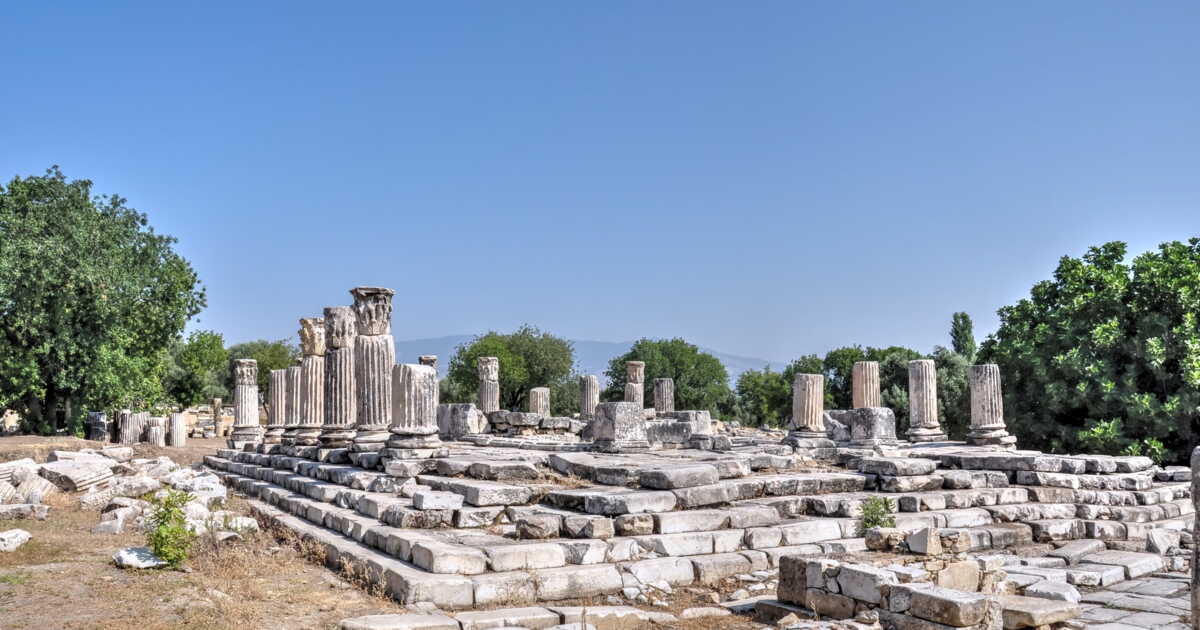
The rolling hills of Muğla Province in southwestern Turkey cradle the ruins of the ancient city of Lagina. Far from being a local tourist draw like the coastal villages of Akyaka, Marmaris, or Bodrum, the site nonetheless attracts a modest yearly stream of visitors who come specifically to pay homage to Hecate.
There, dating to the Late Hellenistic period and the early Roman Empire, a temple was erected in honor of this powerful Greek goddess, traditionally associated with magic and the Moon, but also with passages between worlds and communication with the dead.
While the worship of most other Greek deities, or even Roman ones, faded with Antiquity, Hecate remains a steadfast object of veneration. Followers from all over the world crowd into the complex to leave offerings or call upon her services.
At the End of a Sacred Road
It must be said that the Lagina sanctuary is a unique case in the ancient world. It is not merely a building, but a genuine religious center in its own image. Curious visitors wandering among its ruins, still scattered with columns, feel as if they are crossing the threshold into a parallel world, or at least stepping through a place as charged with history as it is with spirit. “It is the only temple of this scale in the world built exclusively for the goddess Hecate”, explains Professor Bilal Söğüt, who directs the excavations of Lagina and the neighboring ancient city of Stratonikeia, on CNN, the American network.
In the past, the two sites were linked by the Sacred Way, a stone-paved road a little over eight kilometers long. Lined with fountains, wells, or other small villages, this path once served major religious processions to the temple dedicated to Hecate. Already, crowds from across the region traveled to commemorate her.
Still a Pilgrimage Site
The most important ritual of the era was the so-called key-bearer rite, during which a young girl, a “kleidouchos” (literally “key-bearer”), carried the sacred token to and from along this route between Stratonikeia and Lagina. Throughout the journey, she was accompanied by a choir. “This key not only opens physical doors. It symbolizes the ability to move from life to death, from the conscious to the unconscious, from the old to the new”, notes researcher and author Hüma Zeybek, a specialist in Hecate, to CNN.
Since its construction, the site has experienced fierce political upheavals. After 88 BCE, the region was swept by conflicts between Rome and the kingdoms of Asia Minor. Stratonikeia chose the side of the legionaries, an alliance that earned it favors. From then on, Lagina took on renewed importance. In return, the Romans heavily invested in the temple and organized the festival Hekatesia-Romaia in honor of the goddess.
For these adherents of old times as well as those of today, Hecate, archetype of the wise old woman, serves as a guide in moments of crisis or transformation. Today, witches and wizards of a different kind continue to make the journey to greet her, to embrace her legacy, or to absorb her energy. “There is no other cult where material traces and traditions have been preserved so intact.” notes researcher Emrah Urtekin.