“One can travel not to flee from oneself, which is impossible, but to find oneself.”
— Jean Grenier, The Islands (1933, Gallimard)
Have you ever tried to guess the destination of other travelers at an airport? Arriving a little early to check my bags, I sat beside another passenger. In her hands, a copy of Victor Hugo’s Contemplations. A collection the poet wrote in part during his exile on the island of Guernsey, where he settled in 1855. But Guernsey was for me only a stepping stone toward another Anglo-Norman island. The smallest and most discreet of the archipelago: Herm.
Sixty inhabitants, a world apart
Located just twenty minutes by boat from its famous neighbor, Herm island covers only 3.2 km². But it possesses everything one might expect from a British community. “A school, a pub and a church”, jokes John Singer, who has been the leaseholder of Herm since 2008. For although Herm belongs to the Bailiwick of Guernsey, its day-to-day administration is delegated to a leaseholder charged with preserving the island and ensuring its operation. In the 1930s, this role was held by the British writer Compton Mackenzie, who after World War II was succeeded by the Wood family. It is to them that Herm owes its opening to visitors and the development of its first tourist infrastructures.
A mission that John Singer and his wife Julia pursue with a passion, never tiring of the island’s wonders. “It is a place of exceptional natural beauty, conducive to reflection and tranquillity,” they observe. To attract new travelers, the island administration has in recent years developed an offering that blends wine-tasting weekends, yoga retreats, and artist residencies.
But what strikes you upon arriving at Herm is the stillness. The absence of cars, light pollution, and noise offers a welcome disconnect. After leaving Paris and the heat, arriving on the island is a genuine breath of fresh air. I am not alone on the ferry, we are even “unusually numerous”, confides an island resident. It’s because an event is being prepared. Twice a year, in June and September, Herm hosts Six Fest, a festival blending gastronomy, live music, and craft beers at the Mermaid Tavern, the island’s pub.
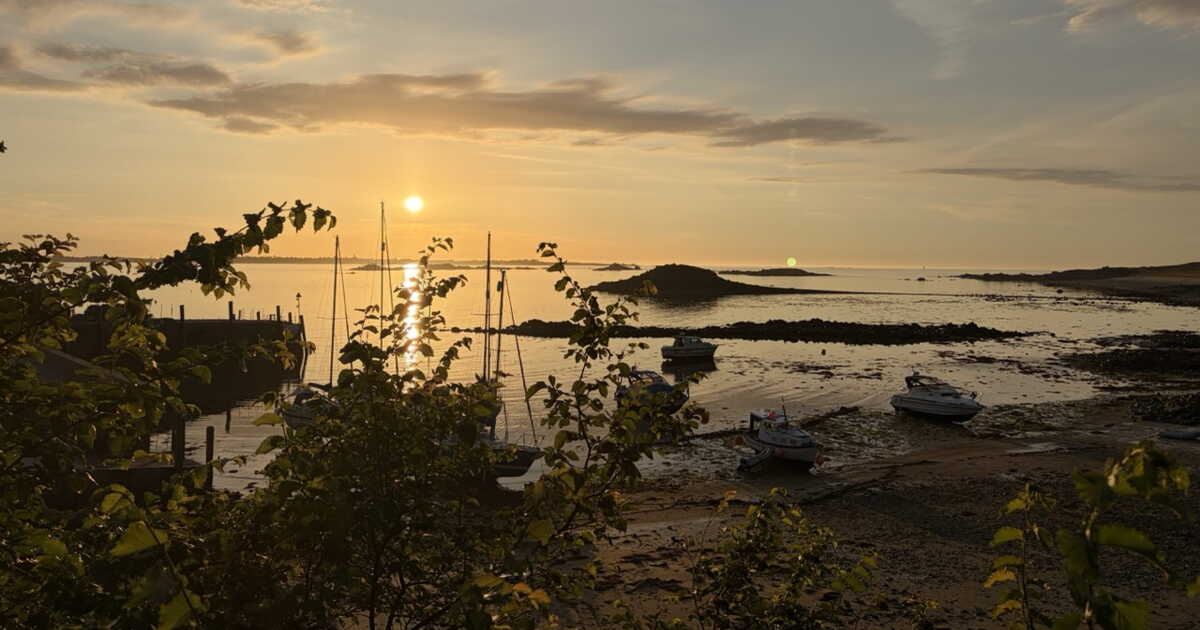
After this festive pause, I head down toward the harbor for my first Herm sunset. A small girl, whom I surmise to be one of the six pupils at the local school, suddenly appears behind me. She knows, she says, the island’s best spot to watch the sun disappear. It is right there, in front of the White House Hotel, the island’s sole hotel. A cinematic view of the sea, with Guernsey in the background. By the time I turn to thank her, she has already vanished. As the sun sinks, the sky becomes spectacular and leaves me with the impression of standing before a living Turner painting.
Herm, a mosaic of landscapes
Despite its modest size, Herm boasts an astonishing variety of landscapes: an English moorland worthy of a Brontë sisters novel, fairy-tale woods, white-sand beaches bordering turquoise waters, and a wild coast of dunes and rocks. Two to three hours are enough to walk around the island, a little longer if you opt for small inland excursions: to watch ongoing archaeological digs (led by a team of archaeologists from Durham University and Rennes, who are exploring the island’s Neolithic past), to pause before the island’s movingly small cemetery, or to visit St Tugual’s Chapel, dating from the 11th century.
Yet Herm mainly invites you to slow down, eyes and lungs wide open. Each of its seven beaches bears a distinct atmosphere. For reading with the sea in view, head to Oyster Point, on the island’s western coast. A beach ideal for visitors seeking tranquillity. As for Shell Beach, located at Alderney Point, this stretch of golden sand extends to the island’s northernmost tip and is a family favorite. But, as with everywhere on Herm, there is room for everyone. Children build sandcastles after a scoop at the beach café, teenagers explore the rocks, and the more sporty set off kayaking along the coast.
And for those who worry about the water’s chill, head to the western coast beaches such as Fisherman’s Beach or Bear’s Beach. A resident told me that the water there is slightly warmer.
The Art of Slowing Down
Many visitors come to Herm for just a day. Yet the island deserves a longer stay. To live like a local, staying in one of the island’s cottages is a distinct experience. We live to the rhythm of the tides and watch the last boats drift back toward Guernsey, free to extend the evening without looking at the clock. The calm and the silence deepen still further, as the lights gradually go out in the village.
The best gift you can give yourself when visiting Herm is to do nothing at all. You come to the island to take your time, to stop running, and to give your thoughts more room. You fill your day with little, but with the feeling, as the sun casts its last rays, that your heart is full.
Discover Herm
Getting there : By plane from Paris, a direct flight to Guernsey with Aurigny Air Services, then a boat to Herm with Travel Trident. You can also reach Guernsey by boat from Saint-Malo.
Where to stay : The island is small but offers a nice variety of accommodations. You can stay at the charming White House Hotel, in one of the island’s cottages, or in one of the campsite’s tents.
Where to eat: For lunch or dinner, you will have the choice between the restaurant The Conservatory, which offers upscale cuisine based on local products, the Mermaid Tavern for hearty pub dishes and The Ship Inn, which offers brasserie-style cuisine. Finally, if you stay in one of the island’s cottages, you will find everything you need to prepare your meals at the island’s grocery store.
One activity : A two-hour kayak trip with Outdoor Guernsey to circumnavigate the island with a guide. You might be lucky enough to spot Atlantic puffins, numerous seabirds, dolphins and seals.