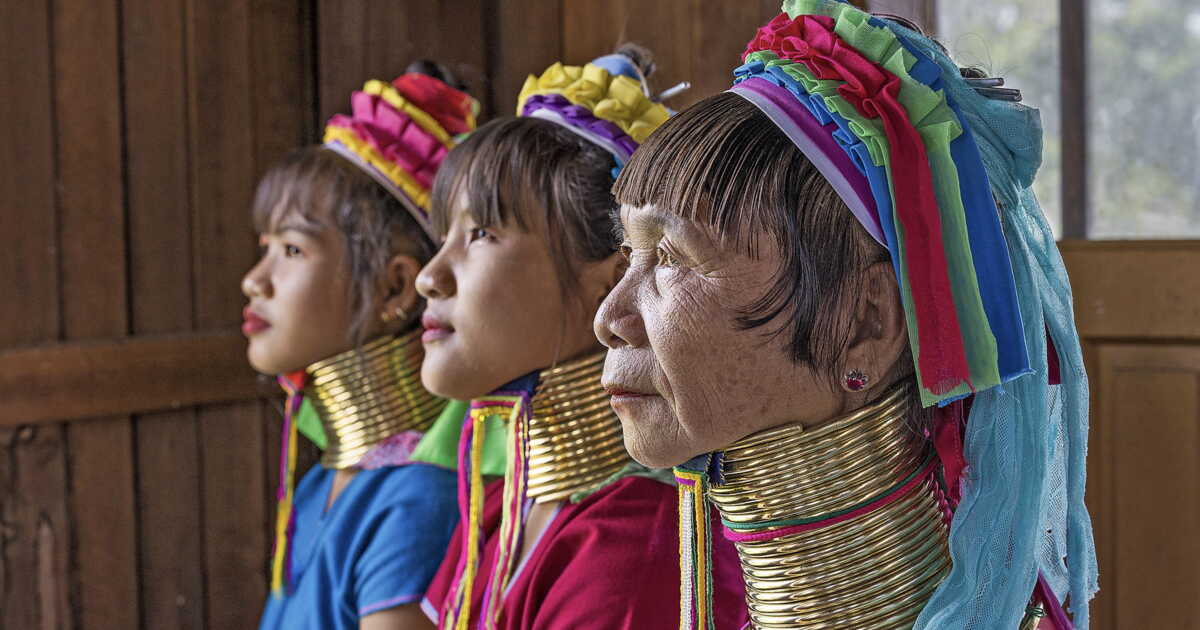
“Hell is paved with good intentions.” And the Kayan community has bore the brunt of that throughout time. Fleeing Burma in the 1980s and 1990s to escape the violence, they were exploited for tourism upon arriving in Thailand. In 2008, after the boycott of the Kayan “human zoos,” they were deprived of their main source of income. Can community-based tourism offer them a route out? This is what the village of Huay Pu Keng, in the northwest of Thailand, is trying to discover.
In Mae Hong Son province, the Grab app (the Asian equivalent of Uber) is unusable. Here, people head to the market in search of a songthaew, a shared taxi that resembles a modified pickup, or they call on a motor-taxi to reach the Huay Pu Keng embarkation point. In this province, the hill tribes comprising indigenous populations and ethnic minorities account for more than half of the population. In the village of Huay Pu Keng, five of them coexist peacefully: the Kayaw, the Kayan, the Red Karen and the Pakayor, originally from Burma, and the Tai Yai or Shan. Of the village’s 200 inhabitants, half belong to the Kayan community, notoriously famous for the exploitation of its “giraffe-women.”
The Folklorization of a Controversial Custom
On the earthen quay facing the village, an older woman steps off a wooden boat. Her back laden, she smiles politely as my gaze slips to her throat. Among the Kayan, the tradition holds that women wear a brass coil around the neck that sinks the collarbones, creating the illusion of an elongated neck. “Mine has 16 rings and weighs 2.5 kilograms, but some reach 30 rows,” explains Muko. Born in Huay Pu Keng to parents who fled civil wars forty years ago, the young woman returned to the village after two years of study in Chiang Mai. “Today we are no longer obliged to wear the necklace,” she asserts. “When we do it, it is by choice. Fewer than thirty people wear it in the village. I decided to wear it because I am proud of my origins. It is a way for me to keep the tradition alive.”
The boat ride across the Pai River takes a few minutes to reach the main path that threads through the hamlet. Along the wooden huts, residents have set up stalls from which they sell their handmade products. Signposts invite visitors to participate in workshops. “When the Kayan migrated to Thailand, the government saw an opportunity for tourism. It gave them three choices: stay in refugee camps, migrate to other countries (which few did), or open themselves to tourism,” recounts Charlotte Vogels, director of Fair Tourism, a Dutch association supporting community tourism in Huay Pu Keng. “In 2008, once it became known and the so-called ‘human zoo’ villages sparked controversy, tourists boycotted them. Tourism collapsed and resources became scarce for the Kayan communities.”
Community-Based Tourism, a Lever for Empowerment?
It is within this context that the forty-something, an international tourism specialist, first travels to Huay Pu Keng in 2013. “I spoke with the village chief through a translator, and the community quickly embraced the project.” The aim: co-create activities that highlight local culture and know‑how, while giving residents the tools to manage tourism autonomously. In 2019, the Fair Tourism team returns to lead its first trainings. Nearly 40 people participate, almost one member per family. Together, they design homestays, agriculture-focused visits, and craft workshops (making bamboo cups, jewelry, headbands, or green roofs). For several years now, the organization has worked closely with the Mae Hong Son CBT local organization to provide on-site training in their absence.
In 2022, the village hosted 2,141 foreign visitors according to Fair Tourism figures. By 2025, that number rises to 3,810. Each entry brings in about 200 bahts (5 euros), plus 40 bahts (1 euro) for the boat crossing. The income generated goes entirely to the community and is distributed equitably. Only the money earned from homestays, workshops, and the sale of crafts goes directly to those who provide them. “The community ensures turnover so that everyone can benefit,” says the Dutch organizer.
Between Isolation and Economic Reality
This approach has changed villagers’ relation to tourism. “Previously visitors were content to take photos without taking time to talk,” laments the founder of Fair Tourism. Several villagers told her that sharing their stories and skills was a source of fulfillment and motivation. The balance between men and women in the village has also benefited positively, according to the specialist who co-authored a study on the topic published on June 17, 2022 in the Journal of Tourism Futures. Thanks to this project, “men and women benefit not only from financial gains but also from designing and managing the tourism experiences themselves,” the paper notes.
Yet implementing such an initiative remains challenging. Ma Pang, who arrived in Thailand at age six and has lived in Huay Pu Keng for forty years, wears golden spirals on her calves and a 20-row brass neck ring for seven years. She laments the departure of some families to the artificial “long-neck” villages near Chiang Mai: “The entry price there is higher, so families earn more even if they don’t receive the full amount, and they have a fixed salary.” She adds, “In Huay Pu Keng, income varies greatly with the seasons.” Tourists cluster from December to January and from July to August. “Fortunately, since they live collectively and collaboratively, the cost of living is also lower. Residents are not forced to work in tourism; some choose farming, but they do not have a wide range of options.” Additionally, lacking an online booking platform makes contacting the village and planning a visit difficult. “The best solution is to contact us directly,” advises the Fair Tourism director. Moreover, while Mae Hong Son has a small airport, it is currently out of service. Reaching Huay Pu Keng requires using local transport. “Many people skip this region due to lack of time,” regrets Charlotte.
Nevertheless, she is convinced: “Community-based tourism is a solution to enable minorities to live with dignity in Thailand. It’s a win-win: the local population shares its culture, history, and know-how ethically, while travelers experience an authentic encounter.” Let us hope that this time such good intentions translate into actions as beneficial as those hoped for.