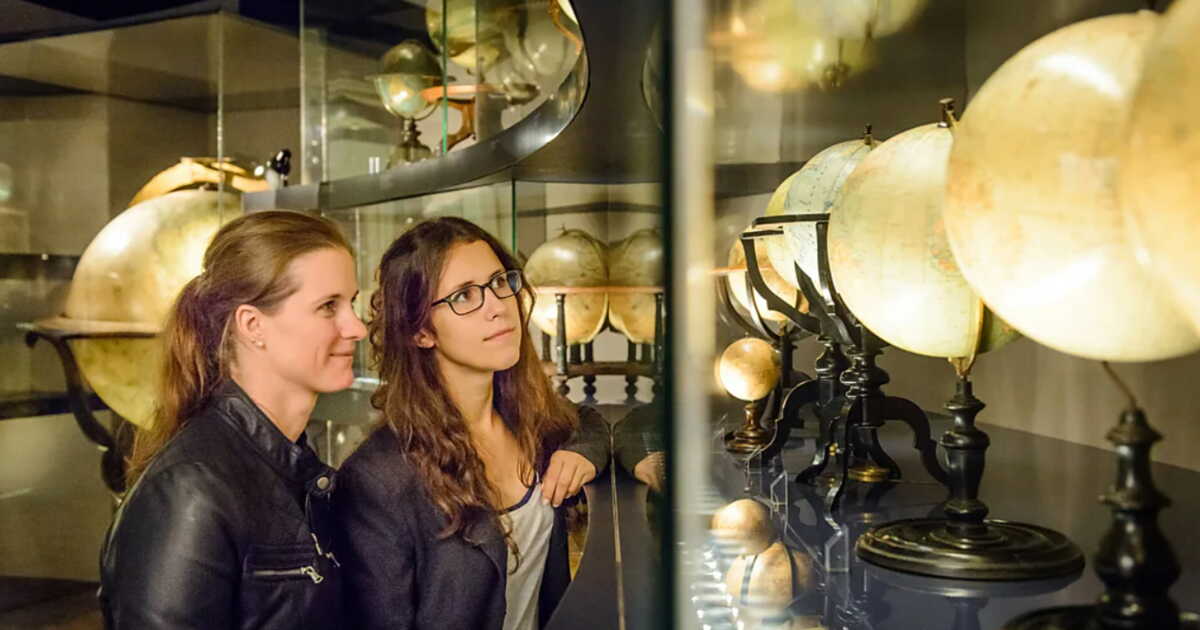
Our view of the world has continually evolved over the centuries, as a quirky museum in Austria attests. In the heart of Vienna, away from the crowds of usual tourist sites, there lies a unique museum on Earth. A gem for history buffs and lovers of maps, and sometimes even of the sky. Located in the Mollard Palace, the Globe Museum is indeed the only public institution wholly devoted to globes.
In this 17th-century setting, more than 220 rare and ancient spheres, most of which were crafted before 1850, are on display. “Globes attest to how our imagining of the planet has evolved. This is the only place in the world where you can see so many gathered together”, explains its director, Nikolaus Schobesberger, to the BBC, on Sunday, August 30.
A true mirror of bygone beliefs
The collection mainly tells how people over time tried to understand a world that remained largely unknown to them. Each globe records what people knew as well as what they did not know at the moment of its creation.
Some 16th-century globes show a North America that is lost among uncharted territories, when California isn’t depicted as an island state, an exaggerated Asia, or an imaginary southern continent in place of Australia and Antarctica. The oceans, meanwhile, are teeming with sea monsters or dragons, not with islands. On celestial globes, Renaissance astronomical observations still sit beside Pegasus, Perseus brandishing Medusa’s severed head, and other mythical creatures or figures.
Colonialism, space conquest…
Other pieces represent a colonial view of the world, with European flags planted on African coasts or caricatured representations of Indigenous peoples, transformed into cannibals. “They reflect the mindset of their time. They are certainly magnificent works of art, but we must also take into account the date of their creation”, notes Nikolaus Schobesberger.
One of the museum’s most fascinating objects is a lunar globe, created in 1961. The visible face of the Moon is meticulously drawn, but its far side is deliberately left white, because it had simply not yet been observed. Two years later, a new globe filled in that unknown portion. It also features a reproduction of the famous Martin Behaim globe, completed in 1492, which immortalizes a world without the Americas, but with an endless ocean separating Europe from Asia.
Initially reserved for princes and wealthy merchants, globes gradually became everyday objects, found in schools and households. In the era of Google Earth, they have not thankfully lost their power to fascinate. “It is not merely a scientific instrument, it is also an object that lets you dream of distant lands”, says the custodian of this place. For him, no other work of art stirs the imagination and the urge to discover distant places as much.