Amid the clamor of belts and sheets whizzing through a Kyoto printing house, two artists watch their work come to life on paper as they strive to win over new audiences in the AI era. Despite the decline of the publishing industry, self-publishing and handmade magazines known as “fanzines” or “zines” are gaining popularity in Japan, a reflection of the country’s enduring love for paper, even in the digital age.
Paper “is a medium that engages the five senses“, as Kazuma Obara, one of the two creators, explains to AFP, his hands stained with ink from his photo essay.
Together with his partner Akihico Mori, this 40-year-old photographer is among the artists using a press provided by the Kyoto Shimbun daily newspaper, which is seeking alternative uses for its machines in the face of falling subscriptions.
As the printing presses roar, five technicians quickly flip through pages to check quality. “I think the printed press is incredibly ‘open’. You can give a newspaper and read it together,” explains Obara, who notes a difference between paper and mobile phones, “which are very compartmentalized.” One can feel the artist’s passion when holding the work in one’s hands, Mori, a 44-year-old writer, explains. “That is what makes it so attractive, and AI simply cannot reproduce it.
The duo’s work was showcased at Kyotographie, the renowned international photography festival, held from April 18 to May 17 across Kyoto.
“Interesting Because It Is Old”
Yoshihiko Okazaki, from Kyoto Shimbun Printing, explains that the age range of his clients—artists—spans from teenagers to people over 70. “Interestingly, this phenomenon resonates with younger people… I even hear comments like: ‘it’s interesting precisely because it is old.’“
The country has seen a rapid decline in print publishing. Book and magazine sales have fallen 40% from their 1996 peak when they brought in 2.6 trillion yen. And print newspaper circulation, which peaked in 1997 at 53.76 million copies, has roughly halved by 2025, according to the Japanese Association of Newspaper Editors and Publishers.
Many authors and publishers around the world fear this trend could be accelerated by AI and social networks: in the United Kingdom, half of novelists believe artificial intelligence is likely to replace their work, according to a 2025 study.
However, as in other parts of the world, self-publishing is rising in Japan, particularly among young people. And especially the fanzines—these publications that emerged in the 1930s among American science-fiction fans. According to a study cited by NHK, Japan’s self-publishing market is estimated at over 800 million euros for the fiscal year ending March 2026—almost twice what it was four years ago.
“Something Tangible”
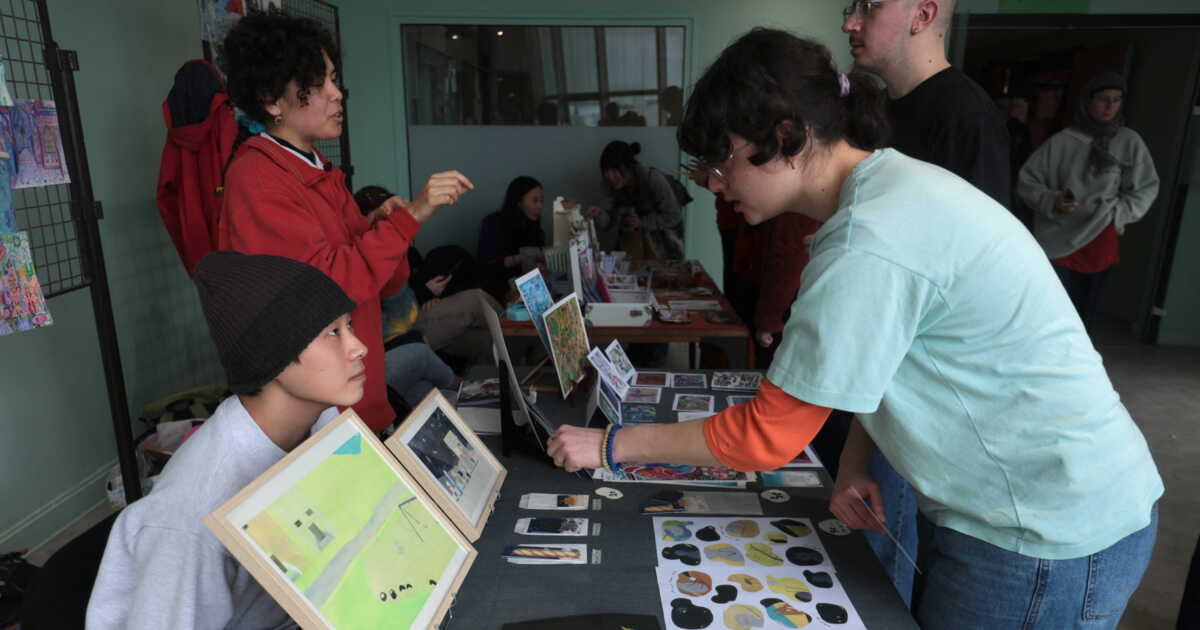
A fanzine fair showcasing a wide range of these handmade magazines in varying sizes and formats has drawn a large crowd in Tokyo.
“AI and social networks are guided by algorithms that only show us what we want to see or what suits us best. But the fact that so many zine creators are taking part in this fair suggests that there are many other visions of the world”, cheers Harumi Kikuchi, a 22-year-old attendee.
The creator Watashi Kishino, who hand-draws her daily life in black-and-white illustrations, concedes that one can “do a lot with AI and digital technology”. “But I also think there is a charm to holding something in your hands”, she says as she displays her works.
Major bookstores are also embracing the trend. Sanseido, a 145-year-old Tokyo bookstore located in the Jimbocho book district, began placing self-published journals on its shelves almost a year ago. “Zines can appeal to an audience different from that of traditional readers,” explains AFP to Masato Sugiura, deputy director of the sales promotion department.
Watashi Kishino believes in the staying power of physical books and magazines despite the digital era. “There is a warmth that only paper can offer,” she says.