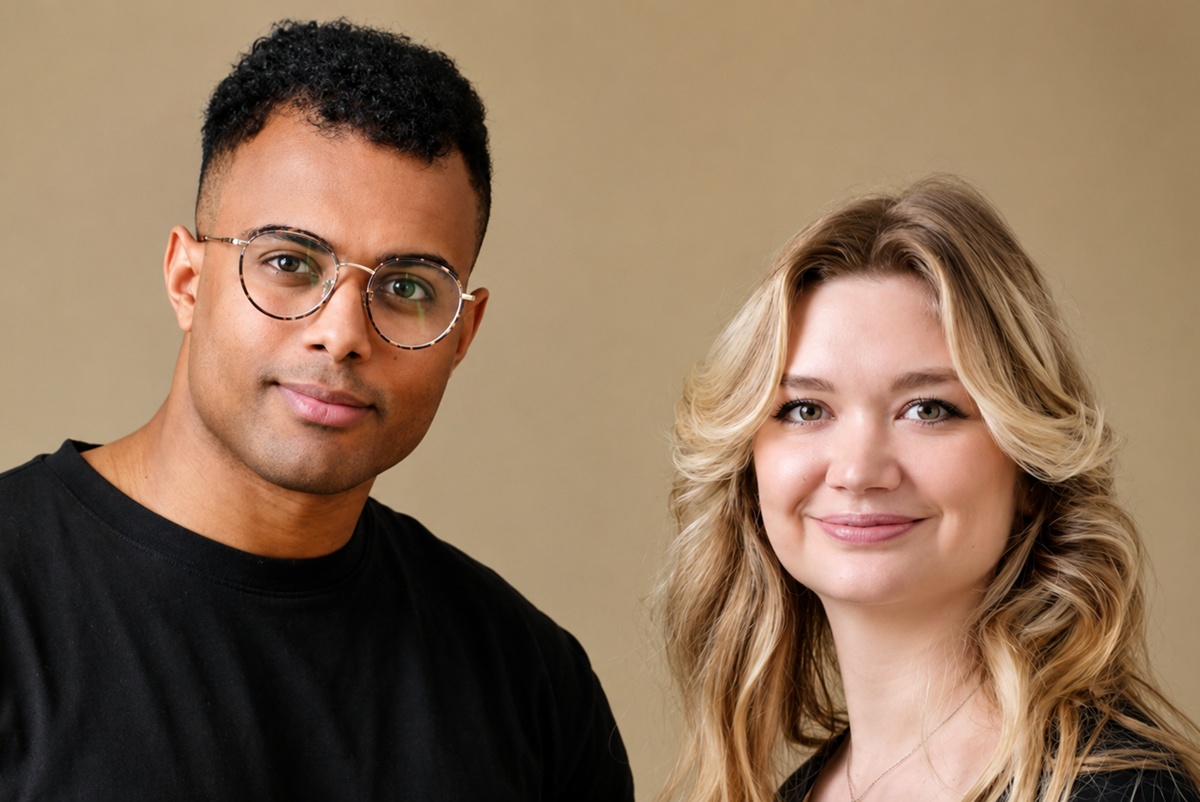
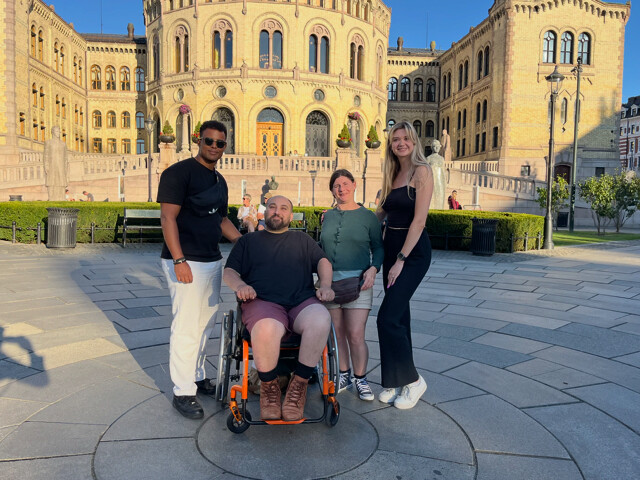

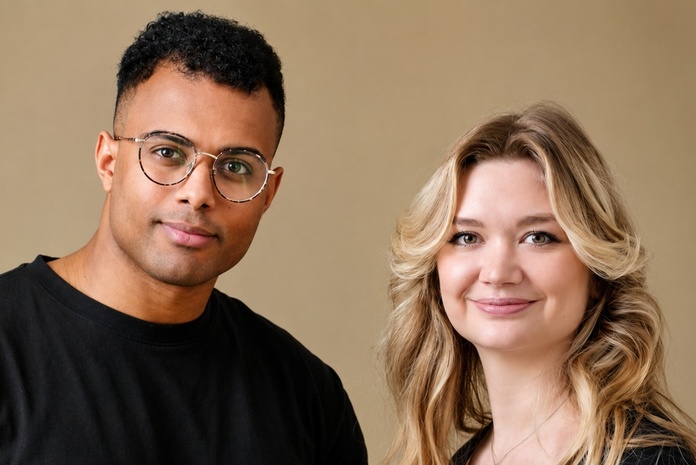
TourMaG – Could you introduce yourselves and explain what Just Travel is?
Stéphane Amado: The idea for Just Travel was born from a personal event. My brother had a serious accident on Réunion. Following his stay in intensive care, he found himself living with a disability and asked me to take him on vacation.
Accompanying him and allowing him to escape really marked me, and I looked for a way to turn it into my profession.
Julie Smith: Together with Stéphane, we met about six years ago. I initially completed a degree in communication and marketing, then we joined forces to pursue a Master’s in a business school focused on tourism, specifically to design this travel-agency project.
TourMaG – You have a travel agency that helps people with disabilities travel. Could you explain how it works?
Stéphane Amado: We are a specialized agency for people with motor disabilities, even if we’re not closed to other types of disability in the future.
Our highlight is to offer human support during the stay: if a traveler does not have a companion to accompany them, we send a professional companion (such as a specialized educator).
We manage everything from A to Z: accommodations, transport, accompaniment and help with activities of daily living (meals, moving around, etc.). For the first year, we are focusing on these guided stays, but we will also offer at some point stays without accompaniment, “turnkey” ones.
Stéphane Amado: The idea for Just Travel was born from a personal event. My brother had a serious accident on Réunion. Following his stay in intensive care, he found himself living with a disability and asked me to take him on vacation.
Accompanying him and allowing him to escape really marked me, and I looked for a way to turn it into my profession.
Julie Smith: Together with Stéphane, we met about six years ago. I initially completed a degree in communication and marketing, then we joined forces to pursue a Master’s in a business school focused on tourism, specifically to design this travel-agency project.
TourMaG – You have a travel agency that helps people with disabilities travel. Could you explain how it works?
Stéphane Amado: We are a specialized agency for people with motor disabilities, even if we’re not closed to other types of disability in the future.
Our highlight is to offer human support during the stay: if a traveler does not have a companion to accompany them, we send a professional companion (such as a specialized educator).
We manage everything from A to Z: accommodations, transport, accompaniment and help with activities of daily living (meals, moving around, etc.). For the first year, we are focusing on these guided stays, but we will also offer at some point stays without accompaniment, “turnkey” ones.
Behind the Scenes of Its Creation
TourMaG – What were the triggers and the journey to officially launch this agency?
Julie Smith : We had the theoretical concept in mind, but we weren’t sure how to structure it. The real turning point happened during our studies and thanks to our entry into an incubator for social-impact businesses.
We were supported by a program that helps young entrepreneurs who aim to move the needle and transform the social environment.
In studying the market, we realized there was a real equality gap. Many people with major motor disabilities crave travel but encounter enormous logistical barriers. The on-site contacts we made confirmed there was a crucial need for a structure like ours.
TourMaG – What were your main financial or logistical challenges when launching?
Stéphane Amado: The main obstacle to creating a travel agency is obtaining the mandatory financial guarantee. When you’re starting out with little equity, it’s nearly impossible: traditional organizations like the APST sometimes require guarantees of 100,000 or 200,000 euros.
Fortunately, we were supported by UNAT (National Union of Tourism Associations) through their financial-guarantee mechanism for social economy and solidarity structures. We were among the first dossiers of this kind to be accepted, and without that, the project could never have become a reality.
Julie Smith : We had the theoretical concept in mind, but we weren’t sure how to structure it. The real turning point happened during our studies and thanks to our entry into an incubator for social-impact businesses.
We were supported by a program that helps young entrepreneurs who aim to move the needle and transform the social environment.
In studying the market, we realized there was a real equality gap. Many people with major motor disabilities crave travel but encounter enormous logistical barriers. The on-site contacts we made confirmed there was a crucial need for a structure like ours.
TourMaG – What were your main financial or logistical challenges when launching?
Stéphane Amado: The main obstacle to creating a travel agency is obtaining the mandatory financial guarantee. When you’re starting out with little equity, it’s nearly impossible: traditional organizations like the APST sometimes require guarantees of 100,000 or 200,000 euros.
Fortunately, we were supported by UNAT (National Union of Tourism Associations) through their financial-guarantee mechanism for social economy and solidarity structures. We were among the first dossiers of this kind to be accepted, and without that, the project could never have become a reality.
Motor Disability: Filling a Gap in the Tourism Market
Tour-MaG – Why focus mainly on motor disability rather than mental or psychological disability?
Julie Smith : The current market for adapted travel agencies (notably those with specific approvals like VAO – Organized Adapted Vacations) already covers mental disability fairly well.
However, there is a glaring lack of structured offers for motor disability, brain injury or polytrauma.
Moreover, in our past experiences in the mental-disability sector, we noticed that departures on holidays often corresponded to “respite” stays organized by institutions, without the person always having expressed a deep travel preference.
At Just Travel, we target an audience that takes an active approach and has a genuine “thirst” to discover the world.
Julie Smith : The current market for adapted travel agencies (notably those with specific approvals like VAO – Organized Adapted Vacations) already covers mental disability fairly well.
However, there is a glaring lack of structured offers for motor disability, brain injury or polytrauma.
Moreover, in our past experiences in the mental-disability sector, we noticed that departures on holidays often corresponded to “respite” stays organized by institutions, without the person always having expressed a deep travel preference.
At Just Travel, we target an audience that takes an active approach and has a genuine “thirst” to discover the world.
No Declarations, 100% On-the-Ground
TourMaG – How do you manage the complexity of arranging a trip and the restrictions of each traveler?
Julie Smith : This is the most complex aspect of our work: every person and every disability is entirely unique. Even if we create standard stays in our catalog, we must systematically rethink and tailor everything according to the exact restrictions and medical needs of the person.
You literally have to put yourself in their shoes to anticipate the slightest obstacle.
If someone needs daily nursing care (for example, one to two visits per day for specific care), our accompanying person can coordinate the intervention of a private nurse on the vacation site.
Conversely, if the pathology requires a medical presence or heavy care 6 to 7 times a day, the organization becomes much more complex and requires substantial sanitary logistics in advance.
TourMaG – How do you concretely verify the accessibility of a destination?
Julie Smith : We never rely on mere statements from a website or a hotellerie saying “yes, yes, it’s accessible at my place.”
There are too many surprises. Our methodology is based on strict upstream verification: we contact providers directly and, as far as possible, we go to visit and test the places ourselves.
There are a multitude of micro-details to check. For example, the type of battery in an electric wheelchair: some airlines categorically refuse certain battery models (lithium, etc.).
It is experience that lets us know exactly which questions to ask airlines and accommodations. And if a hitch occurs on-site despite everything, the presence of our accompanying person helps cover the lack of accessibility and find an immediate solution.
Julie Smith : This is the most complex aspect of our work: every person and every disability is entirely unique. Even if we create standard stays in our catalog, we must systematically rethink and tailor everything according to the exact restrictions and medical needs of the person.
You literally have to put yourself in their shoes to anticipate the slightest obstacle.
If someone needs daily nursing care (for example, one to two visits per day for specific care), our accompanying person can coordinate the intervention of a private nurse on the vacation site.
Conversely, if the pathology requires a medical presence or heavy care 6 to 7 times a day, the organization becomes much more complex and requires substantial sanitary logistics in advance.
TourMaG – How do you concretely verify the accessibility of a destination?
Julie Smith : We never rely on mere statements from a website or a hotellerie saying “yes, yes, it’s accessible at my place.”
There are too many surprises. Our methodology is based on strict upstream verification: we contact providers directly and, as far as possible, we go to visit and test the places ourselves.
There are a multitude of micro-details to check. For example, the type of battery in an electric wheelchair: some airlines categorically refuse certain battery models (lithium, etc.).
It is experience that lets us know exactly which questions to ask airlines and accommodations. And if a hitch occurs on-site despite everything, the presence of our accompanying person helps cover the lack of accessibility and find an immediate solution.
Tourism, Finally Accessible?
TourMaG – Which destinations are the most accessible today, and where is there still the most work to be done?
Stéphane Amado : The most accessible are those involving sea or river cruises. It’s a wonderful product for motor disability. You stay on the boat; accessibility is designed from the outset, elevators are wide, and moving around is easy, even with large electric wheelchairs.
Likewise, some natural spaces are making incredible efforts: I think of certain Regional Natural Parks or protected areas that, despite challenging terrain, have set up specific, flat and smooth routes for people with reduced mobility. Transportation there is also often well thought out.
Conversely, in historically wealthy countries with aging infrastructures, such as Egypt, visiting narrow tombs, descending into crypts or moving around ancient archaeological sites in a wheelchair can be impossible by conventional means.
However, we believe that with goodwill and hands, one can always adapt the trip. That is why we stress the presence of an accompanying person.
If a person in a wheelchair wants to attend a concert or visit a site and official PMR tickets are sold out, the presence of a solid companion allows them to purchase a regular ticket and manage the human logistics so that the person can enjoy the event like everyone else.
TourMaG – Is the tourism sector moving positively toward greater inclusion?
Just Travel : Yes, accessibility is becoming more of a focal point, sometimes even driven by marketing interests from traditional providers, but it is moving the needle.
Travel players are recognizing that it’s a real market. Yet there is still a huge amount of logistical and on-the-ground training work to do.
It’s no longer just a fashionable topic; there is genuine involvement from many sector players (transit networks, hoteliers) who offer partnerships or competitive rates to help us develop the agency. This is very encouraging for the future.
Stéphane Amado : The most accessible are those involving sea or river cruises. It’s a wonderful product for motor disability. You stay on the boat; accessibility is designed from the outset, elevators are wide, and moving around is easy, even with large electric wheelchairs.
Likewise, some natural spaces are making incredible efforts: I think of certain Regional Natural Parks or protected areas that, despite challenging terrain, have set up specific, flat and smooth routes for people with reduced mobility. Transportation there is also often well thought out.
Conversely, in historically wealthy countries with aging infrastructures, such as Egypt, visiting narrow tombs, descending into crypts or moving around ancient archaeological sites in a wheelchair can be impossible by conventional means.
However, we believe that with goodwill and hands, one can always adapt the trip. That is why we stress the presence of an accompanying person.
If a person in a wheelchair wants to attend a concert or visit a site and official PMR tickets are sold out, the presence of a solid companion allows them to purchase a regular ticket and manage the human logistics so that the person can enjoy the event like everyone else.
TourMaG – Is the tourism sector moving positively toward greater inclusion?
Just Travel : Yes, accessibility is becoming more of a focal point, sometimes even driven by marketing interests from traditional providers, but it is moving the needle.
Travel players are recognizing that it’s a real market. Yet there is still a huge amount of logistical and on-the-ground training work to do.
It’s no longer just a fashionable topic; there is genuine involvement from many sector players (transit networks, hoteliers) who offer partnerships or competitive rates to help us develop the agency. This is very encouraging for the future.