And you, could you sleep in a hotel room with no lock? In the Los Cabos region, on the wild coastline of Baja California, that is the experience offered by La Valise hotel. During a report conducted in February this year in Mexico, we discovered this discreet address tucked between desert and turquoise sea, far from the large resort complexes of Cabo San Lucas. Beyond its striking concept, the establishment also serves as a gateway to another facet of the Mexican state: wilder, more pristine and deeply oriented toward nature.
In Los Cabos, an unusual hotel amid nature
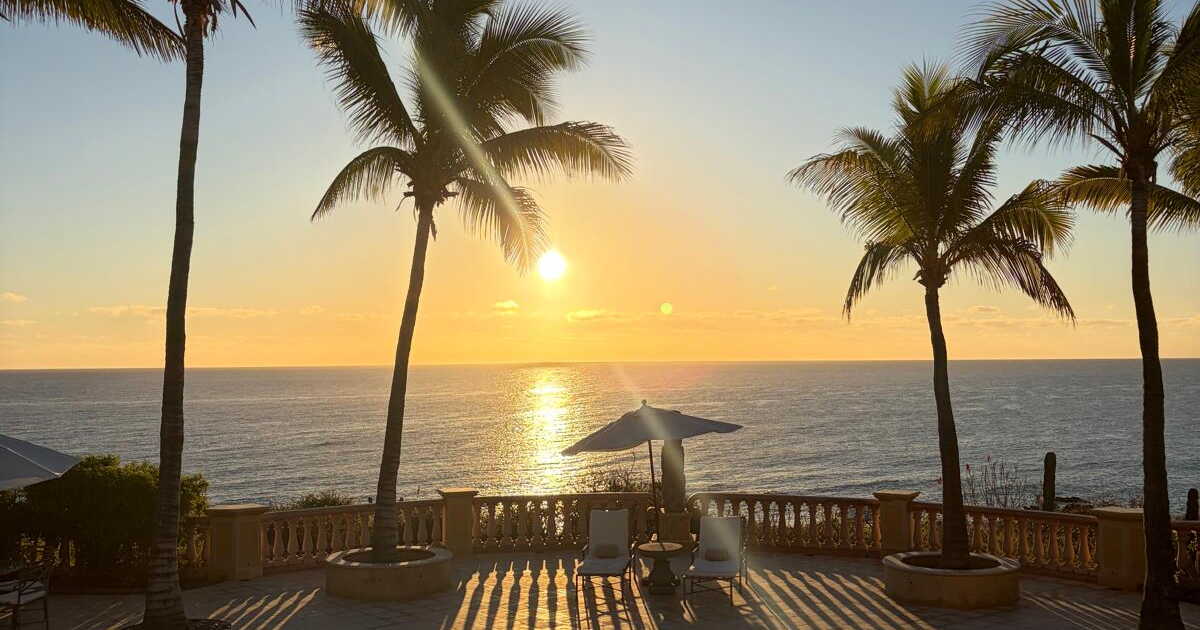
Lost between the desert and the Sea of Cortez, La Valise Los Cabos hardly resembles the properties that have built the region’s tourist reputation. The hotel, whose small buildings draw inspiration from Mexican haciendas and Mediterranean villas, comprises only nine rooms spread over a vast plot bordered by the sea, amid cacti and the dry vegetation characteristic of the East Cape.
Before becoming a hotel, the place was first conceived as a family retreat. For more than fifteen years, a family of artists, architects, and sculptors shaped the property by hand. The tiles were molded on site, the wood carved by hand, while objects from Mexico, Italy, France, and India gradually found their place. The place, powered entirely by solar energy, also accumulates historical curiosities. A long table that belonged to Mark Twain, the American author of The Adventures of Tom Sawyer, thus sits on the property. Some balustrades and moldings come from the former home of Jack Warner, one of the founders of Warner Bros. studios in Hollywood.
But while the place is beautifully decorated, some elements may surprise… starting with the total absence of a lock on the doors of the rooms! Upon arrival, this detail is utterly destabilizing. During our stay, the room did have two doors opening to the outside… but neither could be locked. The hotel explains this choice by the very history of the place, originally conceived as a family house open to nature rather than a conventional hotel. With only a few travelers present at any given time on the property, the operation relies more on a sense of isolation and trust than on visible security devices.
The quirky side is also evident in the layout of the rooms. In some “casas,” the shower sits directly in the garden, blurring the boundaries between indoors and outdoors. To wash, you must step out in a towel and cross your terrace to reach an open-air shower. A disorienting experience at first, especially at night, but one quickly becomes accustomed to it.
Perhaps a chance to encounter one of the region’s wildlife species that live on the property? Starting with foxes, herons, hummingbirds, deer, or even bobcats. As for seabirds, they seem particularly drawn to the mosaic marlin covering the bottom of the pool, occasionally diving to try to catch it.
But this remarkable establishment serves mainly as a starting point for discovering another facet of Los Cabos, far beyond its beachside image.
Between desert, whales and underwater worlds, Los Cabos reveals another facet of Mexico
Long associated with giant resorts and American tourism, Los Cabos also has a much wilder face. Located at the southern tip of the Baja California Peninsula, the region captivates with landscapes where the desert meets the Pacific Ocean and the Sea of Cortez.
The East Cape particularly illustrates this other facet of the destination. Here, roads traverse arid stretches dotted with gigantic cardon cacti before leading to almost-deserted beaches. Far from the bustle of Cabo San Lucas, this coast attracts travelers in search of nature and outdoor activities.
From December to April, whale watching is among the must-do experiences. Each winter, gray whales and humpback whales migrate to the waters of Baja California to reproduce. From the coast or on a boat excursion, it is not uncommon to catch sight of their impressive leaps out of the water.
Snorkelers and divers also find in the region some of the most beautiful seabeds in Mexico. About 45 minutes from the hotel, Cabo Pulmo National Park stands as one of the state’s natural jewels. This protected marine reserve hosts one of the few living coral reefs on the North American Pacific coast. Sea turtles, manta rays, tropical fish and sometimes even whale sharks roam these waters famed for their biodiversity. For our part, we had the opportunity to swim with a colony of sea lions.
Surfers too greatly appreciate the East Cape. Several beaches offer powerful waves and are much calmer than the ultra-popular spots in California or Australia.
On land, excursion possibilities are plentiful: hikes along desert trails, horseback rides facing the ocean, or explorations of the region’s more authentic villages. Unlike the sometimes very luxurious and festive image associated with Los Cabos, this part of the peninsula reveals a rougher, almost contemplative Mexico.
It is precisely this contrast that makes the experience so special. Between the desert’s silence, starry nights without light pollution and the omnipresence of the ocean, the stay can feel as if you are cut off from the world. A rare luxury in a destination that continues to grow in popularity.

Amara Nambinga