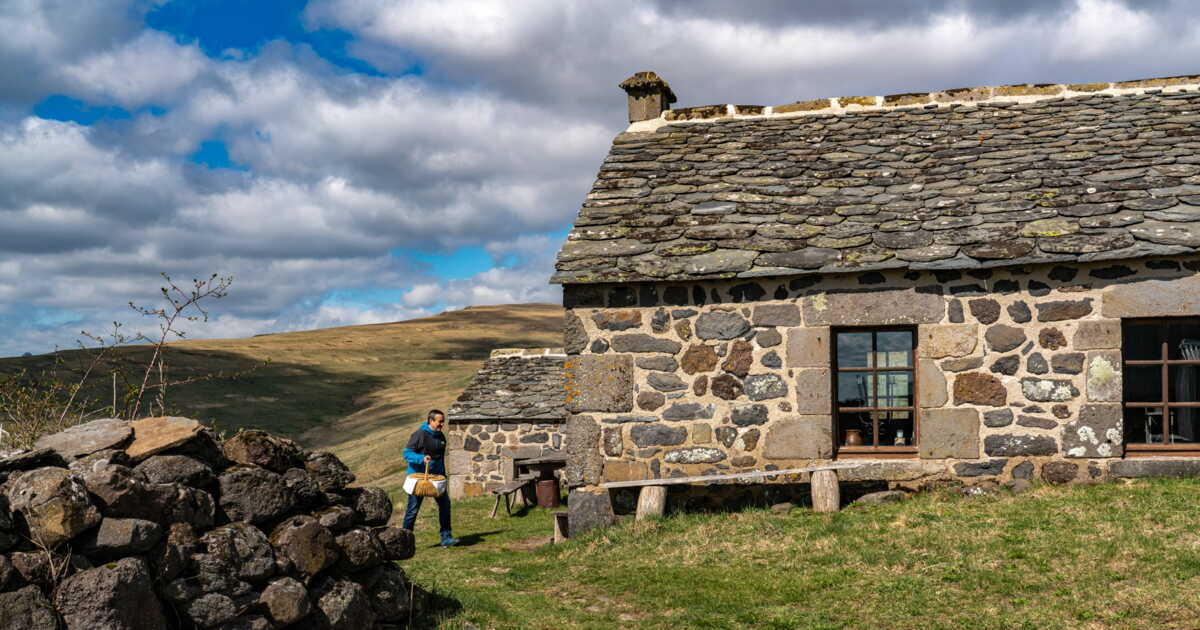
Leaving the village of Pailherols, a tranquil hamlet of 140 inhabitants with its pretty stone houses and mid-mountain pastures (about 1,000 meters above sea level), Vincent Fages’ old, rattling Land Rover, 49 years old, begins up the gentle track that leads to the Puy de Bâne (“horn” in patois), a summit that softens into the horizon. In his trunk, three gourmet baskets, which will await his clients upon their arrival. They make the journey on foot: it is while walking that the ascent toward the high pastures is most enjoyed, crossing the aptly named Beauté stream, moving from forest to pasture, then the sudden appearance, after two hours of hiking, of the buron de Bâne, an old residence that stands as the mountain’s last watchtower.
The Authentic Taste of Cantal
Long neglected, these high-altitude huts built from volcanic stone, which once sheltered people and their animals, have found a second life, becoming restaurants or guest houses. From the buron of Bâne, the view stretches toward the puys Griou, Gros, and Mary. A heart-shaped keychain awaits on the door, foreshadowing the emotions this place in Cantal offers, where Vincent Fages eventually found himself after years spent beside starred chefs such as Michel Bras, Régis Marcon, and Marc Meneau.
As if by ritual, Vincent lights the fire in the fireplace: in this April month, the weather is nice and still cool outside, but the room will warm up quickly. In the wood stove, he heats a caramelized onion soup prepared by Maryline, known as Marie, a talented chef (who is also his wife). Poured into a tureen over pieces of bread and fresh tome, it is the buronnier’s soup, the daily meal of workers of yesteryear. On the table await dry sausages, two Salers cheeses aged 24 months and 12 months, slices of tome tart. Then the candles are lit, for electricity does not reach here.
Chairs are carved from ash trunks, benches from cow feeders, and the grand chandelier is made of deer antlers. On the floor, Bouzentès basalt stone and a few volcanic bombs from the area around the Puy Griou; on the roof, phonolite slate, emblematic stone of the Auvergne volcanoes. People sleep outside the buron, in antique wooden shepherd huts transformed into mini‑rooms. “While renovating this building, bought forty years ago by my father-in-law, I had only one philosophy: respecting the buron of yesteryear and the memory of the people who lived there,” Vincent explains in his sing-song voice. “It’s a place of peace where, as soon as you open the door, you find yourself in nature.” Clinging to the bare mountain, this shelter links sky and earth. By night, total silence and no light pollution to veil the stars.
Up to the first half of the 20th century, the buron was a place of labor and frugality. From May to October, three men were sent there to keep the cows at pasture, to milk them, and to produce the fresh tome that would, once aged, become cantal and salers. “The person in charge was the cowherd, also called cantalès,” explains Michel Frégeac, 79, president of the Association for the Preservation of the Burons of the Cantal. He was accompanied by his helper, called boutilié, and a shepherd, sometimes only about ten years old. We worked from 4:30 in the morning until 8 in the evening; a harsh life with no comfort. Until 1945, about a thousand burons were in operation, 80% of them in the Cantal and the others in l’Aubrac, Lozère, and Aveyron. Abandoned in the 1960s-1970s, many fell into ruin. Since then, dozens have been rehabilitated, some as guest houses, others as farm inns, and some as shelters for hikers.”
Le saviez-vous ?
Less known than the burons, the chibottes or tsabones (“cabins” in the local patois) are, however, characteristic of Haute-Loire. In the 18th and 19th centuries, these dry-stone little houses served as tool huts or seasonal shelters for winegrowers on their plots. Around Vals-près-le-Puy, two walks—the Chibottes path (6.5 km) and the Chibottes circuit (2.5 km)—allow visitors to discover thirteen of these small structures, recognizable by their ogival roofs. Not very comfortable, these huts were gradually abandoned in the 1920s-1930s.
➤ Article published in GEO magazine no. 569, “Rejuvenating in Auvergne,” July 2026.
➤ Do you love GEO? Then to miss nothing, discover our subscription plans to receive GEO at home every month with ease.