You hear it before you see it, a crystal-clear murmur rising in crescendo as the red earth path winds between towering bamboo toward the sea. A few more steps, and the path tilts. Down below, Soulou appears, a fairy-tale cove where turquoise waves kiss the sand. Overlooking the beach, a ten-meter cliff, veiled in greenery, lets a bridal veil slip from its summit. Under this delicate cascade, on this scorching November day in 2025, children splash about, laughing.
Soulou, on the northwest coast, is only a prelude. The mangrove labyrinth of Bouéni Bay, the Dziani Dzaha, a crater-lake nestled in a volcanic crater, the vast lagoon… Mayotte is full of wonders too often forgotten, the archipelago – Petite-Terre, Grande-Terre and a handful of islets – generally reduced to migration crises, security issues, or even meteorological crises (cyclone Chido ravaged it in late 2024). An injustice to be urgently repaired.
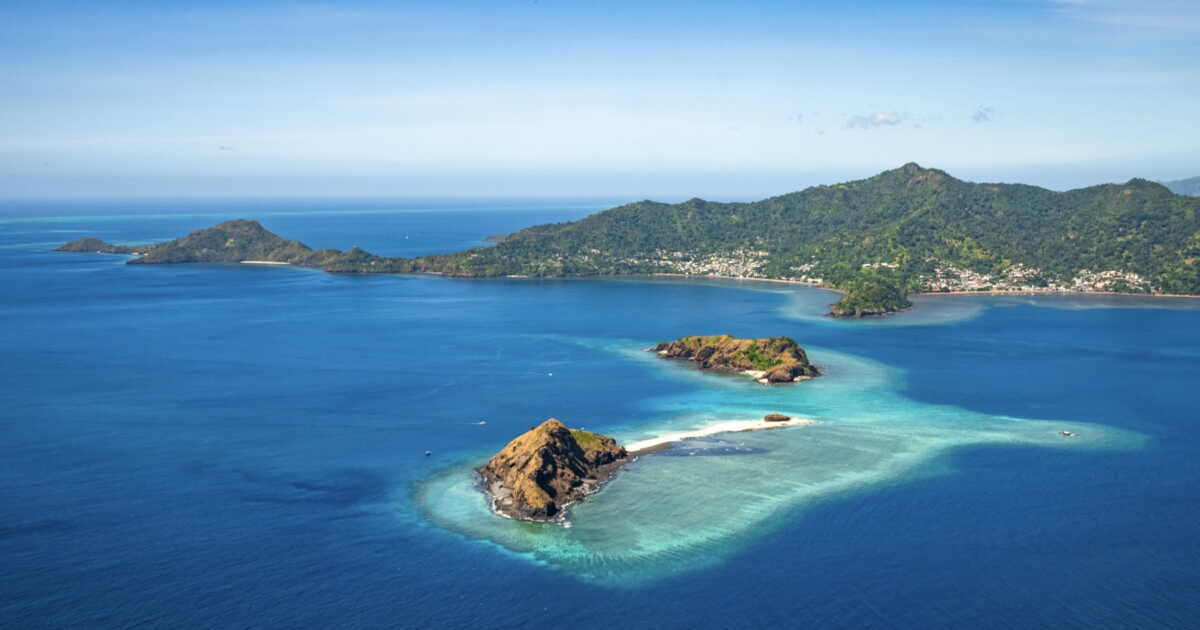
Set in the Mozambique Channel, the 101st French department is a blue jewel (the lagoon), white (the sand), green (the forest) with a pleasant tropical climate and a rich culture, where Malagasy, African, Arab and French influences interweave. Here, French, shimaoré and kibushi are spoken, and 95% of the population is Muslim, practicing a largely syncretic Islam. In Tsingoni, on the west coast of Grande-Terre, the oldest mosque in France (14th century) has preserved its mihrab – the niche that indicates the direction of Mecca – from the 16th century in carved coral.
Dense vegetation
To grasp the splendor of the archipelago, one must venture inland, and perhaps undertake the ascent of Mount Bénara, the highest point on Grande-Terre (660 meters), rewarded with a 360° view over the “hippocampus,” as the island is called from above due to its shape. In the company of Attoumani Harouna, one of the fathers of the Mahoran GR (160 kilometers) and a tour operator, we discover lands two-thirds covered by dense vegetation. A year earlier, after the passage of Chido, between 30% and 80% of trees, depending on the massif, had been devastated by winds roaring at 220 km/h!
Along the trails, banana trees spread their wide pale-green fans, the small local brown lemurs (Eulemur fulvus mayottensis)—the iconic makis here—leapt from mangos to kapok trees. We witness the soaring flight of the fruit bats, the largest bat species, and we cross the little Mahoran zebu, a meter at the shoulder. The archipelago also boasts 44 endemic plant species under protection, including Foetidia comorensis, a plant known here as namoulohna, of which fewer than a hundred remain, and two baobab lineages, the African (Adansonia digitata), with delicate white flowers, and the Malagasy (Adansonia madagascariensis), rarer, with flamboyant red flowers.
On the west coast, time hangs to the local rhythm of the villages
In the village of Combani, thirty-five minutes by road west of Mamoudzou, the main town, the Imany garden, for its part, exhales the scent of ylang-ylang, a memory of the era when Mayotte was “the island of perfumes.” In Sada, on the west coast, time seems suspended to the local pace.
Meanwhile, in Dzaoudzi-Labattoir, on Petite-Terre, the heartbeat of Mahoran life pulses: between colonial buildings and market lanes, the crowds hurry to join the “barge” that links the two main islands. On the deck of the shuttle, village women move wrapped in bright salouva—a piece of fabric tied beneath the chest—faces adorned with msindzano, a beauty and sun-protection mask, made from sandalwood rubbed on a coral stone.
These “ticklers” Mahoraises who chose France
In the late 1960s, about a hundred Mahoraises joined a resistance to keep Mayotte French and not follow the independence movement that mobilized the rest of the Comoros at the time. Their weapon: tickling, an original humiliation tactic aimed at shaming their opponents. But behind the symbolic act, the conflict was violent. In 1969, one of them, Zakia Madi, 25, was shot during clashes in Mamoudzou.
The struggle of the ticklers culminated much later, in 2011, with the archipelago’s departmentalization. Today, draped in their salouva, their heirs revive the codes of their elders to carry the current social claims.
A giant marine sanctuary
During family celebrations, songs in shimaoré and in Arabic accompany the debaa, a celebration with distant origins, accompanied by dances performed by women, whose hands ripple like seaweed underwater. And water is everywhere, where the eye rests: the 1,100 km² closed lagoon, one of the largest in the world, is home to 800 species of fish and marine mammals, including manta rays that seem to fly beneath the waves, dolphins, and humpback whales that traverse it from July to October.
And then, every year, nature offers another gift: 3,000 to 5,000 turtles come to nest on the beaches, notably at Moya, a southeast cove of Petite-Terre. The site is monitored by guardians and volunteers, and the observation of nocturnal nesting follows strict rules. Off the coast, a mask and snorkel are enough to swim with the green turtle (Chelonia mydas) grazing on seagrass, or to glimpse its cousin, the hawksbill turtle (Eretmochelys imbricata), shyer, gliding between the coral patches that dot the giant lagoon of this France at the edge of the world.
Not to miss in Mayotte
A face-to-face with turtles
For an unforgettable sea ride, Rando Palma and captain Halifa, a certified lagoon guide, will accompany you safely. On the program: a dolphin ballet around the dinghy and turtle encounters while snorkeling, even for beginners.
@randopalma on Instagram
An inland immersion
To explore the archipelago up close to its people and landscapes, Attoumani and Hélène form a duo of passionate guides who share both the territory’s secrets and the daily Mahoran stories.
baobabtour.fr
A night in a “banga”
Mud walls, a roof of coconut palm leaves and a view of the lagoon: in Sada (west coast), the banga—traditional huts of the Chissioua—sit in a tropical garden. A perfect starting point to explore the beaches.
chissioua-mayotte.com
➤ Article published in GEO magazine No. 569, “Recharging in Auvergne,” July 2026.
➤ Do you love GEO? Then, to miss nothing, discover our subscription options to receive GEO at home every month with ease.