In the urban mural tapestry of San Francisco, the historic Mission District cannot be visited without addressing the question of wall murals. And anyone who dares to venture in would miss one of the city’s founding narratives.
Central, the district is one of the largest in the metropolitan area. Named after Mission Dolores, founded in 1776, the Mission District is today a vibrant neighborhood, undergoing transformation despite its deep roots in Latin culture. You do not visit it without first passing by the Women’s Building, an emblematic site of the fight for women’s rights and female emancipation: on 18th Street, you cannot miss its tall, colorful façade, painted by a collective of muralists in 1994. The building was acquired by a group of women in the 1970s, becoming de facto the first women-led community center in the United States.
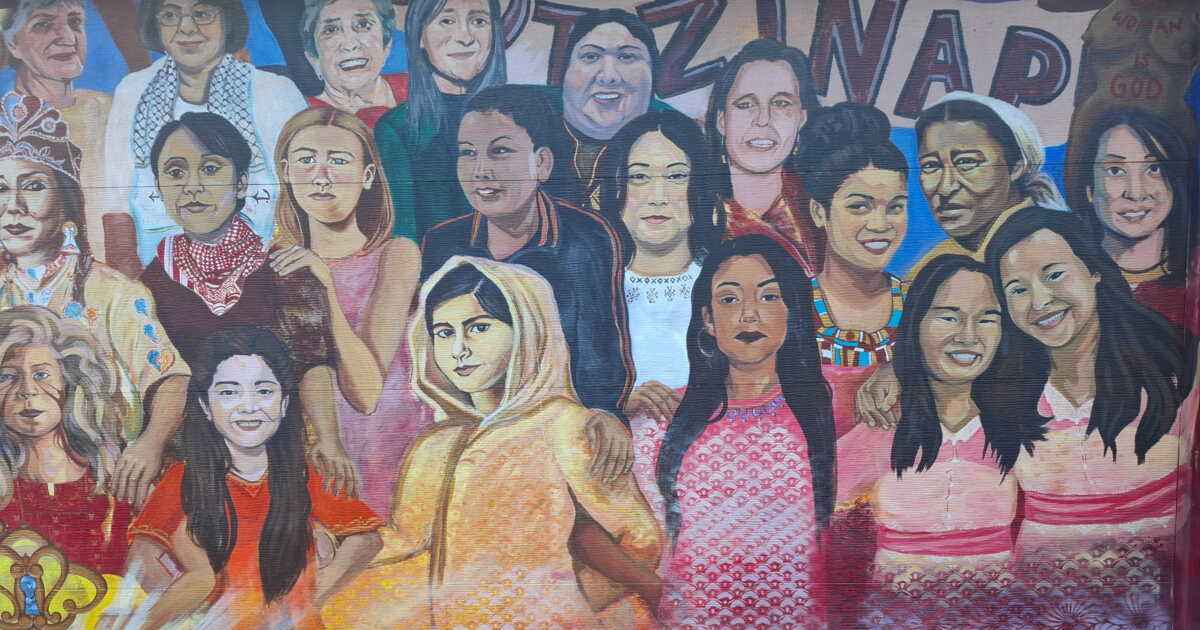
The spectacle is perhaps even more striking on the left-hand wall, which features a tall, vibrant mural tracing the history of the fight for women’s rights across the world.
Dubbed MaestraPeace, the monumental work (it spans five stories) is a manifesto. It reveals women from all backgrounds—activists, artists, spiritual and mythological figures—united in a single celebration of female power. Rigoberta Menchú, Maya activist and Nobel Peace Prize laureate, sits beside writer Audre Lorde, painter Georgia O’Keeffe, and deities such as Coyolxauhqui, Guanyin and Yemayá. The essential contribution of women to the building of human societies unfolds across the wall.
For more than 50 years, the place has hosted associations, activist groups and social initiatives, feminist and LGBT. It also offers support and guidance services to women and their families. A recent addition on the entrance door: a flyer offering help and calling for solidarity in case of ICE intervention, the immigration police much feared under Donald Trump’s presidency. A given in a neighborhood founded on immigration.
Latino Activism: Mission’s DNA
After World War II, many families from Latin America settled there. While American families with children gradually left downtown for the suburbs, they stayed and in doing so shaped the neighborhood’s identity. In 2000, nearly 60% of its residents were of Latin American origin, says Sylvie Walters, a French guide with L’Esprit San Francisco. Today, they would represent only about 30% of the population, due to rising housing costs and successive waves of gentrification.
In the 1970s, affirmative action policies championed by John F. Kennedy helped broaden access to artistic institutions for minority groups. “Yet, in galleries and museums, the artists exhibited remain largely men”, Sylvie explains. “Women then decide to invest in another space, much more accessible: the walls of the street”. They pick up brushes, organize into collectives, and turn Mission’s façades into their platforms.
To better understand this history, one must leave 18th Street and delve into the streets of the neighborhood. Head to Balmy Street, the narrow little alley “where it all began” begins Sylvie. It is here, at the start of the 1970s, that militant women artists, many living in the neighborhood, took to the walls, inspired by Diego Rivera, spiritual father of the movement, communist painter and companion of Frida Kahlo.
Their demands? The fight for women’s rights, first and foremost, but also the defense of Indigenous peoples—in the shaded alley, several works reference the 500 years of resistance of native peoples since Christopher Columbus’s arrival in America in 1492—and the denunciation of the dictatorships that weighed on Latin America in the latter part of the 20th century, with political and diplomatic support from the United States. In Mission, art spurns neutrality.
The street is still today maintained by artist collectives, who ensure that works eroded by time are restored. Among the pioneering associations: Precita Eyes, founded in 1977 by neighborhood artists and muralists. The organization supports mural projects, raises residents’ awareness of this art, and participates in its preservation. It also plays an educational role with the youngest. And schools contribute to teaching respect for these works and their history.
On Balmy Street, artists have reached agreements with homeowners to be allowed to paint the low walls. “One owner once tried to make a white wall”, Sylvie tells us. “A few days later, the freshly painted surface had vanished under new graffiti.” Farther along, Susan Cervantes’s mural of traditional Indian art, The Five Colors of Maize, was reattached to a new wall when the house that hosted it was demolished. An open-air heritage that it is (very) frowned upon to touch. Yet in San Francisco, only two wall murals enjoy the designation of historic monument.
Crouched on the paving stones, Gustavo and a few other artists work, brush in hand, eyes narrowed under the October sun. He is restoring a mural devoted to the rights of women in Nepal. The piece, created about twenty years ago, needed a serious refresh. Across several meters, it depicts oppressed women who rise up and break their chains. “There are many abuses against women in Nepal”, he explains. For him, restoring this painting is prolonging the message it carries. “We were raised by women, today we pay them tribute.”

Gentrification and Silicon Valley
Yet, as in San Francisco, things are changing in Mission.
“The first transformations were felt as early as the 1980s and 1990s, with an initial rush to the Silicon Valley that gradually pushed Latino populations out of Mission”, says Sylvie. A new wave, this time driven by tech companies and artificial intelligence (AI), is accelerating the phenomenon today. Facebook, Google and the new players in the digital economy attract a wealthier population to the Bay, while longtime residents struggle to keep up with the rising cost of living. “The first ones to be displaced from the neighborhood are the artists”, the guide regrets.
The murals’ demands also evolve with their era. On an old mural dating back several decades, the inscription “ICE” has recently been added. On another, robotic entities extend clawed fingers toward a numb population. Even the oldest works converse with current events. A few streets from the new buildings and the cafés frequented by tech employees, Balmy Street reminds us of what the neighborhood was—and still intends to remain: a territory of solidarity, popular expression and protest. Gentrification is reshaping façades, businesses and the population. But on the walls, the voices of women will continue to rise, as long as there are artists to pick up the brush.
This reportage was made possible by L’Esprit San Francisco, San Francisco Travel Association