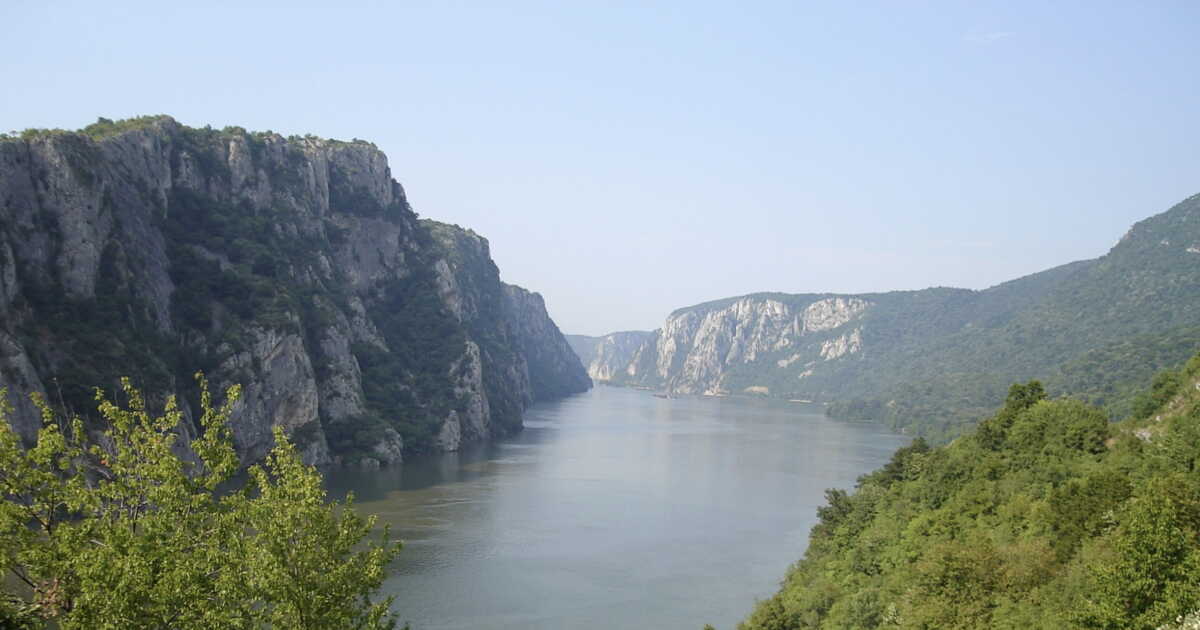
The Danube apparently has not yet given up all of its secrets. This summer, the exceptional drop in its level revealed remnants that the waters usually conceal, offering locals as well as travelers a spectacle that is as fascinating as it is unsettling. On the Serbian banks, silhouettes of ships evoke, in particular, a particularly dark episode of World War II. But the wrecks are not the only vestiges that the river reveals today.
German ships scuttled since 1944
Near Prahovo, in eastern Serbia, at least 20 wrecks of German ships are currently visible from the banks. Some still bear rusted hulls and broken masts. They belonged to the German Black Sea fleet, part of which was deliberately scuttled at the end of World War II.
In the summer of 1944, as the Red Army advanced westward, around 200 German vessels became trapped in this region. The Danube then represented a possible route of retreat, but the Iron Gates sector, a narrow and difficult-to-navigate passage, formed a major obstacle. In September 1944, Rear Admiral Paul-Willy Zieb ordered the scuttling of more than 200 ships to prevent their capture and slow the Soviet advance.
Most have remained underwater for more than eight decades. And their presence poses a danger. Some wrecks may still contain weapons or explosives, which further complicates navigation. Serbia has thus initiated a program valued at 30 million euros to remove some of these remnants, but operations are complex due to munitions hazards.
For Kenneth Reece, who recently navigated the Danube, these wrecks add a new dimension to a journey already marked by the footprints of 20th-century conflicts. “History isn’t just in museums or monuments. A part of it is literally beneath our feet,” he explains to the BBC.
The drop in the river’s level, however, does not merely resurrect memories of the war.
Ancient remains and unexpected objects also appear
In Bulgaria, the retreat of the waters has allowed the exposure of the remains of an ancient bridge dating from the time of Emperor Constantine, near Gigen. Farther away, near Ryahovo, specialists recovered bones and mammoth tusks dating back several thousand years. The remains must be studied and could eventually join the collections of the Ruse Regional History Museum, located about 30 kilometers from where they were found.
Other discoveries are much more recent. In Budapest, a Wehrmacht motorcycle was revealed by the ebbing waters. In Slovakia, near Virt, a British bomb weighing about 700 kg was discovered before being neutralized by a controlled explosion.
For archaeologists, these periods of low water provide a rare opportunity to observe vestiges normally inaccessible. “This gives us a rare chance to observe them, document them and study them in their real environment,” says Pavel Popov, from the Pleven Regional History Museum, cited by Reuters.
A phenomenon increasingly frequent?
These discoveries, however, have another consequence, more immediate for travelers. The low flow has forced some cruise lines to alter their itineraries, move passengers between several ships, or even end certain trips by bus when the river was no longer deep enough.
The phenomenon could also become more frequent. According to the European Copernicus service on climate change, Europe is warming at a rate more than twice the global average. The rise in temperatures and the alteration of precipitation patterns particularly foster episodes of very low water levels.
For passengers navigating the Danube, the spectacle is thus as striking as it is unexpected. Suzanna Fulton, who recently traveled aboard the Viking Honir, sums up her experience as: “It was a humbling and, to be honest, pretty awesome,” she told the BBC. A tourist river can thus become, when its waters recede, a true window opened onto the buried traces of European history.