

A Destination Still Relatively Unknown
New Brunswick is often perceived as a pass-through province, between Quebec and Nova Scotia. This is precisely what gives it its strength today. While some regions of Canada experience heavy traffic in peak season, the province still offers quieter coastal routes, authentic fishing villages, and nature that is easily accessible.
For a clientele that has already explored Quebec or the Rockies and is seeking another Canada, it’s an ideal answer: immersive, welcoming, and still underrepresented in catalogs.
The Only Province Officially Bilingual in Canada
New Brunswick is the only Canadian province officially bilingual. French and English enjoy exactly the same status: public services, road signage, schools and institutions operate in both languages.
In practice, this duality is geographic as well. The north and east of the province, particularly the Acadian Peninsula and the Madawaska region, are predominantly Francophone. The south, around Saint John and Fredericton, the capital, is more Anglophone. Between them, Moncton and its neighbor Dieppe live fully in both languages. You often hear chiac, a local speech that blends French and English in one sentence.
For your Francophone clients, it is a real travel comfort: they are easily understood while discovering a region that has its own identity. It is also a reassuring selling point for travelers less comfortable in English.
Acadie, a Culture in Its Own Right
Do not present Acadie as a mere variant of Quebec. The Acadians descend from the very first French settlers who established themselves in the region in the early 17th century. Their history is marked by the Grand Dérangement: starting in 1755, thousands of them were deported by the British authorities. Over generations, many returned to rebuild their communities along the coast.
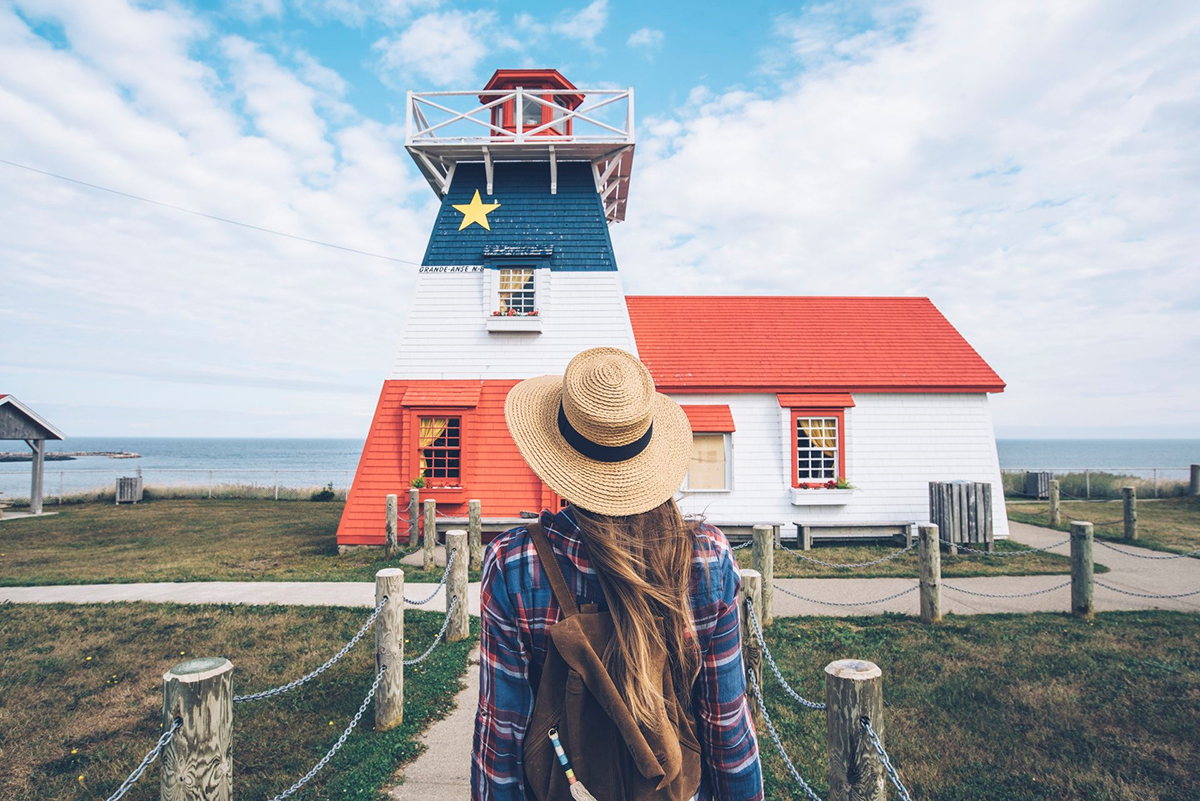
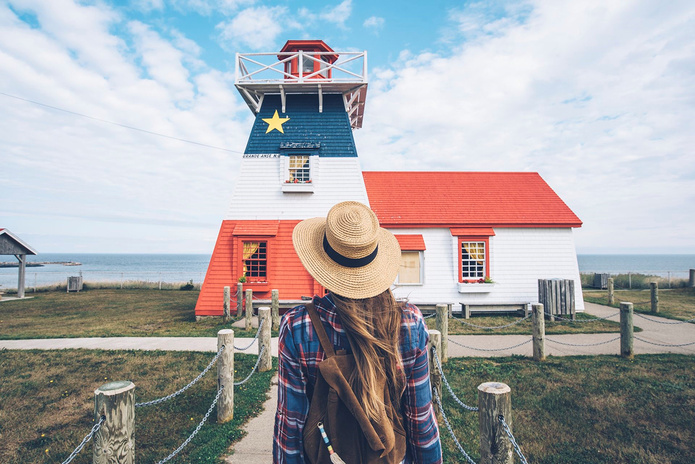
This memory remains very much alive. The Acadian flag, a tricolour of blue, white and red adorned with a golden star, flies over houses and fishing boats. On August 15, the Acadian national holiday, Caraquet hosts Tintamarre, a grand parade where everyone makes as much noise as possible to affirm the Acadian presence.
To understand this culture, the Acadien Historical Village near Caraquet recreates the daily life of families from days gone by. In Bouctouche, the Pays de la Sagouine honors the world of writer Antonine Maillet. Further north, Shippagan and Miscou Island offer an immersion into the lives of fishing communities.
The Bay of Fundy, a Spectacle That Changes Every Six Hours
In the south, the Bay of Fundy is famous for its tides, among the highest in the world. The sea level shifts twice a day, offering a dramatic change to the landscapes.
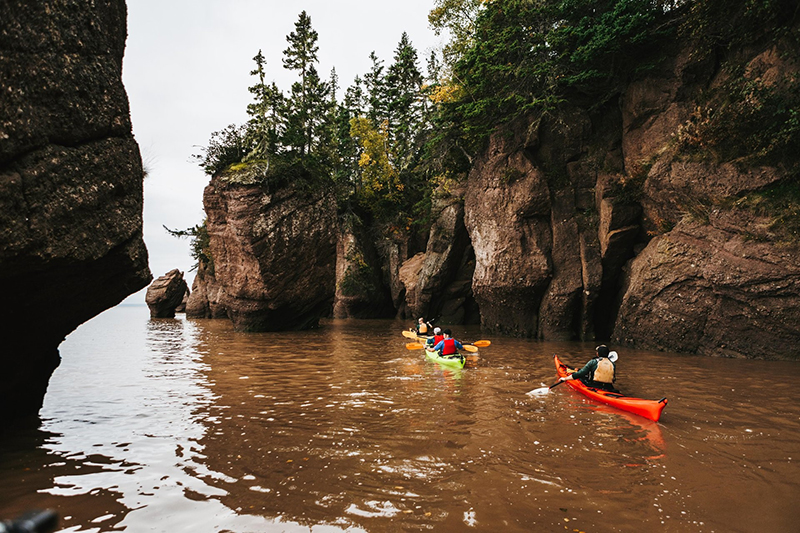
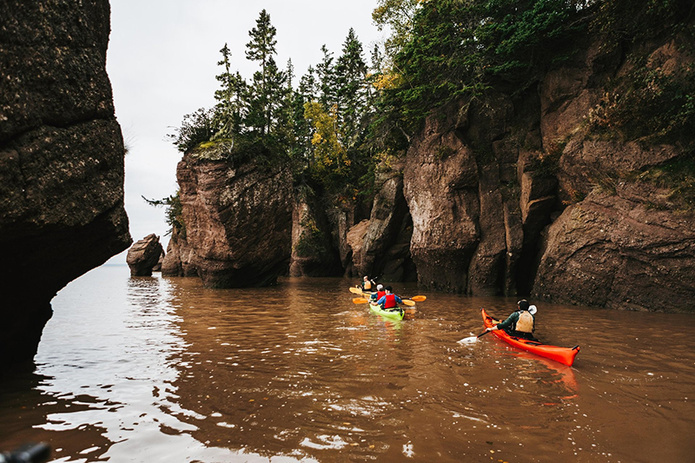
At Hopewell Rocks, you can walk on the ocean floor at low tide, at the foot of rocks sculpted into giant flower-pot shapes. A few hours later, the water covers everything again, and you can return there by kayak. Our tip : schedule the visit according to the tides, and ideally plan two passes in one day to witness both faces of the site. This is the kind of detail that completely changes the client’s experience.
Along the coast, Fundy National Park, the village of Alma, Saint Martins and its sea caves, then the Fundy Trail scenic drive offer superb stops. Saint John, Canada’s oldest incorporated city, adds an urban and port touch. And not to forget the lobster, best enjoyed in a lobster roll facing the sea.
The Journey We Propose
We craft New Brunswick as a 10 to 12-day self-drive journey that showcases the province’s two faces: the Fundy Bay and its tides to the south, followed by the Acadian coastline, Kouchibouguac National Park, and the Acadian Peninsula in the northeast. The trip can easily be paired with Nova Scotia and Prince Edward Island for a complete discover of the Maritime Provinces.
Key points for your clients:
Key points for your clients:
- Best time: mid-June to early October. September and early October offer autumn colors and quieter crowds.
- Access: flights to Moncton or Halifax, usually via Montréal, or a driving extension from a trip in Quebec.
- Advance planning: the charming accommodations on the Acadian Peninsula are relatively scarce. Around August 15, book early.
- Ideal profile: travelers returning to Canada, nature and encounter enthusiasts, families.