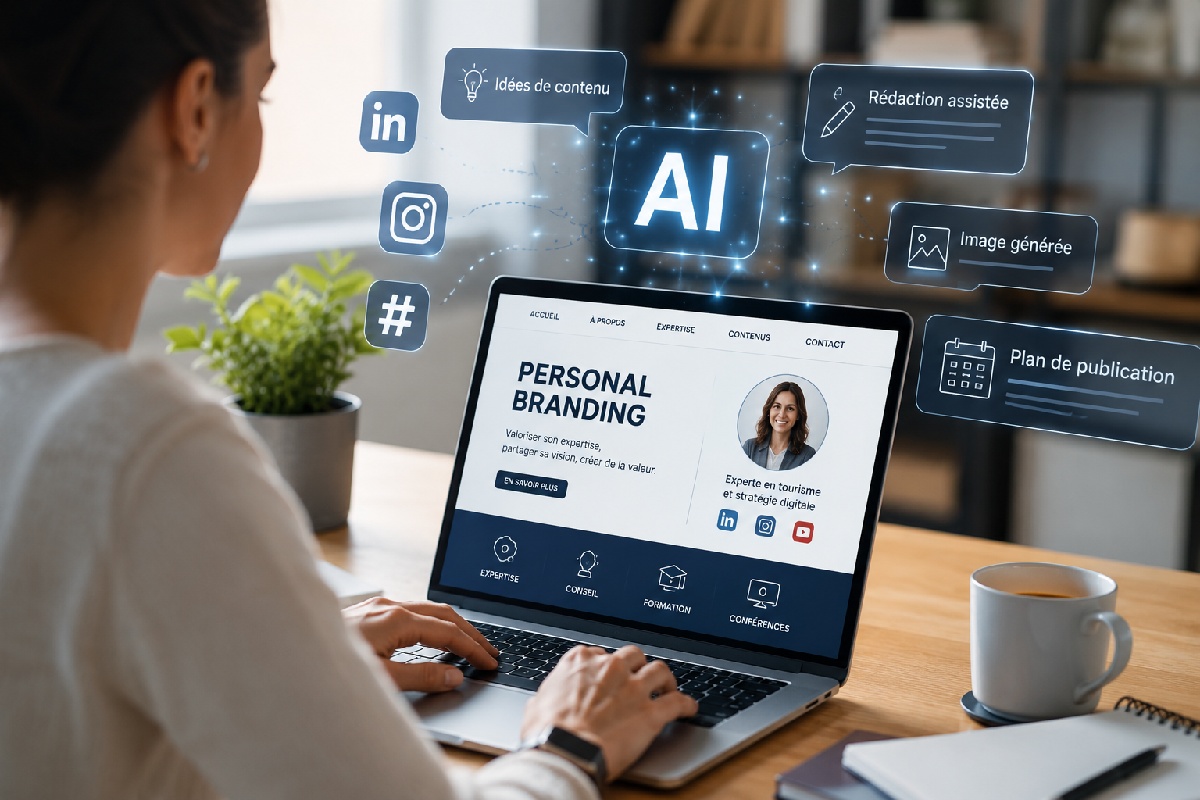


Personal branding has become an important topic for tourism professionals.
It isn’t just about self-promotion out of vanity, even though social networks have largely normalized this tendency.
It’s mainly about making one’s expertise visible, supporting the reputation of one’s business, building trust, and sometimes also opening up more professional options.
In this context, generative AI arrives at the right moment!
It enables content to be produced faster, more easily, with a level of polish that is often quite solid. For professionals who don’t always have the time, the desire, or the ease to write regularly, it’s a real lever.
But there is a problem: personal branding rests on embodiment. It must reveal a person, a point of view, an experience, a way of thinking. Yet AI-generated content often has a recognizable texture: clean, fluent, well organized, but sometimes too smooth.
And this smoothing can produce the opposite effect of what is sought.
It isn’t just about self-promotion out of vanity, even though social networks have largely normalized this tendency.
It’s mainly about making one’s expertise visible, supporting the reputation of one’s business, building trust, and sometimes also opening up more professional options.
In this context, generative AI arrives at the right moment!
It enables content to be produced faster, more easily, with a level of polish that is often quite solid. For professionals who don’t always have the time, the desire, or the ease to write regularly, it’s a real lever.
But there is a problem: personal branding rests on embodiment. It must reveal a person, a point of view, an experience, a way of thinking. Yet AI-generated content often has a recognizable texture: clean, fluent, well organized, but sometimes too smooth.
And this smoothing can produce the opposite effect of what is sought.
1. The undeniable advantage of generative AI for producing personal branding content
 Generative AI offers first a straightforward benefit: it helps produce higher-quality formal content.
In a professional setting, spelling mistakes, poorly constructed sentences, or confusing phrasing weaken the message. They can convey carelessness even when the underlying idea is sound. Generative AI greatly reduces this risk. It typically yields well-structured, grammatically correct texts that are easier to read.
This is an important point for personal branding. When someone speaks publicly, the form matters. It does not replace the substance, but it influences how the substance is perceived. A clear message, error-free and well phrased, gains credibility.
AI also helps fight writer’s block. Many professionals have interesting things to say, but do not always know how to express them. They have an idea, an intuition, a field experience, but translating it into writing can be blocking.
AI can then serve as a spark. It helps to draft a first version, to organize ideas, to find an angle, or to transform a vague intention into workable text.
This sparking role is valuable because it helps thought get moving.
The other major contribution concerns visuals. Many professionals know how to write with a keyboard, at least to a functional level. Yet very few truly know how to produce quality visual elements.
Creating an image, an illustration, a layout, or a coherent visual requires specific skills with specific tools (Photoshop, Illustrator, etc.). Generative AI changes that.
It enables non-designers to produce engaging visuals, sometimes of very high quality. For personal branding, that’s a real advantage, because online presence relies not only on text. Images, carousels, short formats, and visual assets play a significant role in how a person is perceived.
Finally, access to these tools has become very simple. You don’t need to spend hundreds of euros to achieve decent results. Many free models and tools already allow you to produce texts, ideas, visuals, or content variants at a good level.
This is what makes generative AI particularly interesting for tourism professionals. It lowers the entry barrier. It enables more people to speak up, structure their visibility, and produce content with regularity.
2. The risk: producing clean content, but inauthentic
Since November 30, 2022, the launch of ChatGPT-3.5, the general public has become accustomed to AI-generated content. Professionals as well. Result: certain markers are becoming increasingly visible.
The problem is simple: personal branding seeks to reveal a singularity. It must show a person, an experience, a style, a stance.
Yet generative AI often produces content that seems correct, but lacks flesh, lived experience, and authenticity.
The content generated is generic. It may resemble all other content produced with the same tools, the same weak prompts, and the same standard formulations.
This risk is especially visible in writing. Some markers reveal AI usage fairly quickly. For instance, you might encounter titles with capitalization on every word, following an Anglo-Saxon capitalization logic. For example: “Our Ten Tips for Using LinkedIn” is very likely a title produced by Gen AI.
In French, that sounds immediately artificial. It’s a detail, but details always end up betraying us. Another marker: too-perfect punctuation. In real life, people do not always punctuate with absolute rigor.
A text that is too neatly punctuated can thus seem suspicious, especially on social networks where personal voices tend to be more direct, more irregular, and more human.
There are also certain formulations that are too convoluted, too balanced, too general. Phrases that seem well-constructed, but that no one would actually say. They give an impression of standardized text. People then recognize less a person and more a statistical model – which is, fundamentally, what an AI is.
It’s somewhat alarming, because even when ideas genuinely come from you, AI can give them an artificial shape. You might start from an authentic experience, a personal conviction, real field feedback, then lose that authenticity when shaping it.
The problem is simple: personal branding seeks to reveal a singularity. It must show a person, an experience, a style, a stance.
Yet generative AI often produces content that seems correct, but lacks flesh, lived experience, and authenticity.
The content generated is generic. It may resemble all other content produced with the same tools, the same weak prompts, and the same standard formulations.
This risk is especially visible in writing. Some markers reveal AI usage fairly quickly. For instance, you might encounter titles with capitalization on every word, following an Anglo-Saxon capitalization logic. For example: “Our Ten Tips for Using LinkedIn” is very likely a title produced by Gen AI.
In French, that sounds immediately artificial. It’s a detail, but details always end up betraying us. Another marker: too-perfect punctuation. In real life, people do not always punctuate with absolute rigor.
A text that is too neatly punctuated can thus seem suspicious, especially on social networks where personal voices tend to be more direct, more irregular, and more human.
There are also certain formulations that are too convoluted, too balanced, too general. Phrases that seem well-constructed, but that no one would actually say. They give an impression of standardized text. People then recognize less a person and more a statistical model – which is, fundamentally, what an AI is.
It’s somewhat alarming, because even when ideas genuinely come from you, AI can give them an artificial shape. You might start from an authentic experience, a personal conviction, real field feedback, then lose that authenticity when shaping it.
3. Using AI well without harming your personal branding
The correct approach is to use AI as an execution tool, not as a substitute for thinking.
The first skill to develop is the art of prompting.
A vague prompt almost always yields a vague answer. If you simply ask an AI to write a post about your expertise, it will often give you a decent but very generic text — and that’s normal: you gave it a weak brief, it returns a mediocre response.
The machine isn’t a magician; it is mostly very obliging. A good prompt must be structured. It should specify several elements. First, the expected role. You must tell the AI which angle it should work from: writer, editorial advisor, copy editor, sparring partner, tourism sector expert, LinkedIn specialist, etc.
Next, the task. You must state precisely what you want: reformulate, structure, shorten, convert a voice note into a post, propose an outline, create a visual, correct a text without changing the tone.
Finally, the context. This is by far the most important point. Context allows AI to produce something specific rather than general. You should specify who is speaking, to whom, in which sector, with what intention, with what level of language, on which channel, with which examples or constraints.
It is this context that makes it possible to move from generic content to useful content. There are several frameworks to better structure prompts.
You can, for example, use a framework like FOCUS, with a function (i.e., a role), a goal, a context, a utility, and an expected style. The aim is not to talk to the AI like a polite search engine, but to give it a precise framework.
The second skill is training. Using generative AI effectively isn’t learned in a single attempt. You need to test, compare, adjust, and retry. You should observe what works, what sounds off, what improves the text, and what makes it flatter instead.
The use of AI is a long-term practice, not a one-off usage you activate once a month hoping for miraculous results. Those who achieve the best results are the ones who learn to dialog with the tool, to correct its outputs, and to refine their instructions.
The third skill is editing, and it’s probably the most important. A text generated by AI should not be published as is. It must be revised. You should copy it into a document, reread it, cut it, move it, harden it, and simplify it.
You should ask yourself: would I really say it like that? Does this sentence match my way of speaking? Does this example come from my experience? Does this passage add anything or just fill space?
Editing allows reintroducing the person into the text. It turns automatic production into personal speaking. Concretely, this means keeping control at three moments.
The first moment is ideation. The ideas must come from you: your experiences, your observations, your disagreements, your learning, your real cases. AI can help to formulate, but it should not decide for you what you have to say.
The second moment is execution. This is where AI is very useful. It can structure, draft a first version, propose titles, adapt a text to a format, correct mistakes, or create variants.
The third moment is correction. This is where you take back control. You remove generic formulations, you add concrete details, you restore your tone, you verify that the text resembles you.
The first skill to develop is the art of prompting.
A vague prompt almost always yields a vague answer. If you simply ask an AI to write a post about your expertise, it will often give you a decent but very generic text — and that’s normal: you gave it a weak brief, it returns a mediocre response.
The machine isn’t a magician; it is mostly very obliging. A good prompt must be structured. It should specify several elements. First, the expected role. You must tell the AI which angle it should work from: writer, editorial advisor, copy editor, sparring partner, tourism sector expert, LinkedIn specialist, etc.
Next, the task. You must state precisely what you want: reformulate, structure, shorten, convert a voice note into a post, propose an outline, create a visual, correct a text without changing the tone.
Finally, the context. This is by far the most important point. Context allows AI to produce something specific rather than general. You should specify who is speaking, to whom, in which sector, with what intention, with what level of language, on which channel, with which examples or constraints.
It is this context that makes it possible to move from generic content to useful content. There are several frameworks to better structure prompts.
You can, for example, use a framework like FOCUS, with a function (i.e., a role), a goal, a context, a utility, and an expected style. The aim is not to talk to the AI like a polite search engine, but to give it a precise framework.
The second skill is training. Using generative AI effectively isn’t learned in a single attempt. You need to test, compare, adjust, and retry. You should observe what works, what sounds off, what improves the text, and what makes it flatter instead.
The use of AI is a long-term practice, not a one-off usage you activate once a month hoping for miraculous results. Those who achieve the best results are the ones who learn to dialog with the tool, to correct its outputs, and to refine their instructions.
The third skill is editing, and it’s probably the most important. A text generated by AI should not be published as is. It must be revised. You should copy it into a document, reread it, cut it, move it, harden it, and simplify it.
You should ask yourself: would I really say it like that? Does this sentence match my way of speaking? Does this example come from my experience? Does this passage add anything or just fill space?
Editing allows reintroducing the person into the text. It turns automatic production into personal speaking. Concretely, this means keeping control at three moments.
The first moment is ideation. The ideas must come from you: your experiences, your observations, your disagreements, your learning, your real cases. AI can help to formulate, but it should not decide for you what you have to say.
The second moment is execution. This is where AI is very useful. It can structure, draft a first version, propose titles, adapt a text to a format, correct mistakes, or create variants.
The third moment is correction. This is where you take back control. You remove generic formulations, you add concrete details, you restore your tone, you verify that the text resembles you.