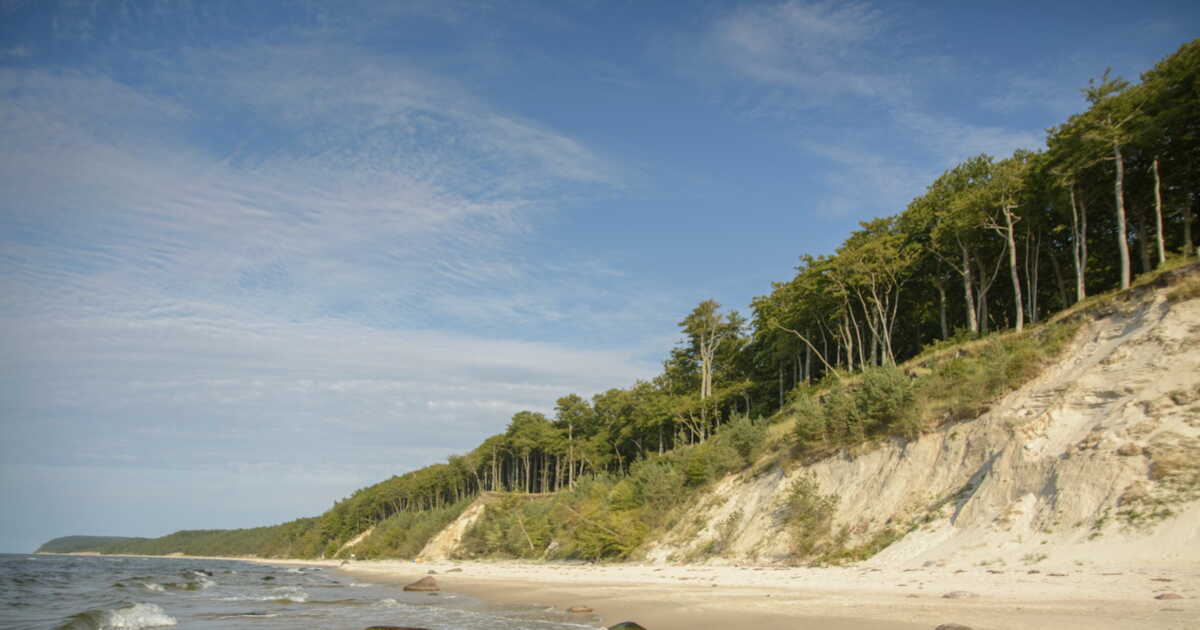
At first glance, Wolin Island, along the Polish Baltic coast, seems like a peaceful holiday destination. Its white-sand beaches, dunes, and beech and pine forests draw numerous visitors each summer who come to enjoy the coastline.
But beneath this preserved nature lies a vast military complex built during the Nazi era, later transformed during the Cold War into a command center for the Polish Army. Today open to the public, it reveals itself through an underground tour that lets visitors enter an old military town almost frozen in time.
Bunkers Secretly Built by the Nazis
To reach Wolin Underground City, you must penetrate the forest on Wolin Island. A few military vehicles and missile components displayed among the trees announce the site’s singular character. But the essence lies underground. The complex was built between 1936 and 1939, at a time when Nazi Germany was strengthening its military defenses. It was part of two coastal batteries named Goeben and Vineta. The latter consisted of four bunkers equipped with rotating cannons, to which were added command facilities, ammunition storage, and support installations.
Construction proceeded secretly, at a time when the Treaty of Versailles prohibited Germany from rearming after World War I. Despite the resources devoted to its construction, the fortress did not witness the battles for which it had been designed. “As the front of World War II advanced rapidly, this region remained very calm during the war, and the Nazis transformed the entire complex into a naval school”, explains Kacper Stachula, the site’s guide, to CNN.
In 1945, German troops tried to destroy the installations before retreating. They blew up the munitions, but a large part of the bunkers remained intact. After the war, the Soviets recovered some of the equipment and metal components, while locals subsequently looted the abandoned facilities. “No one knew what to do with this place after the war”, says Kacper Stachula.
The Cold War changed the situation. After the Warsaw Pact’s formation in 1955, Poland prepared, among other things, a scenario for invading Denmark in case of conflict with NATO. The former German bunkers, isolated in the forest and protected by their subterranean position, made an ideal site for a command center. The Polish army modernized them in 1955, then again in 1965, linking the five bunkers with new tunnels.
A Dive into the Cold War Beneath the Forest
The result is today particularly spectacular to visit. The complex comprises nearly 1.6 kilometers of tunnels and was divided into five security zones. It could function as a fully autonomous base, with dormitories, a kitchen, a canteen, an infirmary, water reserves, and technical rooms. The guided tour allows visitors to traverse these largely preserved spaces. Inside, it stays around 10 °C year-round. The old telephone standards, radios, communication networks, typewriters, and military equipment are all still in place.
In some rooms, mannequins placed in front of the equipment recreate the atmosphere of the command center. The itinerary notably leads to the war room, one of the most impressive areas of the complex. Tactical maps and computer equipment remain visible there, as well as a red telephone. This setting mainly helps to understand the strategic importance the site held during the Cold War, pitting the United States against the USSR.
Since these bunkers were contemplated for plans that could have radically altered the conflict in Europe, “The idea was to deploy tactical nuclear warheads in Danish ports and in western Germany to breach NATO defenses, then to proceed with a larger-scale offensive”, explains Kacper Stachula. The scenario thus envisaged the use of tactical nuclear weapons against NATO forces before a broader offensive into Western Europe.
The red telephone was never used to signal such an attack. The complex nonetheless holds another part of its mystery: when the Germans left in 1945, some tunnels were sealed behind thick concrete walls. Some underground sections remain unexplored.
With around 3,000 visitors per month according to the Polish Tourism Organization, Wolin Underground City has become a genuine tourist curiosity. Its proximity to the island’s beaches makes the outing particularly unusual: after enjoying the Baltic shoreline, one simply steps into the forest to discover, beneath your feet, a military site where Nazi Germany, the Polish Army, and Cold War nuclear strategies have followed one another.