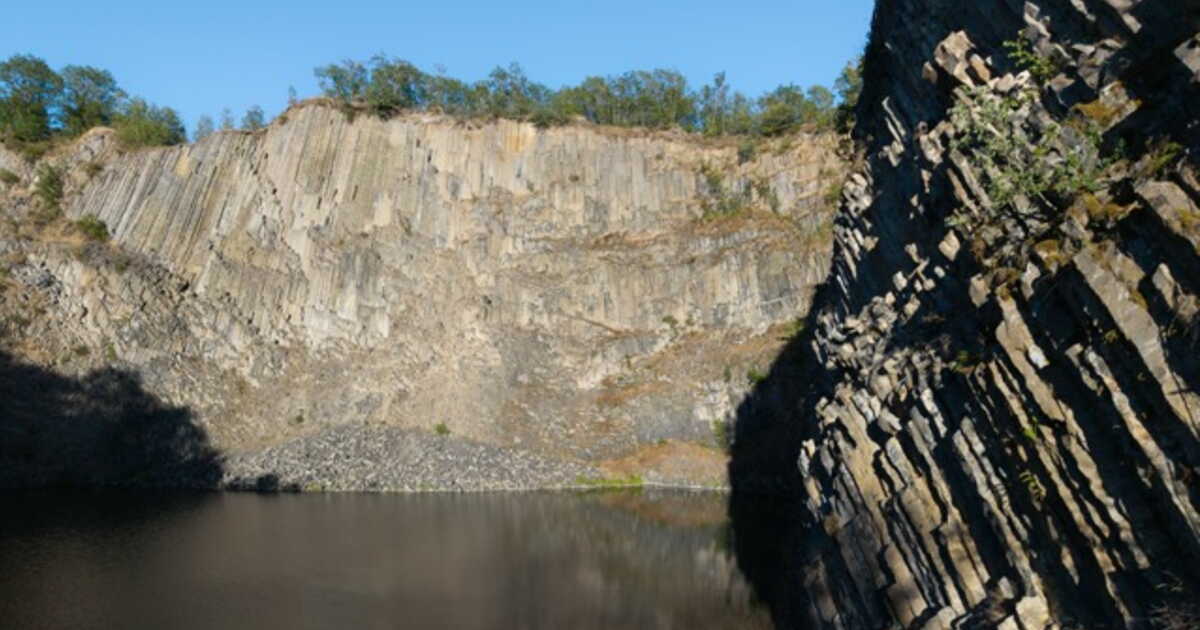
The scene, a floating wooden platform on the lake, appears at the last moment. One must walk along a path lined with pines and ashes before guessing the mineral amphitheater where it is installed: the Montpeloux Organ, 70-meter-tall cliffs carved with basalt columns where tufts of gorse cling here and there. Located in the Ance valley, in Livradois-Forez (the “z” is not pronounced), near the village of Saillant, this geological curiosity, which hosts a music festival every summer, was born from the crystallization of a lava lake 18 million years ago. Montpeloux – the name would mean “hairy hill” – is one of the rare witnesses to the volcanism of the Forez mountains, a range that separates the Dore valley to the west from the Forez plain to the east.
“The crater of this ancient volcano was first filled with molten lava, explains the volcanologist and geologist Pierre Lavina. As it cooled, the magma solidified in layers and the shrinkage formed these dark basalt columns, whose diameters range from 50 centimeters to one meter.”
It was in 1958 that basalt exploitation began here, used for road surfacing. By opening the mountain, the quarry workers uncovered the famous “orgues.” “Without human intervention, the site would have remained in the shadows”, confirms Pierre Lavina. The activity enjoyed a golden age in the 1970s, then ended in 1989. Here, people remember petitions denouncing the nuisances caused by the quarry: clouds of dust, rock splinters… “It was dangerous, confides the former mayor of Saillant, Jacques Chomette. One day, a car and houses were damaged. The inhabitants of the hamlet of Montpeloux, at the foot of the volcano, formed a defense committee that worked for its closure.”
The Singing Stone
On a sign at the entrance to the site, the testimony of Marcel Duroure, a blastman for fifteen years, recounts how risky his work was: “After lighting the fuse, the workers would scatter to hide because sometimes rocks would come tumbling down!”
It is estimated that 500,000 tonnes of basalt in total were extracted at Montpeloux. Having become an industrial wasteland, the crater filled with runoff water, forming a lake.
The idea of turning the mineral amphitheater into a venue for live performances came almost naturally. “The acoustics are excellent”, notes Danièle Hortala, 74, a councilor of the Saillant commune. In the past, I belonged to a choir and we would turn to the orgues to sing. A phenomenon due to the acoustic properties of a rock capable of resonating like glass when struck. Basalt was also used to manufacture some prehistoric lithophones, “musical stones” regarded as the ancestors of the xylophone.
The Volcanic Prison of Queen Margot
Still in the Puy-de-Dôme, 75 kilometers to the west of Montpeloux, the village of Usson also has its stone orgues, revealed by the exploitation of a basanite quarry. This dark magmatic rock, slightly different from basalt, was used to build the houses and the medieval fortress (10th century) perched atop the hill. It is in this fortress, of which only the foundations remain, that Marguerite of Valois (1553-1615), the famous “Queen Margot”, was confined in 1586 and spent nineteen years in banishment.
Dizziness at Nightfall
The layout of the stage dates from 2006, when the festival was launched, which since then has animated the site on Thursday evenings in July and August. “The aim was to sanctuarize the space by turning it into a cultural venue, notes the festival director, Jérôme Bru. Today, it is a theatre of words, song, and gaze.”
Indeed, between comedies, concerts, and circus arts, the performances take place as much on the boards as in the contemplation of this stone giant with rock faces dotted with shrubs, where black kites nest. The trails are accessible year-round, but “in March or April, during the thaw, it’s a festival… of rockfalls”, warns the volcanologist Pierre Lavina. The impressive landslide at the foot of the wall bears witness to this.
Up above, a row of low walls. These are the ruins of an old fortress, built in the 11th century with the volcanic rock quarried on-site. Once the property of the Knights of La Roue, the fortress itself eventually served as a quarry: in the late 19th century, villagers retrieved its stones to build their houses.
At nightfall, the setting offers one final enchantment. Under the festival spotlights, the monumental rock face takes on copper and orange-yellow hues. “Imagine the scene under a starry sky!”, exclaims Jérôme Bru. When lit, the basalt columns reveal a geometry reminiscent of the impossible architectures of the Dutch artist M. C. Escher. And this wonder of nature then converses with the infinity of the Milky Way.
Visit Nearby
- Within 30 minutes by car. A spry elder
In Ambert, the Richard-de-Bas paper mill, dating from the 14th century, continues to produce paper thanks to its water wheel and period hammer hoppers that grind linen, cotton, and hemp rags. During guided tours and initiation workshops, visitors discover the ancient crafts of papermakers and even make a sheet to keep for themselves.
- Within 30 minutes on foot. Living heritage
Planted in 1605 by order of the Duke of Sully – the Henri IV minister who imposed these plantings across the kingdom to celebrate the regained peace – the Saillant lime tree watches over the Saint-Pierre church. It is in the shade of this giant that edicts were once proclaimed. Still vigorous, this remarkable tree remains the favored meeting place for the Saillant residents.
➤ Article published in GEO magazine no. 573, “Scotland, generous and proud,” November 2026.
➤ Do you love GEO? Then to not miss any issue, discover our subscription plans to receive GEO every month at your home with ease.