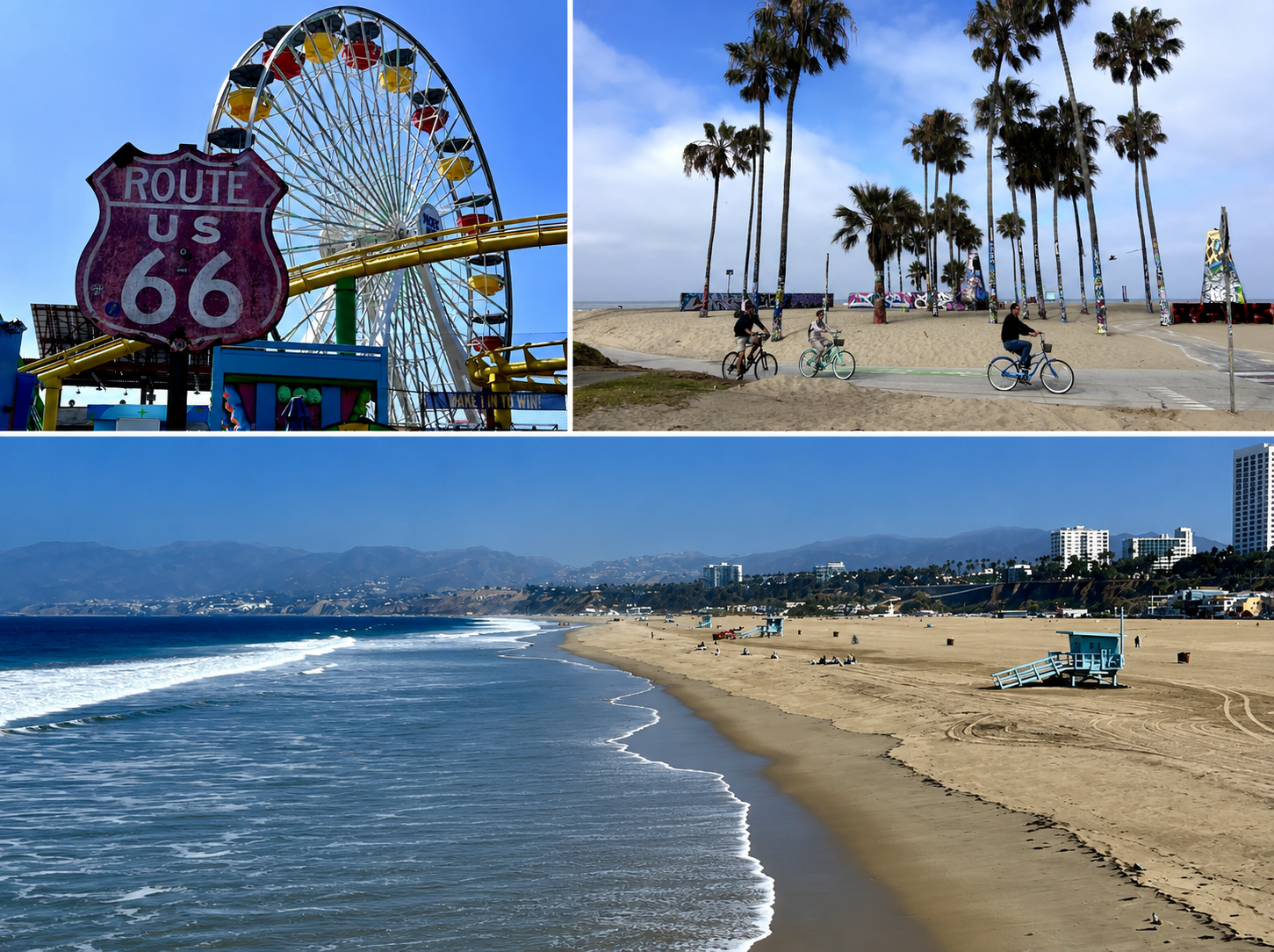
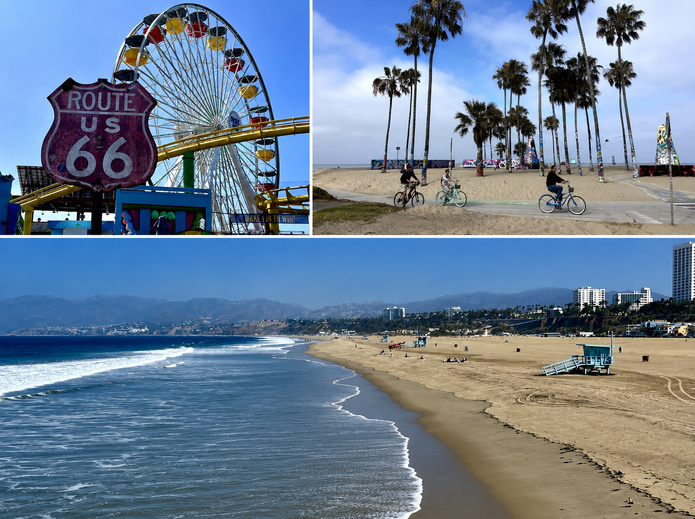


On the edge of the sprawling Los Angeles metropolitan area, Santa Monica (90,000 residents) is a dream seaside destination perched along the Pacific: sunlit beaches, surfing spots, a magnificent pier, an amusement park whose Ferris wheel runs on solar power, elegant residential districts, stylish hotels like the Pierside, and generous restaurants such as The Lobster serving delicious grilled lobsters.
To truly inhabit this California city that has served as a backdrop for countless films and TV shows—from Pacific Blue to Barbie, from The Sting to Forrest Gump and Iron Man—, there is nothing like pedaling between the beach and the sea along the South Bay Bicycle Trail, before heading to Venice of America where, for a century, canals imitate Venice in Italy.
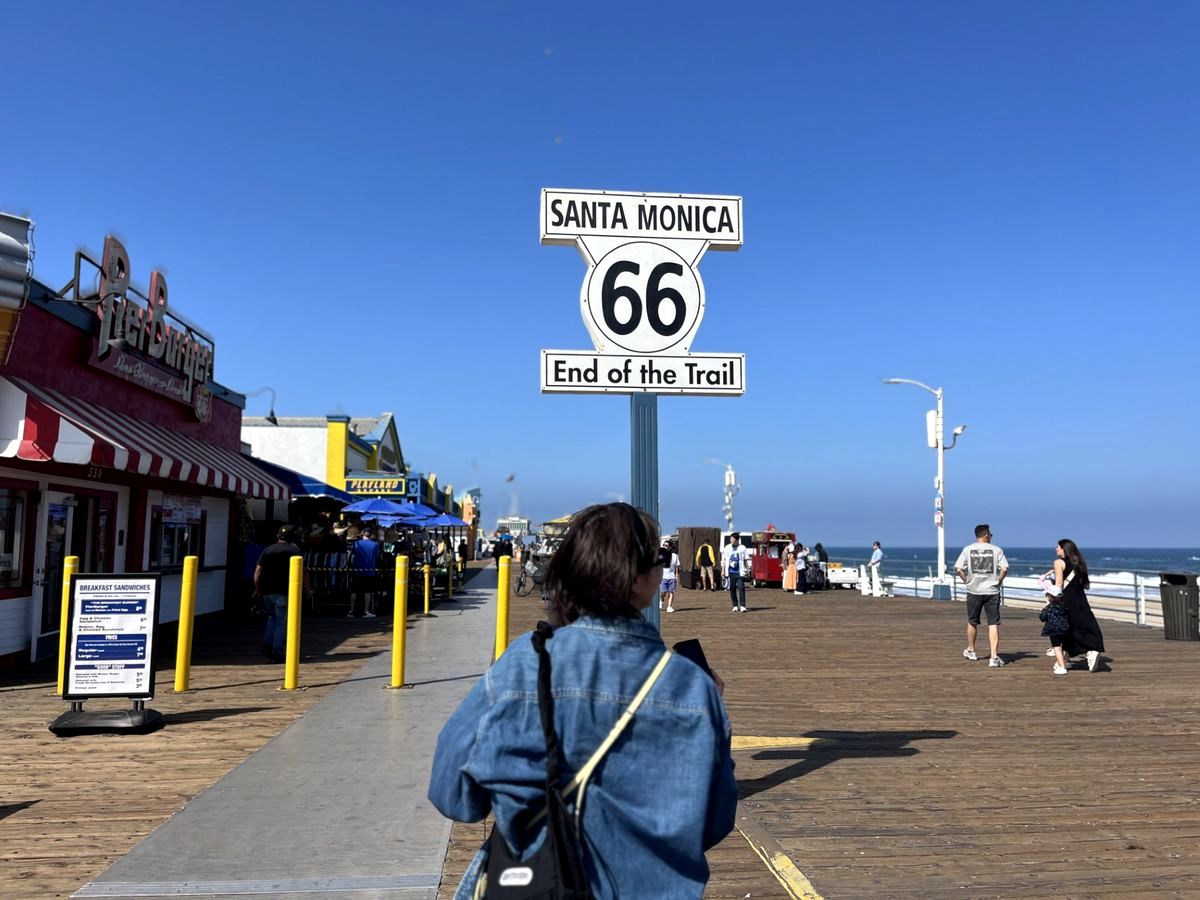
The other major attraction in Santa Monica is the “End of the Trail” sign planted on its pier.
It marks the end of the legendary Route 66. Tourists crowd at its base to photograph themselves there!
To truly inhabit this California city that has served as a backdrop for countless films and TV shows—from Pacific Blue to Barbie, from The Sting to Forrest Gump and Iron Man—, there is nothing like pedaling between the beach and the sea along the South Bay Bicycle Trail, before heading to Venice of America where, for a century, canals imitate Venice in Italy.
The other major attraction in Santa Monica is the “End of the Trail” sign planted on its pier.
It marks the end of the legendary Route 66. Tourists crowd at its base to photograph themselves there!
Yesterday, the “Mother Road”…
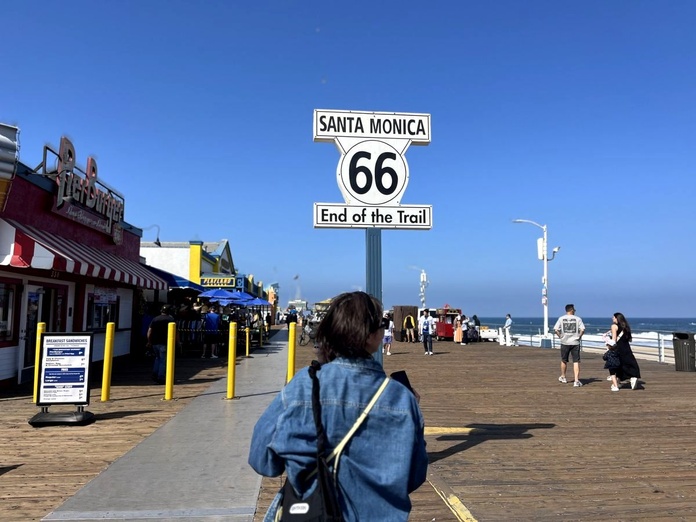
A legendary route that embodies the American dream in popular culture, Route 66 has linked, since 1926, the East to the West of the United States, from Chicago (Illinois) to Santa Monica (California), crossing three time zones and eight states, and covering nearly 4,000 kilometers.
Nicknamed “The Mother Road,” it was immortalized by John Steinbeck in his famous novel, The Grapes of Wrath: the writer depicts some of the small farmers who, ruined by the “Great Depression” of the 1930s and by repeated dust storms, fled to California hoping to find work, land, and a future.
This long ribbon of two-lane asphalt symbolizes both America’s golden age and the nostalgia of the 1950s–60s.
It was during those years that the Interstate Highways, powerful, safer, faster, and better suited to increasingly heavy traffic, began to substitute Route 66.
In the early 1980s, Interstate 40 effectively delivered the coup de grâce.
Following the downgrading of Route 66 in June 1985, its route completely disappeared from official maps.
Nicknamed “The Mother Road,” it was immortalized by John Steinbeck in his famous novel, The Grapes of Wrath: the writer depicts some of the small farmers who, ruined by the “Great Depression” of the 1930s and by repeated dust storms, fled to California hoping to find work, land, and a future.
This long ribbon of two-lane asphalt symbolizes both America’s golden age and the nostalgia of the 1950s–60s.
It was during those years that the Interstate Highways, powerful, safer, faster, and better suited to increasingly heavy traffic, began to substitute Route 66.
In the early 1980s, Interstate 40 effectively delivered the coup de grâce.
Following the downgrading of Route 66 in June 1985, its route completely disappeared from official maps.
…today, “Historic Route”
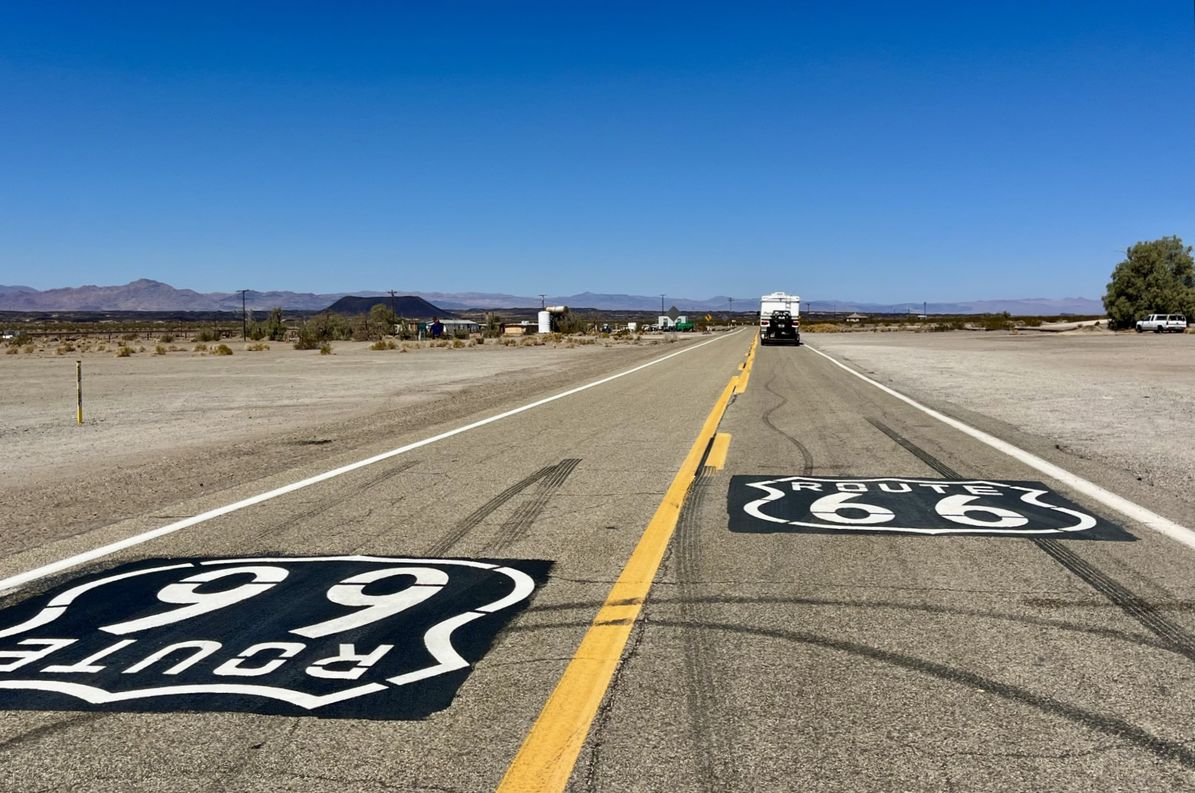
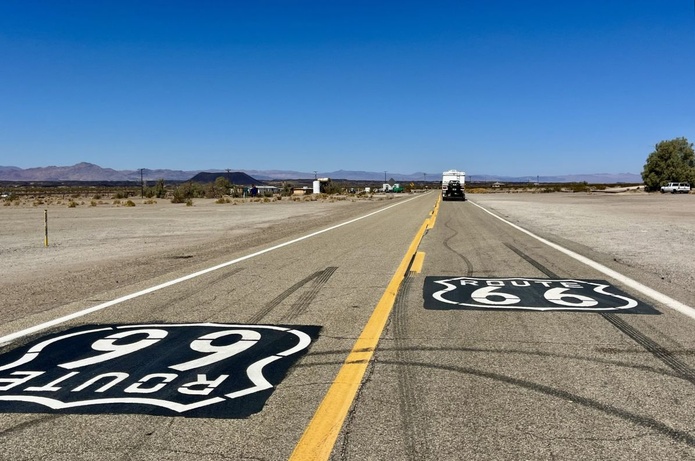
This downgrade proved a tragedy for the small towns traversed by Route 66.
Overnight, traffic collapsed and motels, restaurants, cafés, trading posts and gas stations struggled to survive.
In response, Angel Delgadillo, a barber in Seligman (Arizona), and a handful of stalwarts fought to achieve designation as “Historic Route 66.” Ultimately, by the late 1990s, the United States Congress established a preservation program for this legendary itinerary and the treasures it shelters.
Since then, signage and “Historic Route 66” plaques have been installed; motels, shops, and historic places along Route 66 have been restored. Since then, Route 66 has enjoyed a remarkable revival.
Its historic alignment could not be preserved in the highly urbanized zones around Los Angeles, full of bridges and interchanges.
To reach Barstow – our first stop, we thus left Santa Monica via Interstate 10 as part of a press trip organized by Brand USA with the help of Cercle des voyages, a French tailor-made travel specialist, ranked in 2023 among the 50 best travel agencies in the world for the United States by the Chairman’s Circle Honors.
The road trip program was developed with the involvement of Anthony Enault, head of North America Production, who joined us as well.
Overnight, traffic collapsed and motels, restaurants, cafés, trading posts and gas stations struggled to survive.
In response, Angel Delgadillo, a barber in Seligman (Arizona), and a handful of stalwarts fought to achieve designation as “Historic Route 66.” Ultimately, by the late 1990s, the United States Congress established a preservation program for this legendary itinerary and the treasures it shelters.
Since then, signage and “Historic Route 66” plaques have been installed; motels, shops, and historic places along Route 66 have been restored. Since then, Route 66 has enjoyed a remarkable revival.
Its historic alignment could not be preserved in the highly urbanized zones around Los Angeles, full of bridges and interchanges.
To reach Barstow – our first stop, we thus left Santa Monica via Interstate 10 as part of a press trip organized by Brand USA with the help of Cercle des voyages, a French tailor-made travel specialist, ranked in 2023 among the 50 best travel agencies in the world for the United States by the Chairman’s Circle Honors.
The road trip program was developed with the involvement of Anthony Enault, head of North America Production, who joined us as well.
Barstow, a major rail hub
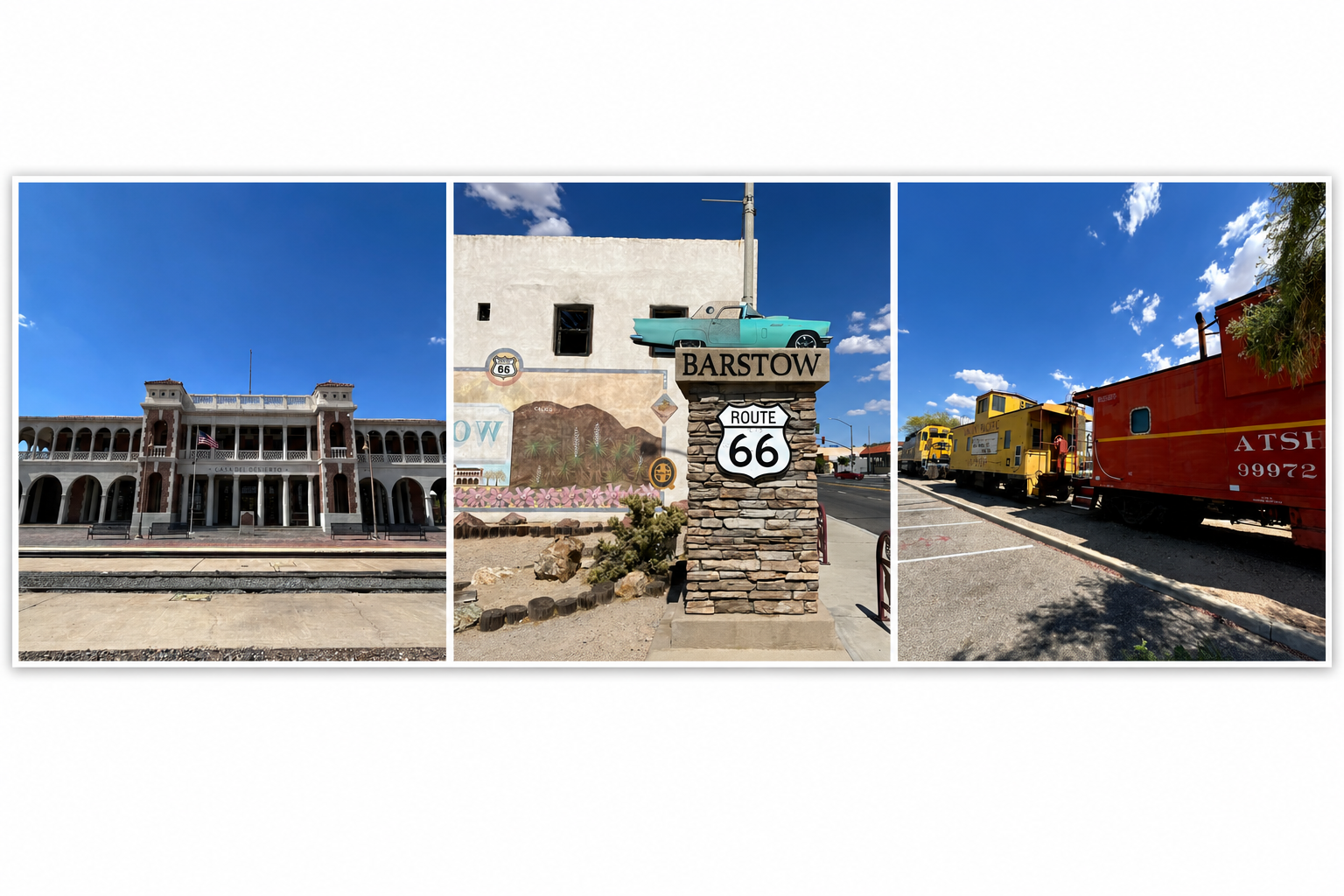
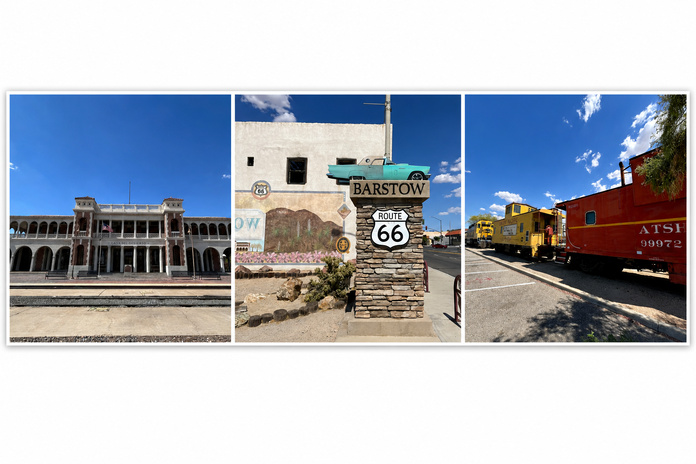
Barstow (25 000 inhabitants) developed from 1860, after the discovery of silver mines : new rail lines had to be built to move the ore through the arid Mojave Desert.
At the time, steam locomotives needed coal but also enormous amounts of water. In Barstow there was water: rail convoys would stock up there and the railway workers would eat and sleep there.
Even if, thanks to its two classification yards, this town remains an important rail hub, that era is no more.
Nevertheless, the vast double-gallery buildings with colonnades of the old station named “Harvey House Casa del Desierto” still look fine.
Néanmoins, ses salles de restaurant ont été reconverties en salles de réception. Son pittoresque Musée de la Route 66 a rouvert voici peu grâce à de nouveaux volontaires, et son Western America Railroad Museum s’efforce de valoriser sa collection d’anciens wagons exposés en plein air.
At the time, steam locomotives needed coal but also enormous amounts of water. In Barstow there was water: rail convoys would stock up there and the railway workers would eat and sleep there.
Even if, thanks to its two classification yards, this town remains an important rail hub, that era is no more.
Nevertheless, the vast double-gallery buildings with colonnades of the old station named “Harvey House Casa del Desierto” still look fine.
Néanmoins, ses salles de restaurant ont été reconverties en salles de réception. Son pittoresque Musée de la Route 66 a rouvert voici peu grâce à de nouveaux volontaires, et son Western America Railroad Museum s’efforce de valoriser sa collection d’anciens wagons exposés en plein air.
Calico, “Ghost Town”
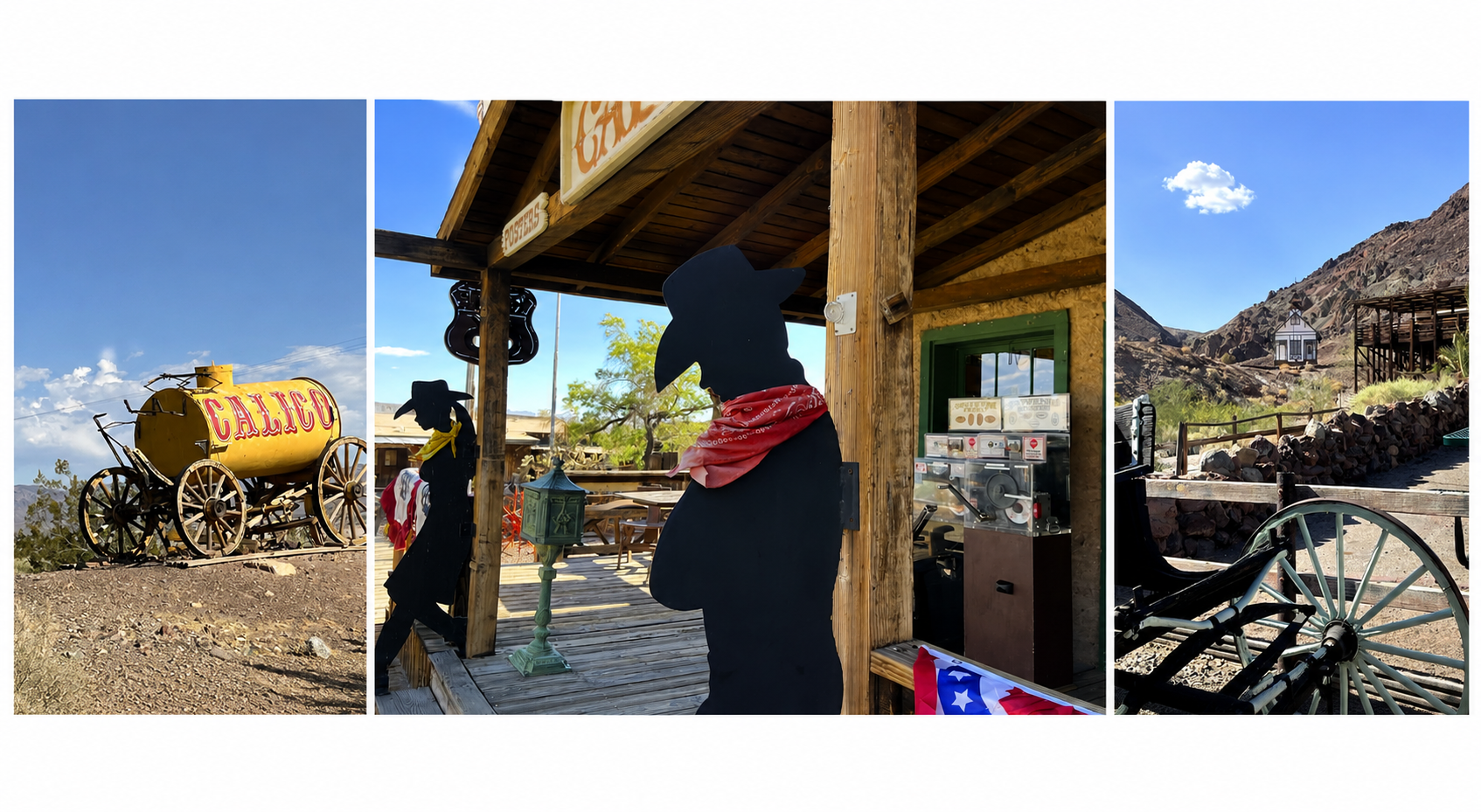
To relive the saga of the American West, nothing beats taking a detour through the arid landscapes where Calico lies hidden.
Founded in 1881, this small town reached its peak (with 3,500 inhabitants) at the end of the 19th century thanks to its silver mines. Alas, when the price of this metal collapsed, its mines declined. Calico was abandoned in 1907.
Re-purchased in the 1950s and restored by Walter Knott, this “Ghost Town” has become a paid tourist attraction (entrance: $8).
With its wooden houses, its church, its school, its hotel, its saloon, its blacksmith, its sheriff and judge, its prison, its coffin maker, one almost feels in a genuine Far West village.
Calico also hosts many souvenir shops, restaurants, cafes, a museum, a small tourist train and offers visits to Maggie Mine, gold-panning demonstrations and even Western shows with… shootouts. Folkloric? Exaggerated? Perhaps, but one gets drawn into the game…
Founded in 1881, this small town reached its peak (with 3,500 inhabitants) at the end of the 19th century thanks to its silver mines. Alas, when the price of this metal collapsed, its mines declined. Calico was abandoned in 1907.
Re-purchased in the 1950s and restored by Walter Knott, this “Ghost Town” has become a paid tourist attraction (entrance: $8).
With its wooden houses, its church, its school, its hotel, its saloon, its blacksmith, its sheriff and judge, its prison, its coffin maker, one almost feels in a genuine Far West village.
Calico also hosts many souvenir shops, restaurants, cafes, a museum, a small tourist train and offers visits to Maggie Mine, gold-panning demonstrations and even Western shows with… shootouts. Folkloric? Exaggerated? Perhaps, but one gets drawn into the game…
Vintage gas stations and motels
Bagdad Café, a myth
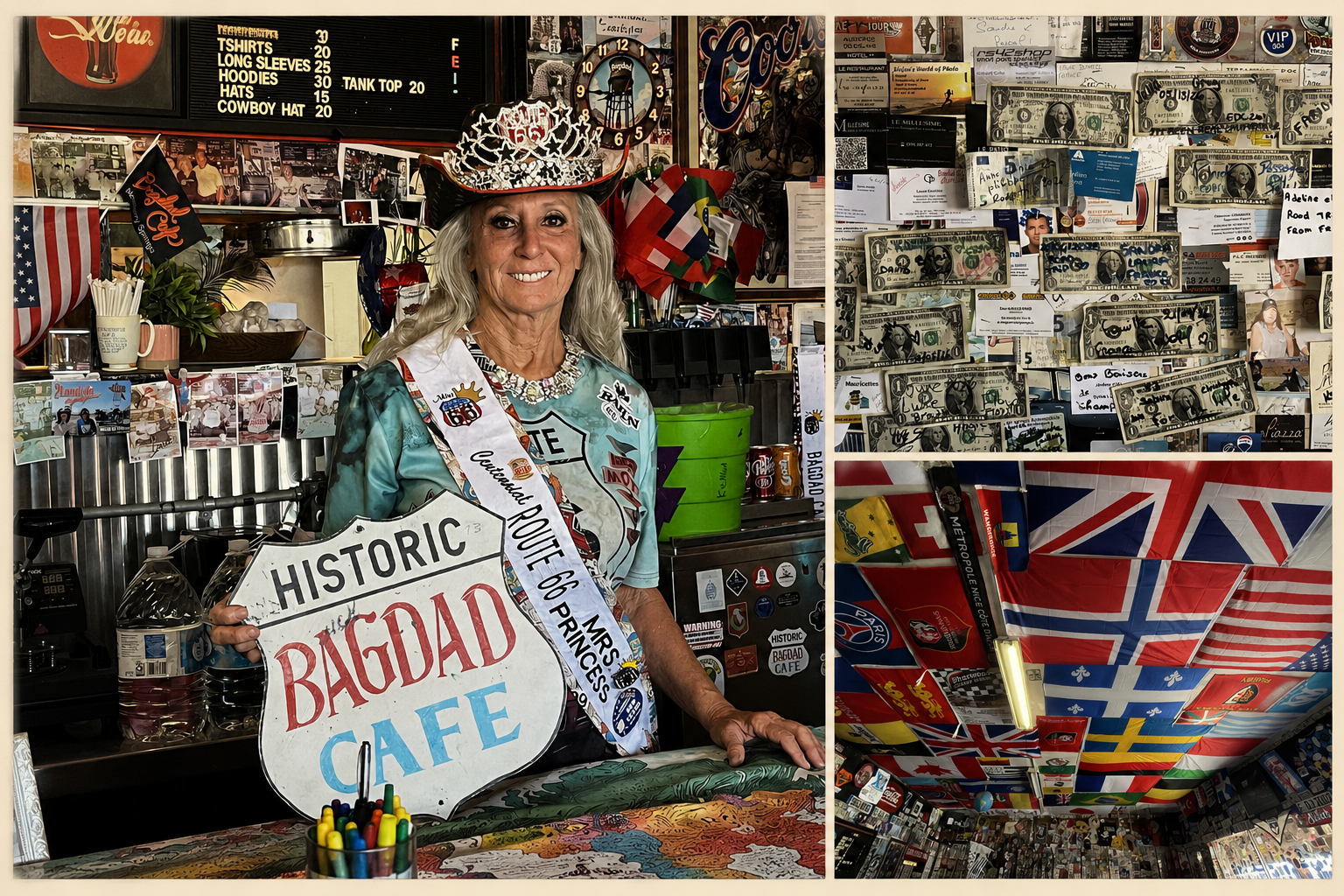
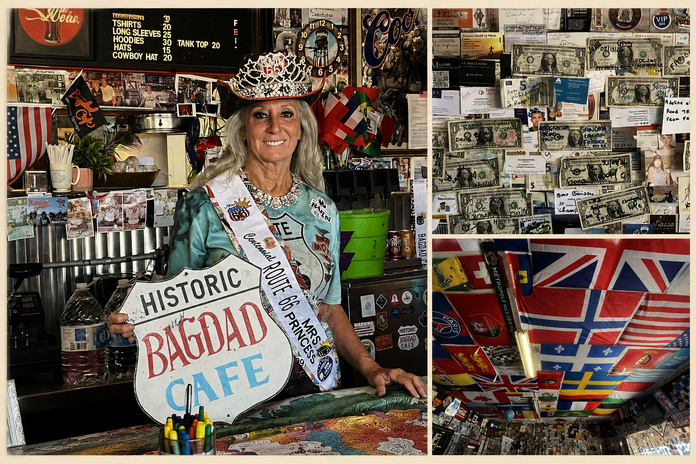
The most striking encounter on the California section of Route 66 remains Bagdad Café. Truly, a genuine myth, not just a café.
This somewhat dilapidated motel sits in Newsberry Springs, still in the Mojave Desert: it is where Percy Arlon’s film, awarded in 1989 with a César for Best Foreign Film, was shot.
As soon as you step inside, the film’s atmosphere — it tells the unlikely friendship between the café’s owner, jaded by life’s rough edges, and a German tourist who has lost everything — grips you again.
Bagdad Café offers ice cream, burgers, fries, sandwiches and souvenirs. It is also a place of pilgrimage with an unparalleled atmosphere. From floor to ceiling and across the walls, the room is filled with flags from around the world, one-dollar bills signed by visitors, police patches, postcards, stickers, and sweet notes…
On the wall, a poster “Make Bagdad Great Again” even invites visitors to contribute funds to save this place.
Andrée Pruett, the historic owner, died on January 13 of the previous year. Despite rumors of permanent closure, Bagdad Café still survives: an unusual couple seems to have taken over.
He is as taciturn as she is original, with glittering bell-bottoms and a Stetson in American colors topped by a dazzling diadem encrusted with jewels.
She was as welcoming as she was talkative. It was hard to leave. But how can one resist the lure of Route 66?
To be continued: Road Trip in the United States, along Route 66, from Oatman to Scottsdale
This somewhat dilapidated motel sits in Newsberry Springs, still in the Mojave Desert: it is where Percy Arlon’s film, awarded in 1989 with a César for Best Foreign Film, was shot.
As soon as you step inside, the film’s atmosphere — it tells the unlikely friendship between the café’s owner, jaded by life’s rough edges, and a German tourist who has lost everything — grips you again.
Bagdad Café offers ice cream, burgers, fries, sandwiches and souvenirs. It is also a place of pilgrimage with an unparalleled atmosphere. From floor to ceiling and across the walls, the room is filled with flags from around the world, one-dollar bills signed by visitors, police patches, postcards, stickers, and sweet notes…
On the wall, a poster “Make Bagdad Great Again” even invites visitors to contribute funds to save this place.
Andrée Pruett, the historic owner, died on January 13 of the previous year. Despite rumors of permanent closure, Bagdad Café still survives: an unusual couple seems to have taken over.
He is as taciturn as she is original, with glittering bell-bottoms and a Stetson in American colors topped by a dazzling diadem encrusted with jewels.
She was as welcoming as she was talkative. It was hard to leave. But how can one resist the lure of Route 66?
To be continued: Road Trip in the United States, along Route 66, from Oatman to Scottsdale
 Publicado por Paula Boyer Jefe de la sección LuxuryTravelMaG – TourMaG.com
 Voir tous les articles de Paula Boyer


Ajoutez TourMaG à votre flux Google Actualités