Up there, the Sioule is still little more than a slender thread of clear water, bending gently between cow-dotted grasses and the blossoms of spring. In a high-altitude meadow at the foot of the Dore mountains, not far from Servières lake, in austere landscapes dotted with beech forests and moors, one can easily make a path to its source, at 1100 meters above sea level. Or rather its sources, for it is several tiny streams, born of melting snow and precipitation, that eventually join to form this brook with its divine splashing, a place where it feels good to splash your face for a refreshment.
Enchanting landscapes
At barely 30 centimeters wide at this spot, the river already has a determined flow as it begins to rush down the slopes of the volcanoes that will guide it, after 164 kilometers and 900 meters of elevation gain, to its confluence. Along its turbulent course, first in the Puy-de-Dôme, then in the Allier, the Sioule goes on to shape enchanting landscapes. In the first third of its journey, between the basalt flows of the Puys chain, it recalls George Sand’s descriptions in the Lettres d’un voyageur (1837). Traversing the region, the writer marveled at these narrow, tormented valleys where the swift waters seem to have carved a path through the cooled lava. Further on, she approaches the Combrailles, where its taut waters wind into mineral ravines bordered by thorns, alders, ashes, and poplars. Then, in its lower bed, the Sioule valley meanders between hills and fields of the Limagne, brushing the vineyards of Saint-Pourçain.
“C’est une belle rivière, bien protégée, très naturelle et réellement sauvage”,
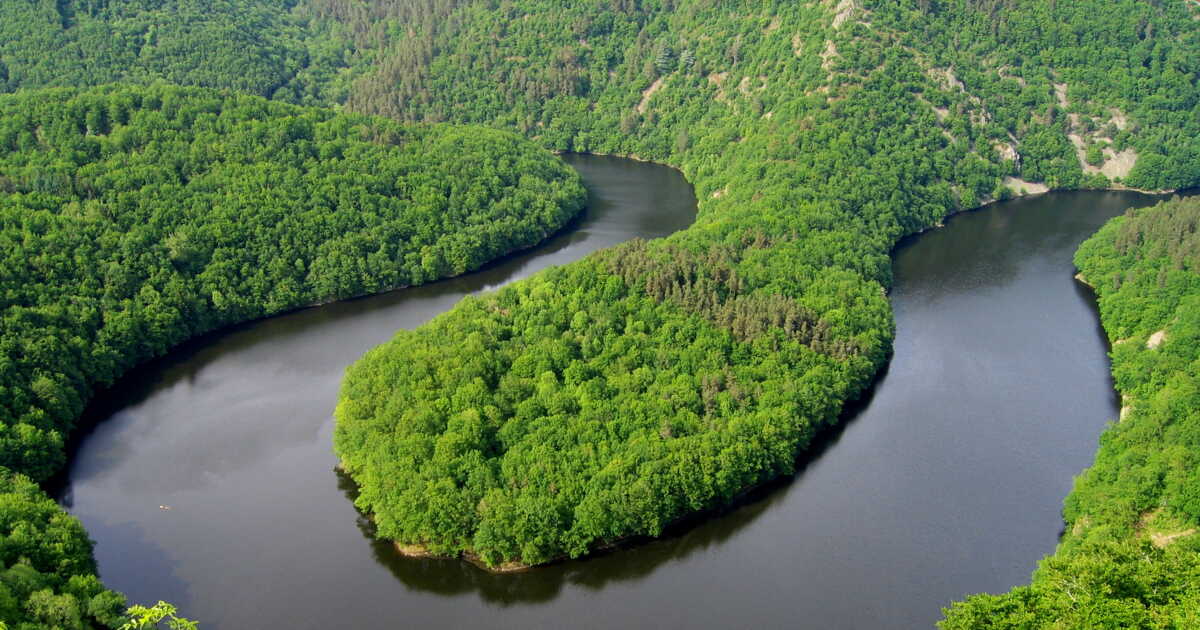
summarizes Frédéric Martin, 55, who rents out canoes in the summer at Ébreuil, downstream of the Sioule gorges. Those gorges, about fifty kilometers long, offer the river a frame of enclosed valleys and rocky canyons. In their middle section, the Queuille meander forms a striking looping bend in the heart of the hills. From the belvedere, charmingly nicknamed the “Paradise,” one can glimpse herons along the water and bustards flying below.
Otters and salmon
For paddling enthusiasts, a popular stretch starts from Menat, known for its medieval Romanesque bridge crowned with a cross, the oldest crossing point from one bank to the other of the Sioule. Frédéric, the canoe rental operator, enjoys taking the rapid sections that follow, full of thrills. From the viewpoints along the gorges, walkers admire the sheer cliffs, sandy beaches, and the reflections of this pure, nourishing water—the discreet presence of otters bears witness to it. “The river is classified in the first category for the quality of its waters,” proudly insists Éric Fleury, 66, who has run the Hôtel-Restaurant des Gorges de Chouvigny since 1979 and loves taking a dip in the icy current as soon as late spring arrives. Moreover, the French fly-fishing championships were held this year in the upper Sioule.
Salmon and minerals
Brown trout abound, as do loaches, gudgeons, roaches, dace, and bleak… And a few salmon still come to spawn here each year, after having moved up the Loire and the Allier from the Atlantic Ocean. In 2024, only 22 were counted, compared with 200 in 2012… “In a book by the local scholar Léon de Rechapt, one reads that salmon were so numerous in the 14th century that future husbands signed a marriage contract promising not to let their wives eat more than twice a week,” recounts Jean-Christophe Thenot, animator at the Wolframines museum in Échassières, dedicated to mining history and local geology. A fount of memory about the Sioule, the 56-year-old offers every summer to introduce visitors to panning, rubber boots on their feet. No intention of hunting for gold. With him, parents and children learn the basics of this ancient technique to discover very fine minerals. Placed under a microscope, hematites, garnets, and cassiterites reveal the river’s geological history. “The valley’s very particular landscapes were formed by the work of erosion, at the same time as the river’s progressive incision into its course,” he explains.
These places have also welcomed a few celebrities. In the Chouvigny gorges, the Sioule is crowned by a 13th-century castle perched atop a rocky spur. It was, among other owners, the property of the La Fayette family, and it is whispered that during the long winter evenings Madame de La Fayette conceived La Princesse de Clèves there in 1678.
Hills with a Tuscan air
Still little known to tourists, the Sioule valley nonetheless offers spectacular viewpoints. Until the mid-19th century, the river was a major artery for the region’s economic activity. About 700 mills there ground hemp, produced flour, and provided energy for mining activity. There were rafts, the only means of crossing from one bank to the other, “forbidden at night except for authorities and clergy”, as the regulation stated. The Sioule served as an administrative border between provinces subjected to the gabelle and the “pays remitted” that escaped it. At the crossroads of Occitan and Oïl languages, it was a nerve center between the North and the South of France.
Leaving the gorges, the river, still crystal-clear, calms and broadens. It flows beneath the Rouzat and Neuvial viaducts, built in 1869 by the Gustave Eiffel company. Then it settles between hills with a Tuscany-like air, punctuated by farms and copses. In Jenzat, it skirts the Saint-Martin church, one of the 25 painted churches of Bourbonnais. Inside, the Romanesque building has preserved its 15th-century frescoes. Next come the Saint-Pourçain vineyards, renowned for their fresh, lively white wines, drawn from Chardonnay and the local grape variety, tressallier. Finally, five kilometers downstream, the wild beauty reaches the Sioule’s “beak,” as locals call the confluence. Before continuing its enchanted course, now in the arms of the Allier…
Did you know?
Stone houses carved in stone, half-timbered façades: Charroux is a jewel of the Sioule Valley, classified among the Most Beautiful Villages of France. Known in the 19th century for its mustard, this craft disappeared in the 1950s. In 1989, a couple, Claude and Simone Maenner, revived it, according to the old know-how. The mustard seeds ground on a mill are mixed with verjus and Saint-Pourçain white wine, giving the whole its distinctive taste. Delicious with roupettes and rooster combs, a local specialty!
➤ Article published in GEO magazine no. 569, “Recharging in Auvergne,” July 2026.
➤ Do you love GEO? Then to miss nothing, discover our subscription plans to receive GEO at your home every month with ease.