Summary
-
Shirtless and Pantless
-
A Common and Amusing Bird
-
Charity Well-Ordered…
-
Ah, the Little White Wine!
-
Infinity, and Beyond
“Clack, clack, clack!”: my wooden clogs hammer the pavement. Half an hour ago, I wore a hoodie and sneakers. Now I am dressed as a pilgrim, head to toe: linen cap, braies, boots, and these odd wooden sandals, which in the Middle Ages were slipped over shoes to protect them from cold and damp… But whose sole function at the moment, as dawn barely breaks over Aumont-Aubrac, appears to be to disturb the quiet of the small fog-wreathed town.
Shirtless, Pantless
It is here, in Lozère, in the former province of Gévaudan, that my adventure begins: a 270-kilometer trek in the skin of Guillaume Coutel, a fictional yet historically plausible character I invented for the occasion. The aim of the experience is neither playful nor folkloric: by donning the XIIIth-century pilgrim’s garb, I seek to understand history through action. To feel also what it meant to walk, at a time when the main means of locomotion was… the feet! I have pushed the sense of detail to the extreme. Take my wool cloak. This medieval mantle varied in length according to social status: to the waist for the humble, to the ankles for the wealthy. For my character, a well-off cutler by trade, I chose a flattering mid-calf length. First surprise: in the deserts of the Aubrac, where I now roam above 1000m in altitude, I love moving about in a robe! A light wind blowing between my stockings makes me feel far warmer than in pants!
A Common and Amusing Bird
Late November, days are short. On these barren expanses, I would have loved to glimpse the starry sky. But for the medieval traveler, scared by the night shadows, that was out of the question. It was imperative to reach his stage before sunset. So I quicken my pace to reach the communal bread oven that will serve as my lodging. These bread ovens, once provided to inhabitants by local lords, are increasingly rare in rural scenery. Happily, the one at Rieutort d’Aubrac is large enough to shelter my first night. In the dim light, I strike a spark with a simple iron loop rubbed on flint, and warm my dinner: chard with bacon. My bag could never have contained the impressive assortment of verrines that make up my meals. Lentils, chickpeas, root vegetables… – all that Europe ate before the discovery of the Americas – are transported in a motorhome, which handles the logistics and carries the film crew following me in my adventure. My only concession to modernity…
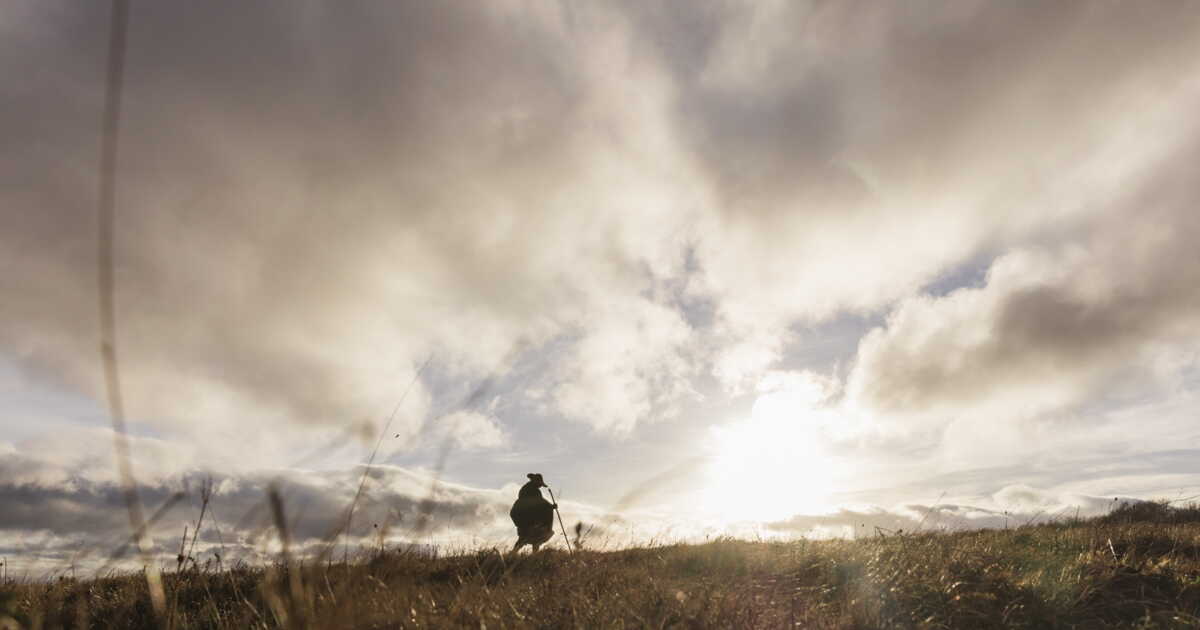
But good luck finding inns open along the route today that serve meals as they did in the era. I lift my head from the oven a little before six. A squall immediately snatches my hat away. Facing winds now flirting with 80 km/h, my medieval layers no longer suffice. I am chilled to the bone. I press on across the Aubrac plateau, these desolate expanses that a certain Adalard, a twelfth-century Flemish noble pilgrim to Saint James, described as “loco horroris et vastae solitudinis” (“a place of horror and vast solitude”). “Hey you there! Come drink a glass!”, calls out the owner of the Nasbinals bar-restaurant (570 residents). He probably aims to entertain the crowd with the odd traveler passing through. But I do not play along. I abandon the idea of warming up and press on, depriving him of the chance to brighten his customers.
Charity Well-Ordered…
After the wind on the plateau, the humidity of the gorges. Less than a week into my walk and my clogs are already in poor shape. I patch them up as best as I can with rope and scraps of wood. Without their aid, my leather soles will not endure the impact. A thick fog, almost tangible, lingers around me. Deep in the gorges, on the eastern slope of the Tarn, the sun disappears for four months. The river sighs in the icy air. Along the gloomy banks where the birds have fallen silent, and where dead wood rolls along the dark waters, I feel strangely happy. I feel Guillaume Coutel for real, but also a bit like Aragorn, the melancholic hero of The Lord of the Rings. Since I began embodying my character, I have roamed through all the region’s churches, chapels, and heritage buildings to spend the night. In the Middle Ages, Christian charity required that the pilgrim, a living representation of Christ, be hosted free of charge in these sacred places. I have not yet experienced charity in its secular form. Tonight, in La Croze, a tiny village on the Tarn downstream from La Malène, I am hosted by a local resident. Different times, different customs: I had to call ahead for Yves de Laromiguière’s family, the hamlet’s owner, to grant me hospitality. I knock my staff against the door, I am greeted with a smile and a crackling fire. In the 13th century, when lodging was too humble, it was not uncommon for the traveler to share his hosts’ bed, beside the husband and wife. This forced closeness was, in fact, one of the spiritual dangers that haunted the pilgrim. I promise my reader that that night, no such threat disturbed my sleep!
Ah, the Little White Wine!
After ten days of “dry” grooming using a simple cloth and brushing my teeth with charcoal and white clay, I finally reach Cévennes country. I confidently approach the Col de la Pierre Plantée, south of the Margeride massif: 450 meters of elevation gain, in a landscape of barren moorland. Reaching the summit, I take a long gulp. And suddenly, I hear myself laughing heartily. As was the custom in the Middle Ages, I drink not water but diluted white wine. Every day I gulp down about three liters of this five-degree alcoholic beverage without trouble. Today, evidently, I am tipsy. Did my 13th-century counterparts take advantage of this light inebriation to forget their fears? At the time, the specter of death was so present that before every departure the pilgrim drafted his will. Among the scariest things were drowning, highway robbers, and the wolf pack. “Alas,” I swim like a fish; the brigands have deserted the fields and the wolves now fear humans. I will still have my face-to-face with wild beasts. They were two wolves pouncing on me south of L’Espérou, near Mont Aigoual. I could see another function of my walking stick: with the great steel tip, I targeted the most aggressive one, which let out a vivid “kaï!” before dashing away. Let’s be honest, my wolves were really two oddly quarrelsome dogs. Thanks to these two mastiffs for letting me touch the ancient fear of men.
Infinity, and Beyond
The pilgrimage is drawing to a close. Saint-Guilhem-le-Désert is less than 5 km away. In an hour, I will enter the Abbey of Gellone, the destination of the journey for my alias, to whom I had fixed this pilgrimage. Around me, the landscape has radically changed: Lozère’s granite has given way to limestone rocks edged with rockroses and junipers. Winter seems to have no hold on this landscape of garrigue. As I pass, I crush bunches of dried lavender. Guillaume would have liked these new scents. At Cape Ginestet, where I stand, he would have covered 270 km since his Lozère homeland. While the vast majority of men of his era did not push beyond 30 km at a time. At the exit of a switchback, I glimpse the sparkle of a diamond: the Mediterranean! In the 13th century, Bishop Jacques de Vitry complained about pilgrims who strayed from the road, not out of devotion but out of a desire to go elsewhere. And if my alter ego from 750 years ago had joined in the game? If he had pushed his path to the ocean’s edge? Perhaps then, leaving behind his status as a cutler and his pilgrim garb, Guillaume would have joined, like me, the noble line of adventurers.
“The Traveler of History”
The Traveler of History, a 52-minute documentary drawn from this extraordinary adventure, will be the subject, in 2026, of several screenings in the company of the adventurer. For more information, visit azimutetcie.fr/le-voyageur-de-l-histoire
➤ Article published in GEO HS magazine no. 133, “France, our preferred walks for the summer,” June-July 2026.
➤ Do you love GEO? Then, to make sure you don’t miss anything, discover our subscription plans to receive GEO at home every month with ease.