Summary
-
Ithaca, Sicily’s jewel on the screen
-
Bringing Troy to life in Morocco
-
The encounter with the Cyclops and the underworld, a journey to the edge of the world
-
Odysseus on the seas of the world
With The Odyssey, his 13th feature film, Christopher Nolan offers an ambitious reimagining of the famous Homeric poem. The American director signs an epic that is as intimate as it is spectacular, where the viewer walks in Odysseus’ footsteps. He does not merely watch him face the Cyclops: he stands beside him in the cave. He trembles with him before a devastated Troy, shares his torments on Calypso’s island. An extraordinary immersion that also owes much to breathtaking sets. Christopher Nolan and production designer Ruth De Jong, nominated for an Oscar for Oppenheimer, the director’s previous film, roamed the world to find unique locations that allowed them to bring Odysseus’ adventures to life.
“We knew that our story began and ended in a Mediterranean region, but to visually render on screen the regions traversed by the hero from the beginning to the end of the tale we needed landscapes with contrasting features and extreme weather conditions: raging seas, strong winds, torrential rain, and snow. We needed a cocktail of all this to give the film an incomparable force, as if we were addressing the very first readers of Homer,” explains Christopher Nolan in the film’s press kit. So the British director did not limit himself to Italy and Greece; he also shot in Morocco, Iceland, Scotland, and also in the United States, where a vast set was built in a Los Angeles studio.
The Beautiful Ithaca, Sicily’s Jewel on Screen
Odysseus, king of Ithaca, leaves his wife Penelope and his son Telemachus to join the expedition led by Agamemnon in the name of his brother Menelaus, whose wife has been abducted by Paris, one of Troy’s princes. It is on Favignana Island, the largest of the Egades archipelago, a few kilometers from Sicily, that most of the scenes set in Ithaca were filmed. The island holds a true treasure, Castello di Santa Caterina, a 15th‑century castle perched atop Mount Santa Caterina, where Christopher Nolan was granted permission to place his cameras by the Italian Ministry of Culture.
A true logistical headache for the filming crew, who did not obtain permission to build a road access. A cable car, installed for the occasion, and helicopters allowed the equipment to reach the castle. As for the crew, actors and technicians, they made this exhausting daily trek on foot.
Other sets were built nearby, including the city of Ithaca, the pigsty and the dwelling of Eumaeus, Odysseus’ faithful companion. Yet the production had to move to Los Angeles, in a studio, to shoot the interiors of the palace, notably the confrontations with Penelope’s suitors.
Bringing Troy to Life in Morocco
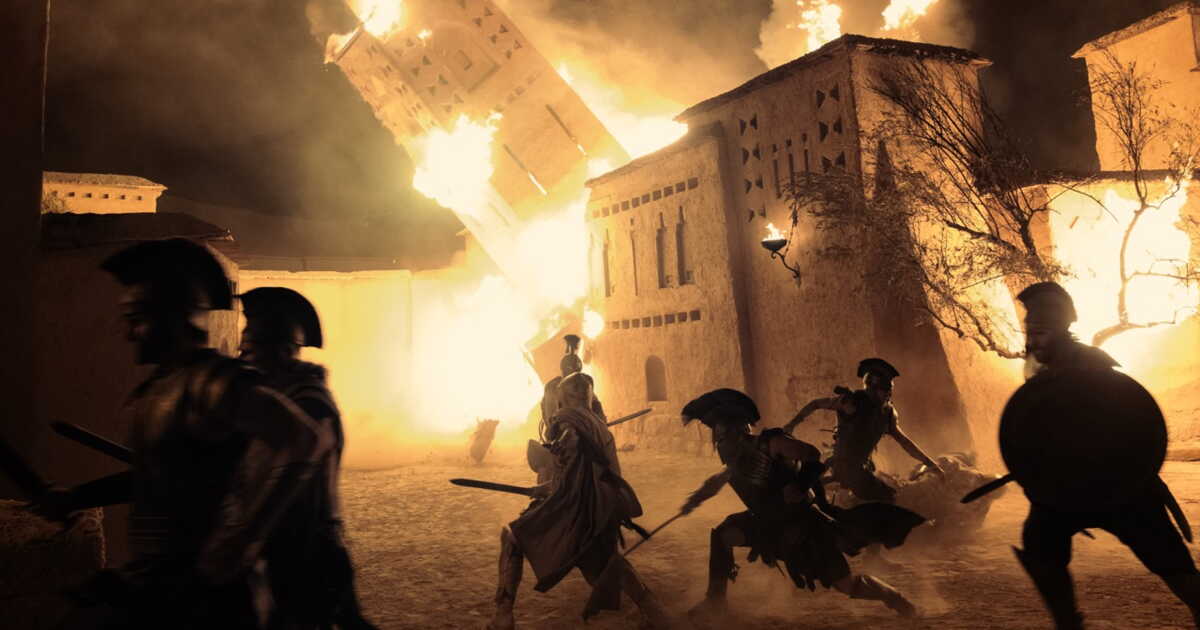
In Homer’s telling, Troy is “holy Ilion,” a city “with broad streets,” protected by tall and impregnable walls. Each reader projects their own vision of Troy. A city that resists but finally succumbs after 10 years of siege and a ruse that remained mythical. To depict Troy, the Odyssey crew settled in Aït Benhaddou, a Moroccan village in the Ouarzazate province that had already embodied Zucchabar in Gladiator or the city of Yunkai in Game of Thrones.
It was here that an immense set of more than 10,000 m2 was built, consisting of more than 60 structures. True to his habits, Nolan avoided relying on visual effects to enlarge the set in postproduction. Thus the Temple of Athena, over 11 meters tall and 26 meters deep, and the wide staircase leading to Troy’s central square were built from scratch.
A second major challenge awaited the crew: to depict the legendary Trojan Horse, usually shown on wheels. Nolan insisted on making Odysseus’ ruse even smarter. So, when the horse first appears on screen, it is half-buried in the sand, as if cast ashore by Poseidon. That beach is Essaouira, in Morocco.
The Encounter with the Cyclops and the Underworld, a Journey to the Edges of the World
To capture the essence of the underworld—a desolate realm where light bears no resemblance to any other—Nolan drew on a natural marvel: Iceland’s midnight sun. Far from Ithaca, Odysseus wrestles with wind and rain, but above all with Hades and a figure, whose name we will keep secret, who confronts him with his terrible mistakes.
Another legendary confrontation, the one between Odysseus and his companions against the Cyclops. It is in Greece that the director set his cameras this time, in the Cave of Nestor, located in the Peloponnese. An exceptional natural set by its dimensions (20 meters long by 16 meters wide, topped by a vault rising 30 meters) which also has the particularity of being linked to several Greek myths. Indeed, in this cave the god Hermes is said to have hidden the fifty oxen stolen from his brother Apollo.
The Enchanting Calypso
During his voyage, Odysseus becomes waylaid and lands on the island of Ogygia, where lives the alluring and dangerous Calypso. The nymph keeps him captive for seven years, promising immortality… if he forgets his homeland and his family. It is the famous white dune of Dakhla, located on the Moroccan coast, that served as the setting for the scenes between Odysseus and Calypso. With its immaculate sand and turquoise waters, this landscape, both fascinating and unsettling, perfectly illustrates Calypso’s ambiguous refuge.
Odysseus on the Seas of the World
During the ten years of his turbulent voyage back to Ithaca, Odysseus does not merely face the Cyclops or confront the witch Circe; these astonishing scenes were filmed in Scotland, between Culbin Forest and the cliffs of Findlater Castle, battling giants and resisting the siren songs. The bulk of his journey actually unfolds on the seas. It is a Norwegian ship, the Draken, built using ancient techniques, that embodied Odysseus’ vessel.
The nautical scenes were shot at sea in most of the countries traversed, including Morocco, Italy, Greece, Iceland, and Scotland. The actors, who learned to row and navigate, faced extraordinary weather conditions. “As spectators, we ourselves witness the trials faced by Odysseus’ men, and we empathize with them. The harsh reality of their journey is a vital element of the story, and the dedication of these remarkable actors was crucial to making these sequences convincing”, notes Christopher Nolan. Mission accomplished.