

Arriving in Belfast, you quickly encounter one of the world’s most significant urban maritime renewal projects.
Almost thirty years after the Troubles ended, which had left Belfast and Northern Ireland scarred, the Titanic Quarter evokes the city’s maritime heritage and now stands as the driving force behind its revival.
There, in a neighborhood once on the city’s edge, the XIXth-century extraordinary industrial expansion of Belfast unfolded.
Today residents take pride in showcasing the rehabilitation of the industrial riverbanks along the Lagan, a flagship project of present-day Belfast, illustrating a city looking to the future without forgetting its past.
Belfast Harbour Marina and the Maritime Mile Walk
It is easily reachable on foot from the old town centre, via the modern footbridge that crosses the Lagan.
It leads to the Belfast Harbour Marina and the Maritime Mile pedestrian route, bordered by a new shopping and leisure complex and The Arena Belfast.
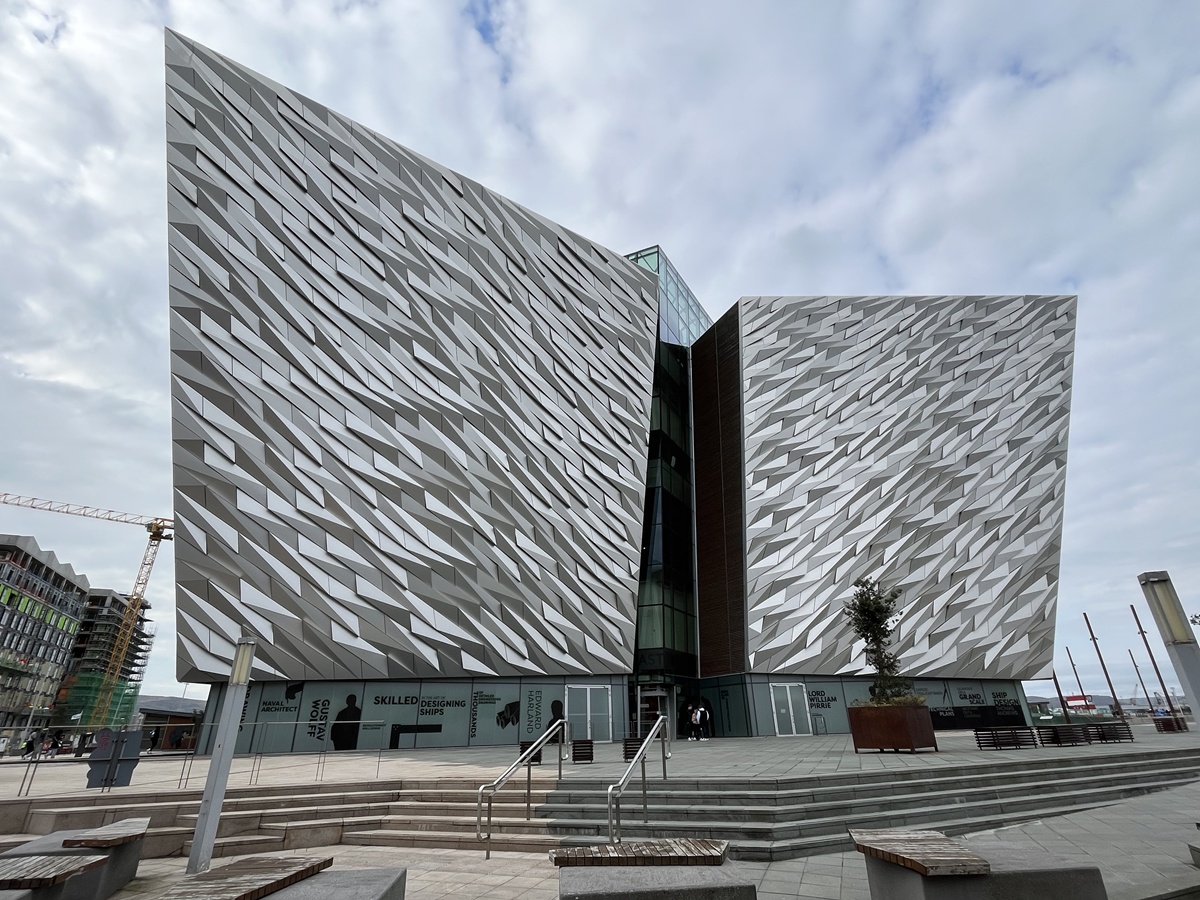
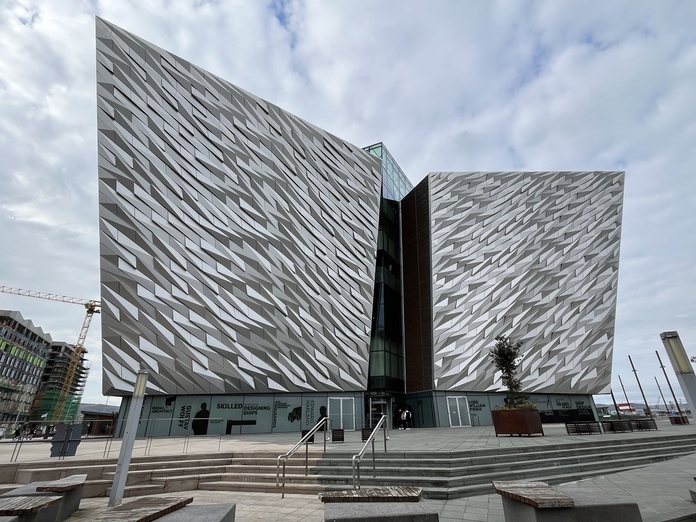
The district’s emblematic building is the Titanic Belfast museum. Opened in 2012 to mark the centenary of the legendary liner, it is today the most visited site in Northern Ireland.
The façade evokes the bow of a ship, while the corrugated aluminium walls, the same height as the Titanic’s hull (38 m), recall waves and ice.
The museum explores the history of shipbuilding and traces the story of the Titanic, from its construction to the disaster, including life aboard.
Expanded in 2023, the tour is modern and immersive: a dockyard tour in a crane cabin, recreations of Belle Époque cabins, holograms, computer-generated imagery and atmospheric soundscapes.
Four recent galleries plunge the visitor into the sequence of events that led to the catastrophe, recall the submarine investigations prior to the wreck’s discovery in 1985, and even discuss the Titanic’s influence on cinema, theatre and literature.
Also read: Northern Ireland: 9 good reasons to visit Derry-Londonderry
Harland and Wolff Cranes
A few steps from the museum, the SS Nomadic is the last remaining vessel from White Star Line, Titanic’s shipping company.
This tender was used to ferry passengers from Cherbourg’s quays to the transatlantic liners. It was later operated as a minesweeper and troop transport during the two world wars, before becoming a restaurant. Its early 20th-century interiors have been fully restored: a real trip back in time.
Around Titanic Belfast and the SS Nomadic lie the remains of the shipyards.
The sky above the docks is streaked with the cranes of Harland and Wolff. Builder of the Titanic, this shipyard was the world’s largest at the start of the 20th century. The two yellow gantry cranes of one of these structures are known here as Samson and Goliath.
A little further along the Lagan’s banks, the Pump House (pumping station) houses the machinery to fill the dock with water. It is occupied by Titanic Distillers, a whiskey workshop whose visit reveals the original fusion between industrial heritage and distillation equipment.
Nearby lies the world’s largest dry dock: it is here that the Titanic and its sister ships were assembled.
This post-industrial panorama is completed by office buildings, HBO Studios, and housing, including a vast residential complex.
Thirty minutes on foot from the Titanic Museum, visitors interested in urban vibes will head to Banana Block. This creative space in the Portview district, a hub for cultural experimentation, hosts exhibitions and artistic and musical events.
Also read: In the footsteps of Saint Patrick, in Northern Ireland
Practical Information
Getting there : direct flights from Paris with easyJet. Seasonal flights from several regional cities (Lyon, Bordeaux, Nice).
Where to stay and eat : Malmaison Hotel – Housed in a former Victorian grain warehouse, there lies an elegant boutique hotel offering all modern comforts. On-site brasserie and pub.
Where to stay and eat : Malmaison Hotel – Housed in a former Victorian grain warehouse, there lies an elegant boutique hotel offering all modern comforts. On-site brasserie and pub.