

Même si quelques limites sont apparues ces derniers jours.
En raison de la canicule, le matériel et le réseau ont été soumis à rude épreuve, entraînant, sur la seule journée de mercredi, près de 1 000 annulations de trains sur les 15 000 en circulation.
Les raisons sont multiples. Les rames ne sont pas conçues pour résister à des températures avoisinant les 40 degrés. Une fois cette zone rouge atteinte, la climatisation ne refroidit plus suffisamment, quand elle ne se coupe pas complètement dans les voitures Corail ou certains TER.
De plus, les rails subissent des températures proches de 60 degrés, provoquant des risques de dilatation, tandis que les caténaires peuvent également céder.
Le train est le moyen de transport d’aujourd’hui, mais il va devoir s’adapter au climat de demain, afin de ne pas faire gratuitement de la publicité à l’aérien.
D’autant que le ferroviaire ne cesse de gagner des parts de marché depuis la crise sanitaire, à tel point que, selon l’Autorité de régulation des transports (ART), il est désormais temps d’augmenter l’offre pour répondre à la demande !
The train advances at full speed in the travel habits of the French
To begin with, the train is in vogue and public transport is showing record ridership, surpassing pre-pandemic levels.
This helps reduce greenhouse gas emissions from transport. According to ART’s calculations, they dropped by 1.2% in 2024, even as travel increased by 1%.
Since 2019, the cumulative reduction in GHG emissions stands at 7.4%. That’s the good news of the week!
This decline is not explained only by airlines’ efforts, but above all by a modal shift in favor of rail.
Trains now account for 10.9% of trips in France. And it’s not so much that the supply has increased in recent years as the ridership of the trains.
Last year, according to the latest ART data, TGV ridership rose by 4%, while improvements continued for other train categories.
The occupancy rate on high-speed lines is approaching 80%, i.e. “an unusually high fill rate“, according to the Authority, even if it is lower than low-cost air travel (85%), but 1% higher than its conventional version.
These good figures are explained, on the one hand, by rising demand and, on the other, by a 10% reduction in frequencies compared to 2019 due to a lack of available rolling stock.
A situation that helps improve occupancy and the average ticket, notably thanks to yield management.
TGV: capacity has fallen by 36% in fourteen years!
In the mid-2010s, SNCF decided to get rid of its most bulky trains. Faced with occupancy rates hovering below 60%, the operator chose, for cost reasons, to reduce its TGV supply.
It retired no less than 105 trains out of the 482 it owned at its peak in 2012. By the end of 2023, the decline had reached about 20% in ten years, as Libération recalls.
Unfortunately, the situation has not improved since.
According to the latest count we consulted, the company now has only 307 high-speed trains, a 36% drop in fourteen years!
Sauf qu’entre-temps, le train est redevenu à la mode. -> But in the meantime, trains have returned to fashion.
Les Français veulent faire des efforts pour le climat et la SNCF pour les contribuables. L’offre baisse, la demande augmente, le yield s’affole et les prix grimpent.
-> The French want to reduce their carbon footprint and SNCF wants to protect taxpayers. Supply falls, demand rises, yield soars, and prices climb.
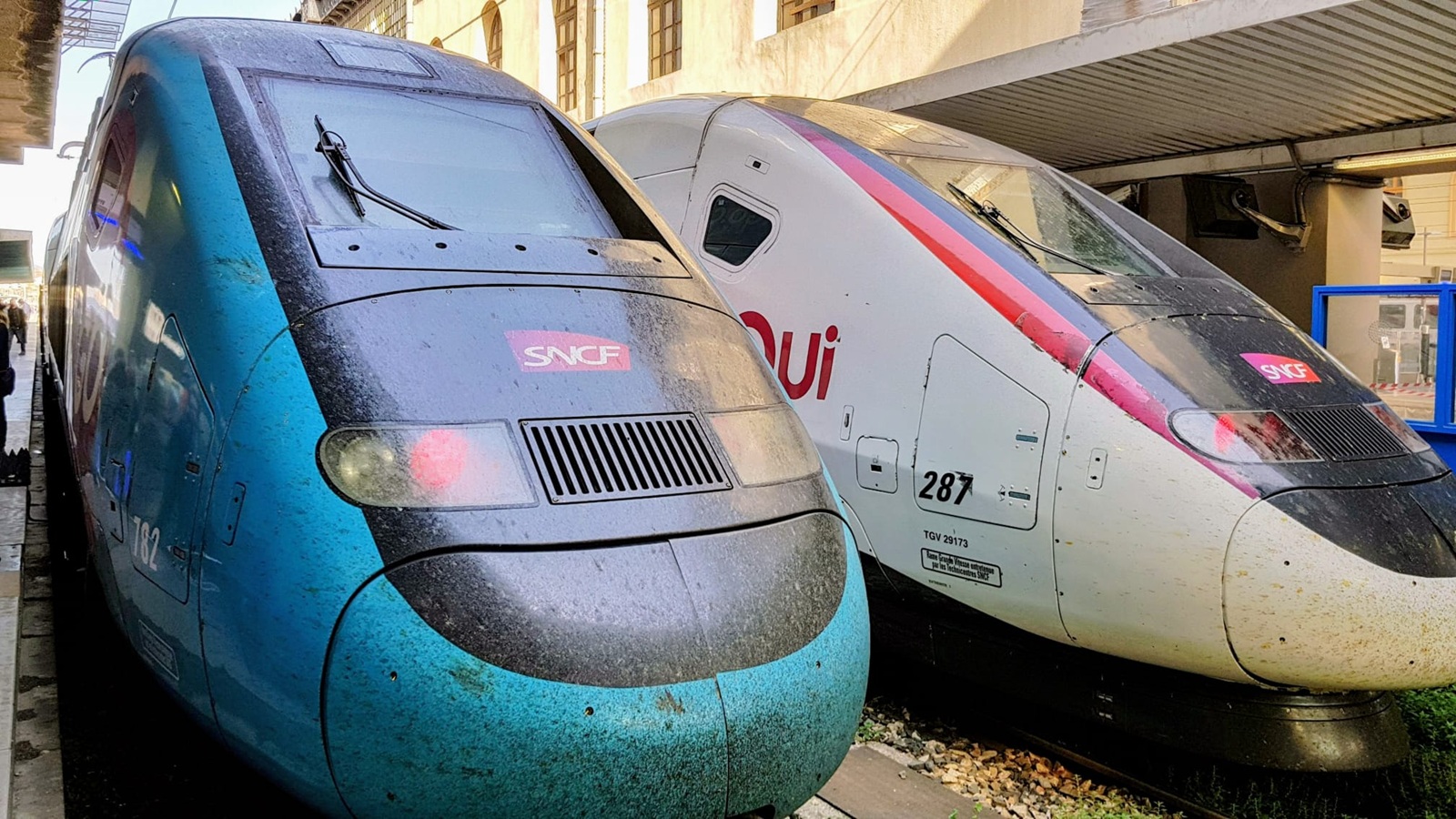
L’opérateur français a bien commandé de nouveaux équipements afin d’accroître ses capacités. Le TGV M devrait entrer en service en septembre 2026, avec deux ans de retard.
-> The French operator has indeed ordered new equipment to boost capacity. The TGV M is expected to enter service in September 2026, two years behind schedule.
À la fin de l’année, treize rames devraient normalement circuler sur les rails. Ce nouveau TGV disposera d’une capacité de 740 places.
-> By year end, thirteen trainsets should normally be in service. This new TGV will have a capacity of 740 seats.
Au total, pas moins de 130 rames ont été commandées. Une quantité qui ne permettra toutefois pas de revenir au pic atteint au début des années 2010.
-> In total, no fewer than 130 trainsets have been ordered. However, this amount will not be enough to return to the peak reached at the start of the 2010s.
Air travel in France: domestic routes collapse…
The offering thus rose by 20% on the Paris-Lyon-Marseille axis, but also by 100% on services to Italy. Not enough to reverse the trend. Moreover, while Trenitalia went all out upon entry and found an audience, the Italian carrier still struggles to truly take off.
Its occupancy rate stands at 45% after five years of existence, according to BFM.
For comparison, this figure must reach 75% for a TGV to be profitable at SNCF. It is therefore natural that Trenitalia’s losses continue to widen.
They were 20 million euros in 2021 and reached 68 million in 2024, even though the carrier benefits from a 16.5% reduction on rail tolls until December 2026.
Read: Trenitalia: why, from 2027, fares could be less attractive?
Beyond this date, Trenitalia will again need to approach ART for a decision on a new pricing scheme, more or less advantageous.
And according to the latest report on the French transport market, published a few days ago, public transport is also benefiting from the weakening of air travel.
The demand for domestic flights has fallen by about 20% since 2019.
The drop nonetheless reached 4.3% in 2024. That dynamic continued in 2025 (-2.6%), even as international routes remained on the rise (+3.6%).
If rail transport is the most used mode in France, for distances beyond 400 kilometers air travel captures 15% of trips and keeps gaining share as distances grow, while rail follows the opposite trajectory.
Between 200 and 600 kilometers, the TGV represents 80% of travelers.
It must be noted that, between the government’s elimination of certain lines and the debate that followed, combined with taxes and a sharp rise in prices, domestic air transport has been particularly unsettled in recent years.
Prices explode!
Since the start of 2026, these same prices have fallen by 3.8%. If we widen the observation window, they have nevertheless risen by 15.1% since 2023.
Read: Train more expensive than flying: “a matter of political will”
Despite this general increase, the price of standard air travel stood at 23 euros per 100 kilometers in 2024, versus 13 euros for low-cost carriers.
These carriers accounted for nearly 70% of domestic flights, while at that time Air France was still based at Orly. Meanwhile, rail remained competitive, provided one considers the air-distance.
In this scenario, the cost per 100 kilometers was €12 for conventional trains and €6.90 for the Ouigo offer.
But trains do not run in a straight line to reach Paris and must sometimes detour around towns, mountains, forests or other natural obstacles. The average price then rises mechanically.
The distance traveled by land transport is generally about 20% longer than by air. The gap reaches as much as 42% for a Paris–Nice route and 35% for a Paris–Toulouse trip by TGV. This makes the train less competitive, still according to ART.
The year 2024 was also marked by a lull, with relatively few cancellations in the French transport sector.
Last-minute cancellations accounted for 0.4% of domestic rail movements. Here is what to take away from this 96-page document.
Rail, once deemed old-fashioned, is back in vogue.
But this enthusiasm might not last, due to an undersupply of capacity, rising tariffs, and equipment that could be strained by climate change.