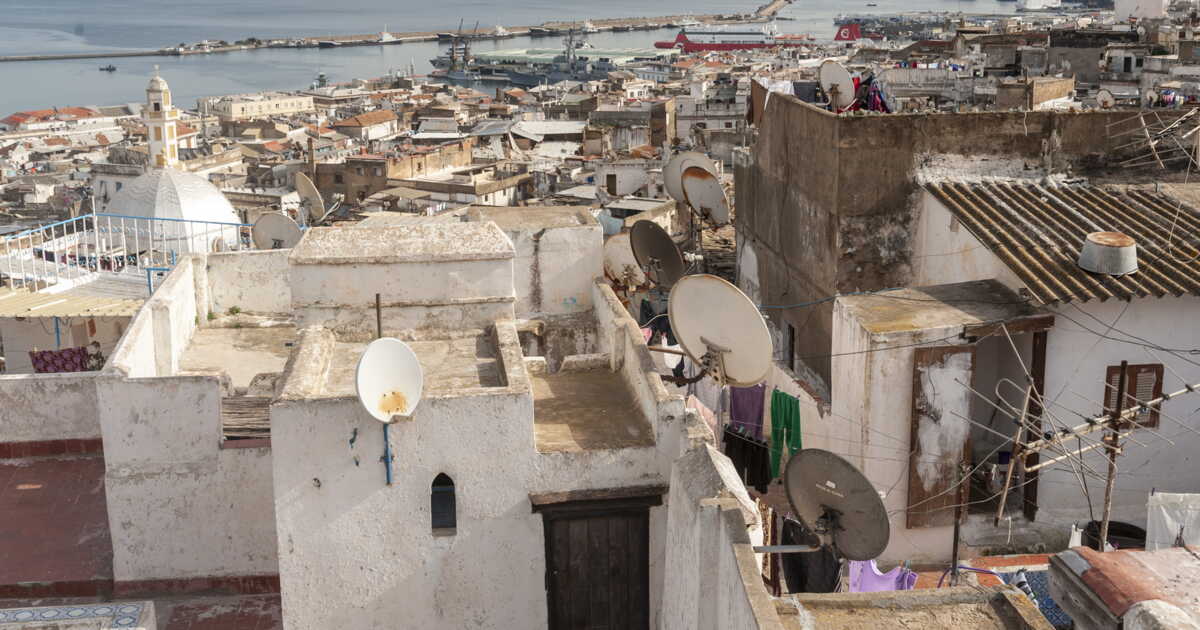
The labyrinth of the old Casbah, the shaded lanes of the Jardin d’essai, the treasures of the Bardo Museum… White Algiers holds surprises in store. Discovering them, one by one, is a journey in its own right.
1. Strolling through the Casbah of Algiers
The Casbah of Algiers, listed as a UNESCO World Heritage site, stands as one of the Maghreb’s most significant historic urban ensembles, noteworthy for its spatial layout as well as its architectural and social value. This ancient quarter, perched on the hillsides above the medina, is characterized by a complex lattice of narrow alleys, vaulted passages, and tucked-away squares, bearing witness to Ottoman urban design and its adaptation to the terrain.
As you wander through the Casbah, you gain a tangible glimpse into Algiers’ Ottoman past, evidenced by traditional wooden-balcony houses, historic mosques such as the Ketchaoua Mosque, and small artisan workshops still in operation, preserving time-honored crafts. This district, though weathered by time, retains a rare urban coherence and offers an immersive experience within a living fabric where every turn reveals another facet of Algerian cultural heritage.
2. Admire the view from the Basilica of Notre-Dame d’Afrique
Overlooking the bay from the heights of Bologhine, the Basilica of Notre-Dame d’Afrique stands as one of Alger’s major architectural and spiritual landmarks, notable for its location and symbolic significance. Dedicated to the Virgin Mary, this basilica built in the 19th century in an eclectic Byzantine-inspired style is distinguished by its dome, its interior mosaics, and its ornate arcades, offering a rare example of Christian religious architecture integrated into the North African Mediterranean landscape.
From its forecourt, the panoramic view over the Bay of Algiers provides a privileged vantage point, reachable along a cliff-side road. The site remains an active place of worship and interfaith dialogue, attracting both worshippers and curious visitors eager to explore Algiers’ religious and historical heritage. It is advisable to check opening hours before a visit, as access is limited to specific times. The Basilica of Notre-Dame d’Afrique thus represents a must-stop to understand Algerian cultural and religious diversity within an exceptional architectural setting.
3. Unwind at the Hamma Botanical Garden
The Hamma Botanical Garden, located in the heart of Algiers, is one of the Mediterranean basin’s most important botanical gardens, renowned for its plant wealth, meticulously designed landscapes, and educational mission. Created in the 19th century, this park of more than 30 hectares is organized into thematic zones — French garden, English garden, rose garden, palm grove — enabling a structured exploration of local and exotic flora.
The shaded avenues, lined with rare species, provide a setting ideal for family strolls, while the rest areas allow for moments of rest in nature within the urban environment. The garden also houses a small zoo, enjoyed by children, enhancing its recreational dimension. Used by both locals and visitors, the Jardin d’Essai plays a central role in showcasing Algerian landscape heritage.
4. Discover the history at the National Public Museum of the Bardo
The National Public Museum of the Bardo, housed in an old Ottoman palace from the 18th century, is an essential stop for anyone wishing to deepen their understanding of Algeria’s ancient history. This museum is notable both for the richness of its archaeological collections and for the architectural quality of its building, tracing the major periods of human occupation on the territory—from prehistory to the Roman era—through the Numidian and Berber civilizations.
The exhibited objects — tools, ceramics, sculptures, inscriptions — allow a grasp of the diversity of cultural influences that have shaped the country over the centuries. The arrangement of the rooms emphasizes historical continuity while incorporating accessible educational supports. The Bardo Museum also hosts temporary exhibitions, often centered on specific themes or recent discoveries, offering a renewed perspective on Algerian heritage.
5. Walk along the seafront
The Corniche of Algiers constitutes a structuring coastal axis that connects the city center to the coastal districts, while providing privileged access to the Mediterranean Sea. This landscaped promenade, lined with palm trees and punctuated by clear viewpoints over the port, the bay and the surrounding hills, is especially appreciated in the late afternoon for its soft light and relaxed atmosphere. It accommodates a variety of uses, ranging from morning jogging to cycling, in a safe and open setting. The numerous cafés and kiosks along the route allow for a pause, notably over a mint tea, while watching the sunset over the sea, a moment particularly cherished by locals and visitors alike.
6. Teri Park, a Cultural Walk
Located a few kilometers from Algiers, Teri Park is a beloved spot during a stay in Algiers, offering a distinctive atmosphere where urban landscapes, historical memory, and carefully integrated plant life mingle. From this park laid out atop a cliff, the stunning view over the bay, the sea level, and the surrounding relief helps to understand the city’s strategic geography.
This place lies in the extension of Algiers’ historic district, near the old medina and its labyrinth of alleys, where emblematic Algerian buildings— hérités of the Regency of Algiers and French colonization—line the landscape. Not far away, the Grande Poste d’Alger, the Catholic Sacred Heart Cathedral, and Jamaa al-Jdid attest to the diversity of architectural influences, spanning from 17th-century structures to more recent constructions. Teri Park thus stands as an urban breathing space, revealing Algiers’ unique charm through a balanced dialogue between nature, heritage, and the country’s history.
7. The Martyr’s Memorial, symbol of the struggle for Algerian independence
Overlooking the capital from the heights of El Madania, the Martyr Memorial stands as one of Algeria’s most powerful emblematic buildings, dedicated to the struggle for independence and national memory. This contemporary architecture landmark, inaugurated in 1982, is distinguished by its three tall, palm-like structures that evoke majestic minarets, rising to several tens of meters in height. Their minaret-inspired form, both stylized and symbolic, reinforces the site’s solemn character.
At its base, statues of fighters recall the sacrifices made in the face of French occupation, linking the monument to the country’s history. Visible from many points across the city, this memorial masterpiece converses with other architectural gems like Ketchaoua Mosque with its tall minarets or works influenced by French architect Jean-Eugène Fromageau.
What to do in Algiers in 3 days? Exploring the capital of Algeria between history, sea, and living culture
The first day can begin with a visit to the Casbah, a UNESCO World Heritage site, followed by the Rais Palace and the National Museum of Fine Arts. The second day invites you to explore the seafront, with the Jardin d’Essai du Hamma, the harbor, and the famous Notre-Dame d’Afrique Basilica. Finally, a stroll through the colonial-era downtown and a detour to the Bardo Museum complete a full yet balanced itinerary. Three days are enough to grasp the complexity of Algiers, between memory, contrasts, and a Mediterranean outlook.
What to do in Algiers with family? A human-scale city between nature, culture, and relaxation
Algiers for families offers a setting conducive to relaxed tourism, combining green spaces with accessible cultural venues. The Jardin d’Essai du Hamma, a true botanical treasure, allows children to discover a variety of fauna and flora in a safe environment. The Antiquities Museum or the Fine Arts Museum offer routes tailored for young audiences. For a more playful approach, a stroll along the Corniche, an ice cream at Place des Martyrs, or a cable car excursion to Notre-Dame d’Afrique provide relaxing moments favored by families. Algiers, though dense, remains manageable with children, provided travel times are anticipated and a relaxed pace is chosen.
What to do in Algiers at night? A city that reveals its convivial night-time atmosphere
Even if Algiers by night remains quieter than some major Mediterranean capitals, it nevertheless offers an authentic nightlife. Seaside restaurants, notably along the Corniche or in Bab El Oued, provide pleasant settings to savor local cuisine, from grilled fish to Kabyle specialties.
Cafés in the historic center stay lively late into the night, and some cultural spaces, such as the Alger Opera or Art-house cinemas, offer regular programming. Finally, a nocturnal stroll along the port or through Hydra district allows one to appreciate another city atmosphere, calmer yet just as vibrant.
What to do in Algiers when it rains? Between museums, historic cafés, and cultural immersion
Even in the rain, Algiers retains a discreet elegance conducive to inner exploration. The Bardo Museum, housed in an Ottoman house, or the National Museum of Fine Arts, one of Africa’s most important, provide quality cultural shelter. History enthusiasts can turn to the Army Museum or the Antiquities Museum. Traditional cafés in the city center, such as Tantonville or Cafétéria Ruisseau, also allow immersion in local life while staying sheltered. Weather can thus become an opportunity to discover a more introspective Algiers—less seaside, but no less informative.
Algiers is a city that captivates with its historical heritage and varied landscapes. Whether you are a culture enthusiast, a nature lover, or drawn to breathtaking views, Algiers has something to satisfy every desire. As you explore the city, you will discover a unique blend of tradition and modernity that makes this place so distinctive.
This article was drafted with the help of artificial intelligence, then revised, expanded, and validated by the newsroom’s journalists.