Two hours’ drive north of San Francisco, the landscapes along the California coast take on unexpectedly striking features. Between vineyards, cliffs, towering redwoods, and Pacific-beaten beaches, an old fort reminds us that a portion of California was once under Russian rule. Perched on a promontory in Sonoma County, Fort Ross today stands as a singular stop along the coastal road. A detour that invites visitors to discover a largely little-known facet of California’s history and heritage.
A Remarkable Slice of Russia on the Pacific Edge
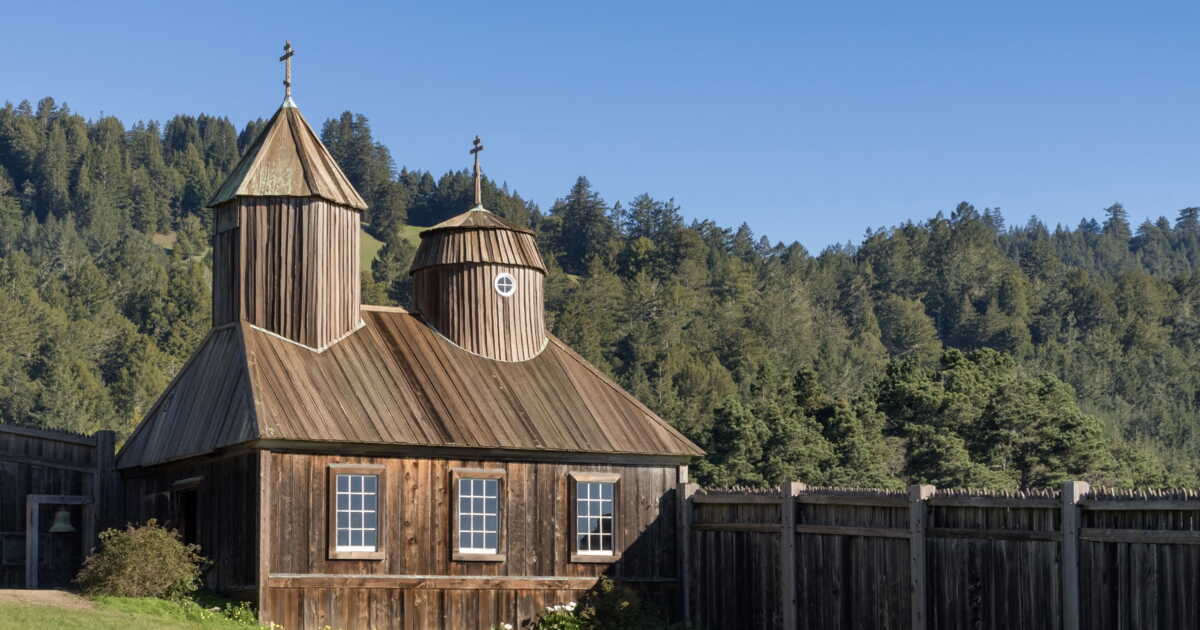
Fort Ross sits roughly 145 kilometers north of San Francisco, within Fort Ross State Historic Park. For travelers taking the famous Pacific Coast Highway, the site offers a pause quite different from the major parks and seaside towns that dot the coast. From the fort’s ruins, the view opens wide to the ocean, while a small Orthodox chapel topped with a cross recalls the Russian origin of the site.
The colony was founded in 1812 by the Russian-American Company, which administered the Russian territories in America at the time. Its goal was largely practical: to establish a southern base to supply the Russian colonies in Alaska, where climate conditions made farming particularly challenging.
The Russians had already developed activities in the northern Pacific, notably in the fur trade. In California, they found a more favorable climate and abundant resources. The site chosen along the Sonoma coast was also near territories under Spanish control, such as San Diego, Santa Barbara, Monterey, and San Francisco, with whom the newcomers would quickly trade.
“A prosperous and pluralistic trading village”
“Welcome to Fort Ross, the southern limit of the Russian Empire”, explains Chris Kimsey, archaeologist for California State Parks, to the BBC. At its peak, the colony gathered nearly 400 people. The fort, surrounded by a palisade 3.6 meters high, housed notably the military and company representatives. But most of life occurred outside: workshops, warehouses, dwellings and agricultural facilities formed a much larger village.
The place also possessed an astonishing multicultural dimension. Russians, Europeans, workers from Finland or Hawaii, indigenous Alaska hunters and members of local Native American communities lived and worked there together. “It was a prosperous and pluralistic trading village, with many languages and people from different origins living side by side”, says anthropologist Kent Lightfoot of the University of California, Berkeley.
A Stop That Tells Another California
Today, Fort Ross mainly offers a chance to measure the imprint left by this Russian presence on the land. The fort has been partly reconstructed and several buildings can be visited. Saint Nicholas Chapel is one of the most remarkable elements of the site, while the former locations of the village, cemetery and workshops allow continued exploration on foot.
The landscape itself is a draw. The park spans approximately 1,376 hectares and overlooks a spectacular stretch of the California coast. Trails lead to the coastline to observe the ocean from the cliffs. The region is also well suited to exploring Sonoma County’s landscapes, now famous for its vineyards.
For the Russian heritage also lives in wine. In 1817, the settlers introduced grapevines into what is today Sonoma County and notably cultivated the Mission grape. “It was the Russians who planted the first vines in what is today Sonoma County in 1817”, notes Megan Jones, head of Sonoma’s Wine Library.
The experience can thus extend far beyond the fort, through wine routes, rugged coastline, and Sonoma’s villages. The Russian River, which traverses the region, also preserves a trace of this history, which the Russians called Slavyanka.
And the Russian Adventure Came to an End
Nevertheless, the Russian venture did not endure. The overharvesting of sea otters contributed to exhausting local resources, while agricultural harvests remained insufficient to feed the Alaska colonies. In 1839, the Russian-American Company began to rely more on supplies provided by the Hudson’s Bay Company.
In 1841, it finally sold the buildings, livestock, and equipment of Fort Ross to John Augustus Sutter, a Swiss entrepreneur based near present-day Sacramento, for $30,000 (about €26,000). The land itself was not included in the sale and remained claimed by Mexico. Today, Fort Ross is freely accessible, allowing visitors to discover the fort, the Orthodox chapel, the cemetery, and the various sites of the former colony.
The Visitor Center and its museum complement the stroll with objects and information about the Russian, Alaskan, and Kashaya peoples who lived here. To deepen the visit, California State Parks also offers free one-hour presentations with its interpretive guides, usually on weekends, while private tours can be arranged by reservation.
For travelers tracing the coast between San Francisco and Sonoma, the site thus makes for an easy stop to fit into an itinerary. One can dedicate a few hours to explore the ruins and trails of the park before continuing toward Sonoma’s vineyards. A way to discover, along the road, a California less well known.