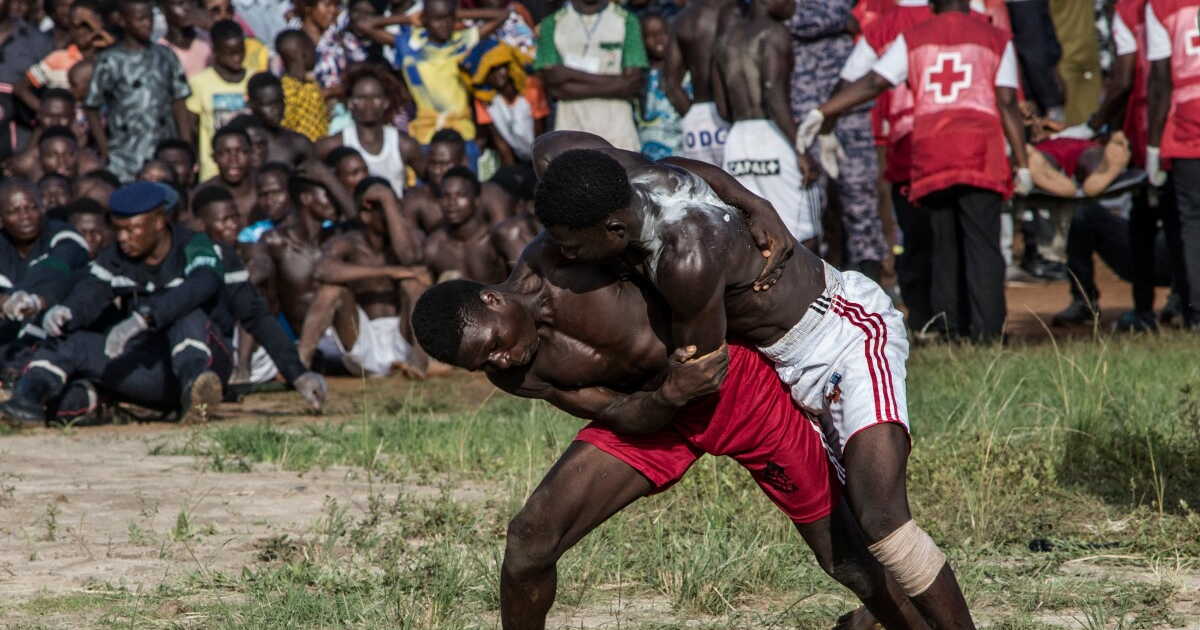
In mid-July, as every year in the West African country, thousands of young people from the Kabye ethnic group, aged 18 to 20, subjected themselves to this ancient tradition practiced in the Kara region, hundreds of kilometers from the capital Lomé. They first took part in a ceremony during which they ate dog meat “for the first time” in their lives, according to AFP, explained Samah Achille Bidiwana, the head of the Tchitchao canton. Then three small scars were made using blades near each of the Evalo’s ears, the term used for the young participants.
With that completed, they joined a rite in which they danced with a dog until it collapsed from exhaustion. “The dog is a strong, enduring, and cunning animal. By consuming its meat, the initiate assimilates these qualities. On the field, the one who defeats his opponent is the winner,” details Samah Achille Bidiwana, dressed in ceremonial black-and-white attire and wearing a matching traditional cap. The battles begin. Each young man watches for the moves of his opponent, often someone from another village, then takes advantage of a moment of weakness to furtively grab an arm, a leg, and try to bring him to ground.
The clashes are fierce and the falls sometimes spectacular. Injured wrestlers receive first aid from the rescue teams deployed on site, and some are evacuated to nearby hospitals. Around the arena, each camp urges its fighters on. “Hold tight, don’t let go,” shouts a member of the crowd. “Keep your legs tight and push him forward,” advises another. “We are great warriors!” chant supporters in the Kabye language. “Our encouragement helps the wrestlers stay brave until the end of the fight,” one of them notes.
Social Pressure
In Kabye tradition, participating in the Evala is not compulsory, but it is the subject of social pressure. “We do not force a young Kabye to wrestle, but if he does not wrestle—especially if he is in good shape—he brings shame to the community,” notes Tchaa Tidiyé, supervisor of the wrestlers in the Pya canton. And according to “the standards of our grandparents, you cannot have a wife before becoming an Evalo,” recalls Samah Achille Bidiwana. Nabédé Kpatcha came to watch his son wrestle. “I am very proud,” he says.
“What my parents showed me, I must pass on to my child, and he will pass it on to his children.” Several high-ranking figures, including ministers and Togolese army officers from the Kara region, have gone through the Evala. Beginning with the leader Faure Gnassingbé, in power since 2005, who attended the fights as every year and spoke to the wrestlers in Kabye. He had carried out this rite of passage just like his father, Gnassingbé Eyadéma (1967–2005), whom he succeeded as head of the country.
“Faure Gnassingbé is considered one of the best wrestlers of his generation,” says Mr. Tidiyé. The Togolese state has begun steps to inscribe the Evala on the UNESCO list of intangible cultural heritage, Isaac Tchiakpè, minister of Tourism, Culture and Arts, told AFP.
“The Togolese government hopes to see the Evala recognized for their true value on the international stage,” he added. These fights are already drawing the curiosity of tourists, both domestic and foreign. “It’s a wonderful discovery,” exclaimed Sandrine Plathey, who came from France for the occasion. But for several years, the violence of jihadist groups active in the Sahel neighboring region has reached the extreme north of Togo and threatens tourism, drawn to areas with lush landscapes. ek/bam/mba