
At the Verona Arena, opera enthusiasts often come seeking spectacular stagings and grand international voices. This year again, for the 103rd edition of the Festival of Lyric Art, they were well served!
At first glance, the contemporary staging of Nabucco (Verdi’s opera) conceived by the Italian Stefano Poda sometimes raised concerns: thus on August 8th, not all the seats were taken, while the following evening they were packed for Aïda (also Verdi) presented through Franco Zeffirelli’s monumental and historical staging, with luminaries of the lyric art such as the Franco-Italian tenor Roberto Alagna.
Nevertheless, this Nabucco ultimately won over the audience. Beyond its bold staging, Foda handled the sets (pared-down), the costumes and the lighting. A holistic approach.
At first glance, the contemporary staging of Nabucco (Verdi’s opera) conceived by the Italian Stefano Poda sometimes raised concerns: thus on August 8th, not all the seats were taken, while the following evening they were packed for Aïda (also Verdi) presented through Franco Zeffirelli’s monumental and historical staging, with luminaries of the lyric art such as the Franco-Italian tenor Roberto Alagna.
Nevertheless, this Nabucco ultimately won over the audience. Beyond its bold staging, Foda handled the sets (pared-down), the costumes and the lighting. A holistic approach.
Verona: a Nabucco full of surprises
Far from the classic historical recreations of the clash between the Hebrews and the Assyrians that underpin Nabucco, Foda’s staging was rich with symbols, surprises, and special effects.
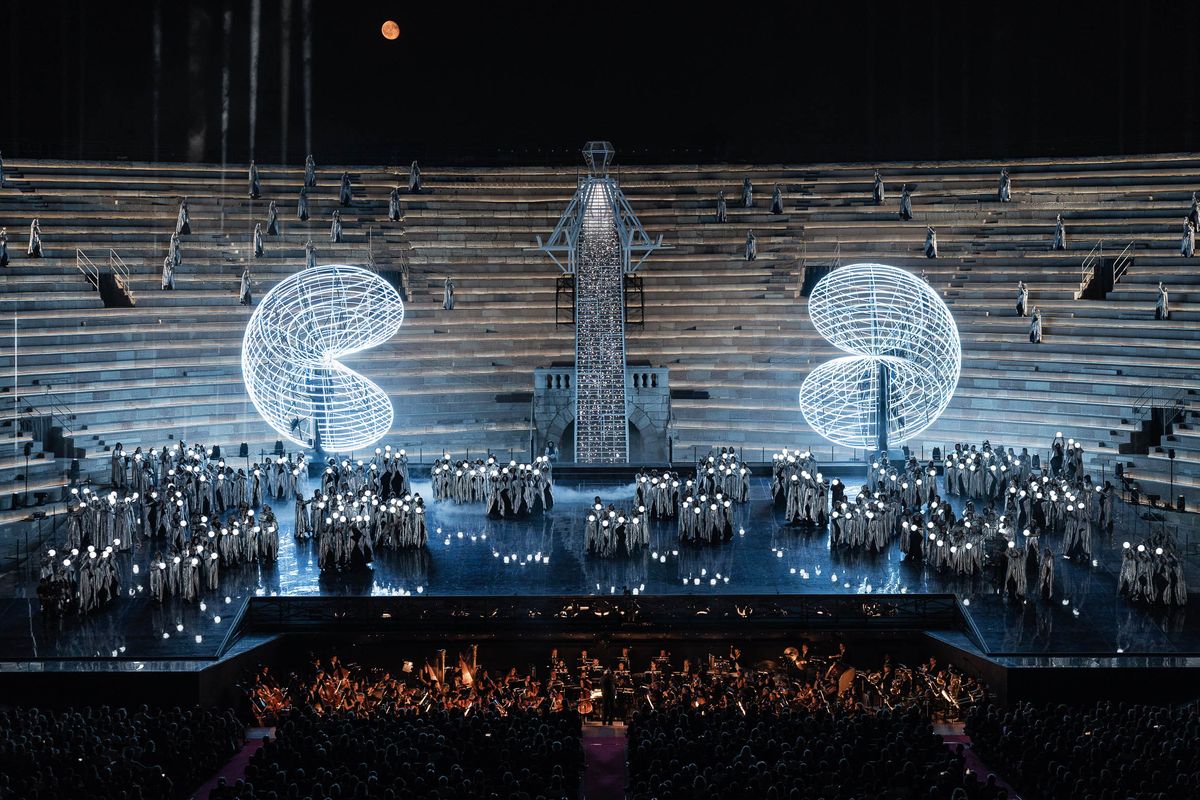
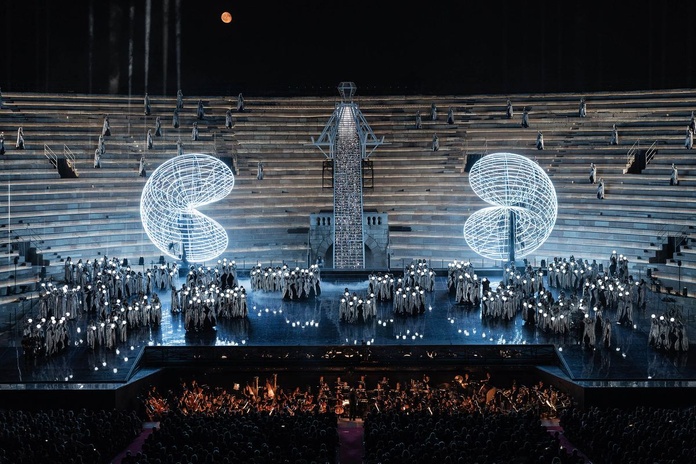
In terms of scenery, two mobile luminous half-spheres; and also a structure imitating an ancient water clock dominated by the word “Vanitas” from which descended a grand staircase. The staircase periodically gave way to a light cascade, a symbol of the hubris that leads humanity to its downfall.
The audience’s reactions (shouts and applause) were sometimes startling. In particular when a spectacular nuclear explosion, with a mushroom cloud, sounded just as the Babylonian king Nabucco, struck by lightning, plunged into madness after proclaiming himself a god.
Throughout the evening, the choreography of the extras and dancers (in sometimes fluorescent costumes), clocked to the millimeter, perfectly matched the music.
Regarding the famous slave chorus (“Va, pensiero”), impressive in its cohesion and power, it faithfully captured the Hebrews’ longing for freedom.
The principal performers were also of exceptional quality, especially the Italian soprano Marta Torbidoni (as Abigaïlle), the Russian bass Alexandre Vinogradov (as the High Priest of the Hebrews) as well as the German mezzo-soprano Anna Werle who sang Fenena. By contrast, despite his vocal gifts, the South Korean baritone Youngjun Park did not always render the Babylonian king convincingly.
In terms of scenery, two mobile luminous half-spheres; and also a structure imitating an ancient water clock dominated by the word “Vanitas” from which descended a grand staircase. The staircase periodically gave way to a light cascade, a symbol of the hubris that leads humanity to its downfall.
The audience’s reactions (shouts and applause) were sometimes startling. In particular when a spectacular nuclear explosion, with a mushroom cloud, sounded just as the Babylonian king Nabucco, struck by lightning, plunged into madness after proclaiming himself a god.
Throughout the evening, the choreography of the extras and dancers (in sometimes fluorescent costumes), clocked to the millimeter, perfectly matched the music.
Regarding the famous slave chorus (“Va, pensiero”), impressive in its cohesion and power, it faithfully captured the Hebrews’ longing for freedom.
The principal performers were also of exceptional quality, especially the Italian soprano Marta Torbidoni (as Abigaïlle), the Russian bass Alexandre Vinogradov (as the High Priest of the Hebrews) as well as the German mezzo-soprano Anna Werle who sang Fenena. By contrast, despite his vocal gifts, the South Korean baritone Youngjun Park did not always render the Babylonian king convincingly.
An exceptional setting
In any case, this Nabucco reaffirmed Verona’s status as a must-visit for opera lovers.
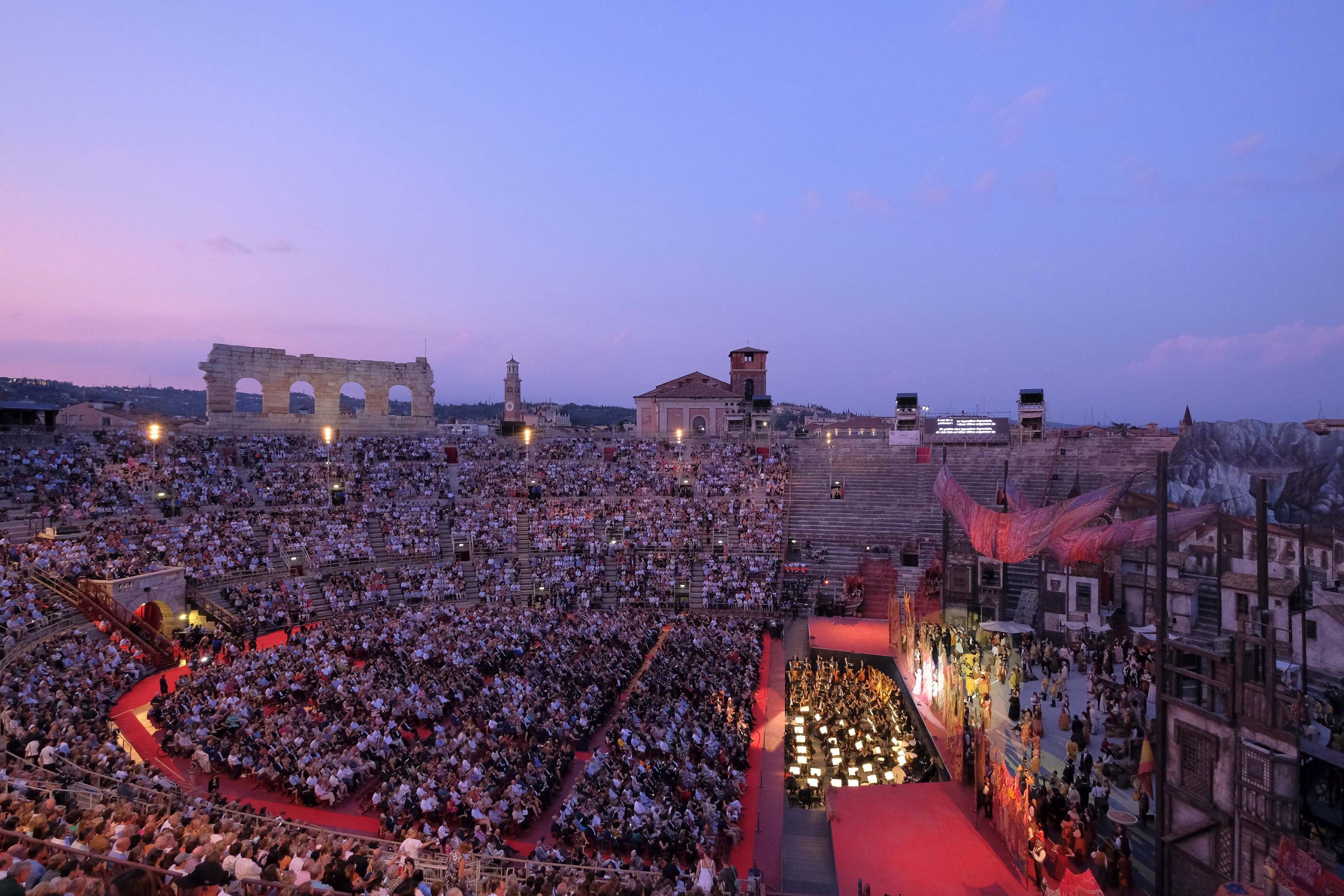
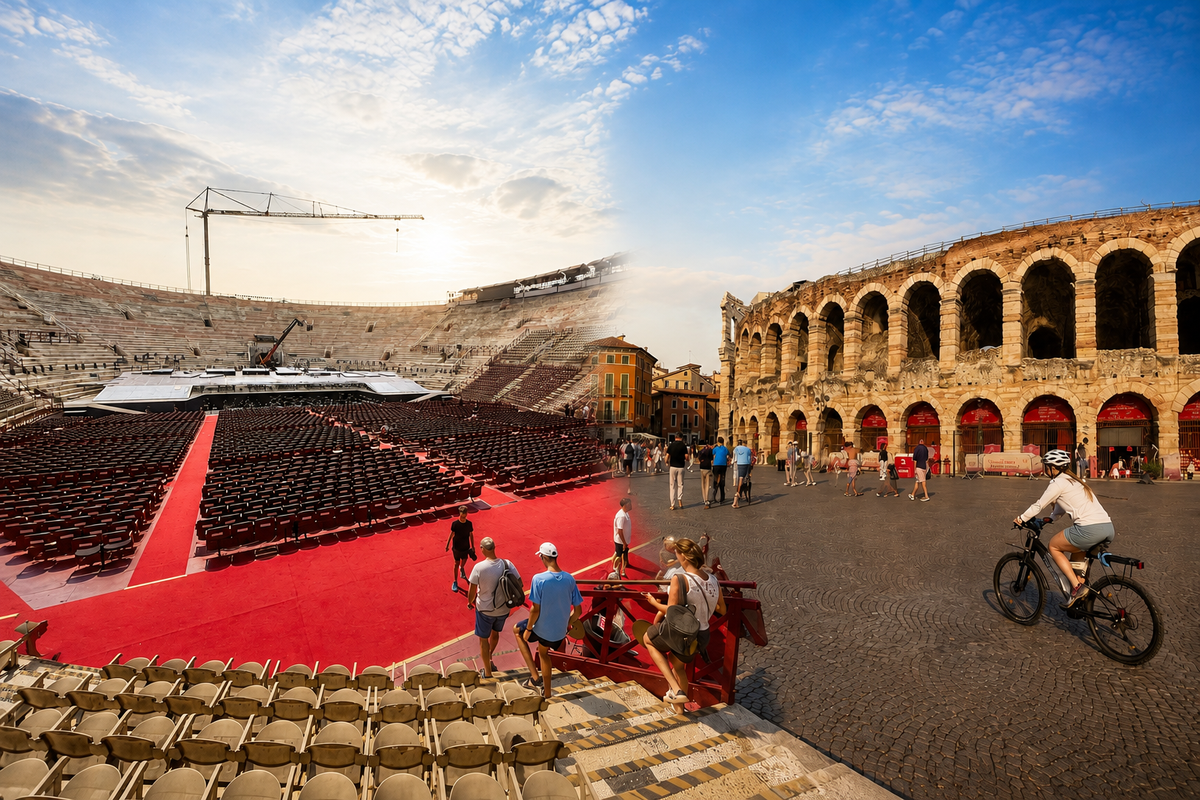
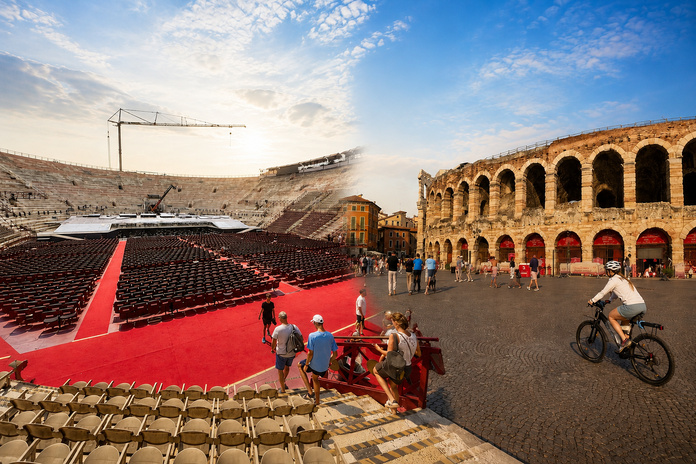
Its antique Arènes, extraordinary in scale, aim to serve this ambition: completed in 30 CE, originally equipped with three concentric walls, they are the third-largest in the world after the Colosseum in Rome and the Amphitheatre in Capua.
Located on Praça Brà, in the city center, they are among Italy’s best-preserved ancient edifices.
True, the violent 1117 earthquake did cause significant damage, notably destroying much of their outer third wall. But since the 16th century, they have benefited from several restorations.
Since 1913, they have hosted the Lyric Art Festival in the summer, and the rest of the year host concerts and events such as the arrival of the final stage of the Giro d’Italia.
During the day, they are open for visits (12 €, excluding reduced rates). A chance not to miss to appreciate the expanse of the cavea, the height of the upper tiers, and the breadth of the internal galleries. Be aware, in summer, book in advance!
Its antique Arènes, extraordinary in scale, aim to serve this ambition: completed in 30 CE, originally equipped with three concentric walls, they are the third-largest in the world after the Colosseum in Rome and the Amphitheatre in Capua.
Located on Praça Brà, in the city center, they are among Italy’s best-preserved ancient edifices.
True, the violent 1117 earthquake did cause significant damage, notably destroying much of their outer third wall. But since the 16th century, they have benefited from several restorations.
Since 1913, they have hosted the Lyric Art Festival in the summer, and the rest of the year host concerts and events such as the arrival of the final stage of the Giro d’Italia.
During the day, they are open for visits (12 €, excluding reduced rates). A chance not to miss to appreciate the expanse of the cavea, the height of the upper tiers, and the breadth of the internal galleries. Be aware, in summer, book in advance!
Past as a circus, today as an opera stage
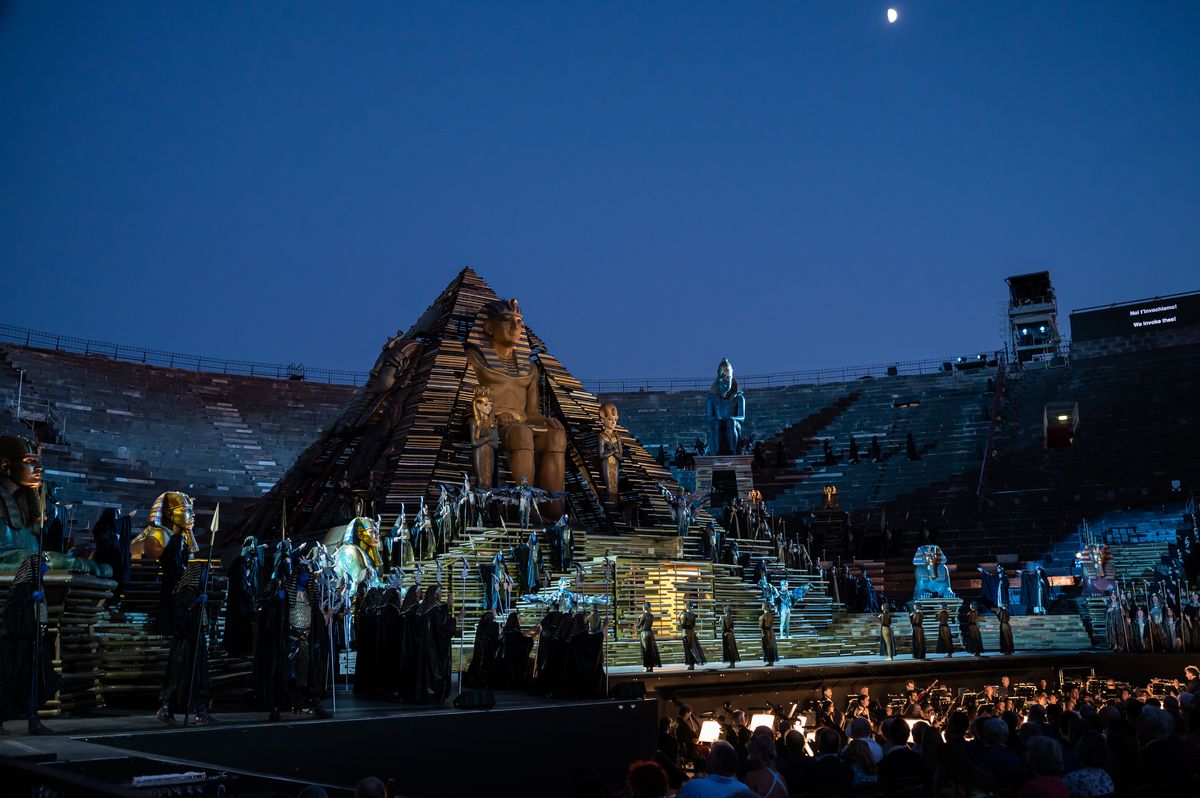
In the past, these Arenas could welcome all of Verona’s inhabitants. Circus games and gladiator combats also drew crowds from across Veneto.
Now, these Arenas enjoy incredible prestige with a knowledgeable audience eager to hear the world’s greatest voices: in the past Maria Callas and Luciano Pavarotti; today Anna Netrebko, Jonas Kaufmann, Ludovic Tézier, Roberto Alagna and many others… Yet the vast space (over 20,000 seats), its distinctive acoustics, and the requirement to sing outdoors pose a demanding vocal challenge.
Paradoxically, the renowned Franco-Italian tenor Roberto Alagna did not sing there for the first time until July 2022 (as Don José in Carmen), but since then he has returned regularly. This summer, he embodied Radamès, the hero of Aida, Verdi’s opera, for two evenings.
Created in 1871, this work is one of Verona’s fetish titles: has it not been revived for 63 seasons, totaling 749 performances?
Now, these Arenas enjoy incredible prestige with a knowledgeable audience eager to hear the world’s greatest voices: in the past Maria Callas and Luciano Pavarotti; today Anna Netrebko, Jonas Kaufmann, Ludovic Tézier, Roberto Alagna and many others… Yet the vast space (over 20,000 seats), its distinctive acoustics, and the requirement to sing outdoors pose a demanding vocal challenge.
Paradoxically, the renowned Franco-Italian tenor Roberto Alagna did not sing there for the first time until July 2022 (as Don José in Carmen), but since then he has returned regularly. This summer, he embodied Radamès, the hero of Aida, Verdi’s opera, for two evenings.
Created in 1871, this work is one of Verona’s fetish titles: has it not been revived for 63 seasons, totaling 749 performances?
An Aida that succeeds, though a touch grandiloquent
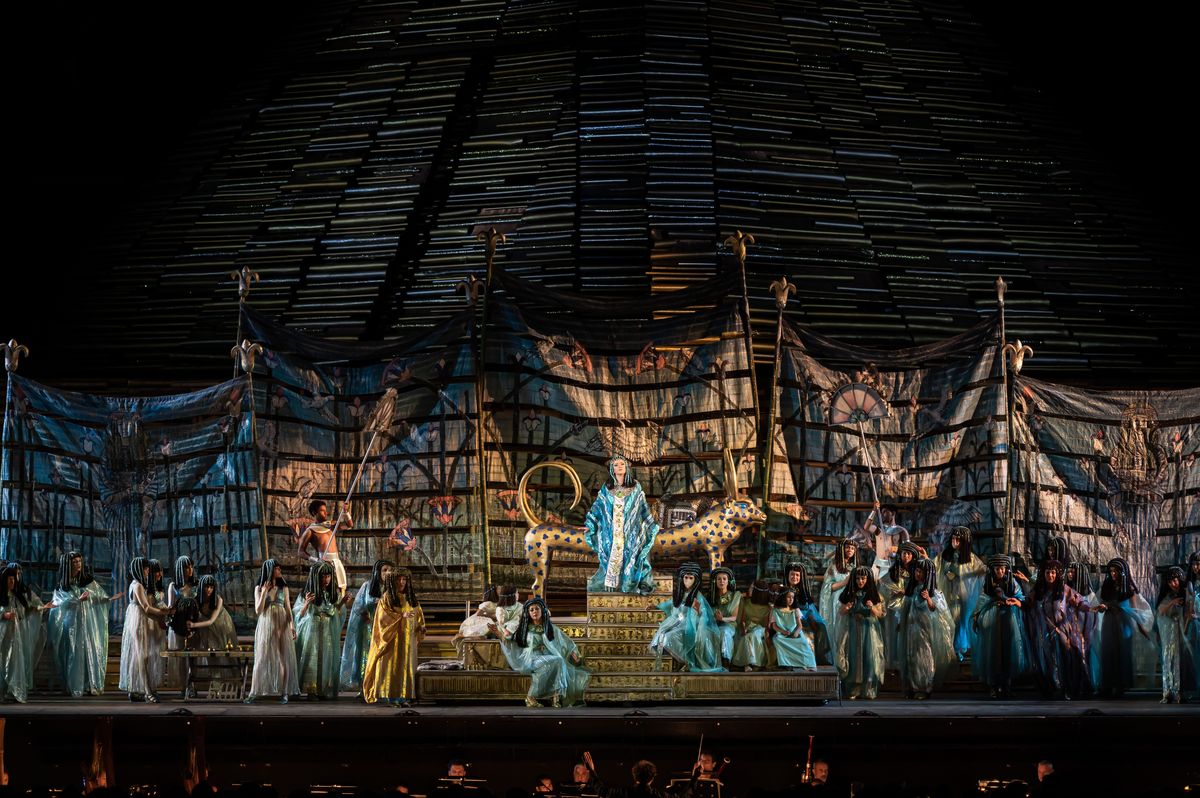
For this 2026 edition, Aïda was presented in Franco Zeffirelli’s staging. The contrast was at least striking with Foda’s more minimalist approach for Nabucco! Yet Verona’s genius lies in drawing in directors with very different styles and in pleasing audiences just as varied.
In any case, this production once again stood out for its grandiose reconstructions of ancient Egypt, its pharaonic sets (so large that they had to be stored outside the Arenas and a crane used to install them!), its golden pyramids, its shimmering costumes, and its expansive crowd scenes…
On August 9, despite the oppressive heat not doing it any favors, Roberto Alagna performed Radamès, the victorious commander of the Egyptian army, with fervor, alongside his wife, Polish soprano Aleksandra Kurzak, who portrayed the Ethiopian princess Aida, enslaved by Egypt.
The generosity and on-stage chemistry of this couple shone through their portrayal of the impossible and tragic love at the heart of their characters. They delivered memorable emotional moments—vigorous applause—along with Alagna’s courage and mature performance, notably in the first act with the aria Celeste Aida (long applause), which helped mask some minor fatigue in the higher registers.
In any case, this production once again stood out for its grandiose reconstructions of ancient Egypt, its pharaonic sets (so large that they had to be stored outside the Arenas and a crane used to install them!), its golden pyramids, its shimmering costumes, and its expansive crowd scenes…
On August 9, despite the oppressive heat not doing it any favors, Roberto Alagna performed Radamès, the victorious commander of the Egyptian army, with fervor, alongside his wife, Polish soprano Aleksandra Kurzak, who portrayed the Ethiopian princess Aida, enslaved by Egypt.
The generosity and on-stage chemistry of this couple shone through their portrayal of the impossible and tragic love at the heart of their characters. They delivered memorable emotional moments—vigorous applause—along with Alagna’s courage and mature performance, notably in the first act with the aria Celeste Aida (long applause), which helped mask some minor fatigue in the higher registers.