Table of Contents
-
Vincent van Gogh’s Alpilles
-
Paul Gauguin’s Brittany
-
Armand Guillaumin’s Limousin
-
Claude Monet’s Normandy
-
Chaim Soutine’s Pyrenees
Vincent van Gogh’s Alpilles
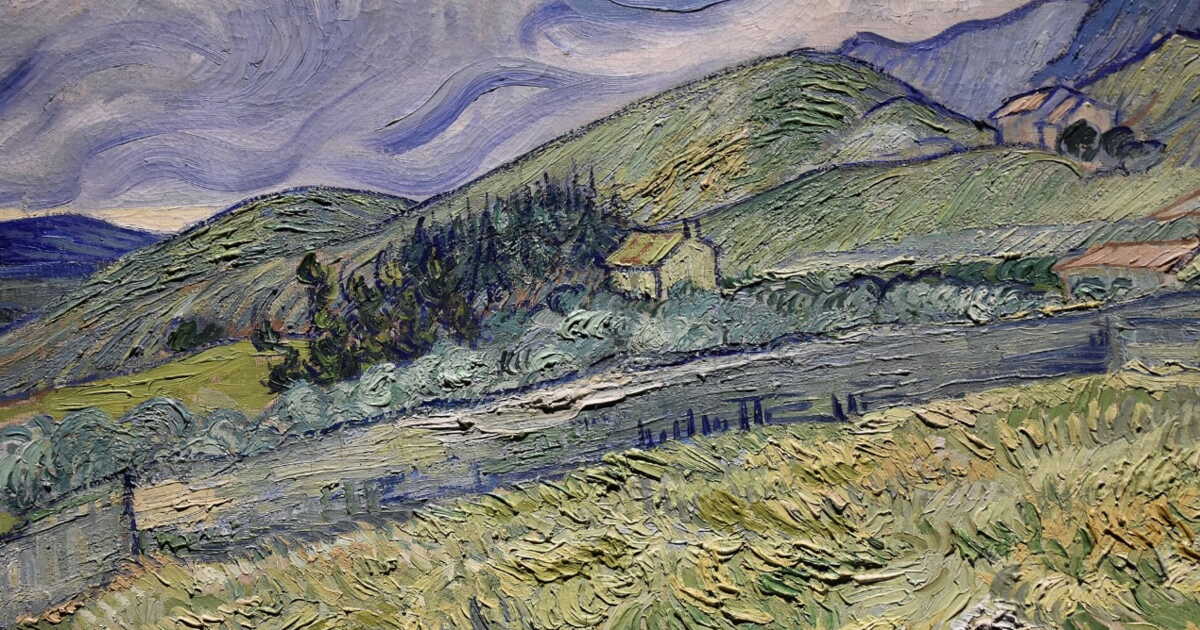
During his residence in Arles, Vincent van Gogh experienced a period of mental turmoil in which he severed his own ear, and the “red-haired madman” was admitted to the Saint-Paul-de-Mausole asylum in Saint-Rémy-de-Provence. Inspired by the luminous landscape visible from his window and by strolls through the surrounding hills, he painted tirelessly. Wheat fields, olive groves, villages, cypress trees… More than 150 paintings, mostly landscapes, came to life from May 1889 to May 1890 in this tranquil refuge, where he began the most prolific phase of his short life.
In the Master’s Footsteps: Van Gogh
The Saint-Paul-de-Mausole monastery has preserved the memory of its illustrious resident. After visiting his room and the garden that inspired his works, one can follow the one-hour trail to Saint-Rémy. Along the way, 21 reproductions attest to his fascination with the Alpilles.
Paul Gauguin’s Brittany
Weary after years of bohemian life and the disappointments of Parisian life, the penniless artist Paul Gauguin settled in Pont-Aven in 1888. In search of purity, he fell under the charm of this corner of Finistère reachable by rail. “I love Brittany, I find the wild, the primitive”, he wrote to a friend from the Gloanec pension, an inn frequented by many painters of the time. Fascinated by local folklore and beliefs, Gauguin drew from the magic emanating from Breton nature enough to break with the codes of Impressionism and draw closer to a current that centers on mystery and the sacred: Symbolism.
In Gauguin’s Footsteps
To discover the places where Gauguin and the other Pont-Aven painters set up their easels, there are two main options: the Amour Wood circuit (9 km) which runs along the Aven river to the Trémalo chapel; and the painters’ path, in the neighboring commune of Clohars-Carnoët, a 5 km loop dotted with interpretive panels, starting from the Gauguin Center.
Armand Guillaumin’s Limousin
This early representative of Impressionism, who remained faithful to the movement throughout his life, discovered the Limousin countryside late in life, at the age of 51. It was 1891, and the artist, having just won the lottery, decided to settle in Crozant, a hamlet north of Pontarlier, where the Creuse meets the Sédelle at the foot of the ruins of a castle. There, where other painters, struck by the scenery, were forming a school, Guillaumin would capture on canvas every nuance and every season of this region for three decades, until his death in 1927, dedicating no fewer than 300 paintings to it, some of which prefigure Fauvism.
In Guillaumin’s Footsteps
Starting from the ruins of Crozant Castle, the Guillaumin circuit (4 km) winds along the Sédelle and the Creuse gorges to seize all the views that inspired the artist.

Claude Monet’s Normandy
From Étretat to Giverny, all of Normandy this year marks the centenary of the death of the man who turned the region into an open-air studio. The changing lights of the English Channel, the cliffs of the Alabaster Coast, the meadows of the Seine and of the Epte valley… Monet painted every facet of this territory, which inspired about a third of his colossal body of work (around 2,000 paintings). He had a particular affection for the city where he grew up and began his career, painting portraits of local notables: Le Havre.
In Monet’s Footsteps
Le Havre is going all out for the centenary of the painter’s passing, notably with a temporary exhibition (June 5–September 27) entirely devoted to the ties between Monet and the port city. It’s a chance to walk the “Impression, Sunrise” circuit, which runs 3 km from the quay where the masterpiece was painted to the beaches of Saint-Adresse.

Chaim Soutine’s Pyrenees
Popular among Picasso and Braque, Céret, the capital of Vallespir, situated 25 kilometers from Perpignan, did not attract cubists alone. It also served as a refuge for other avant-garde artists, such as Chagall or Soutine, both of Russian origin. The latter lived in the region from 1919 to 1922, in considerable hardship. Although he spoke little about his artistic vision, the roughly 200 landscapes with tumultuous forms painted during this period mark a turning point in his aesthetic.
In Soutine’s Footsteps
From the Céret Modern Art Museum, a 4 km loop passes by the various cubist-commissioned buildings, then ventures, climbing the Tech river, into the mountain scenery that inspired Soutine.

➤ Article appeared in GEO HS magazine no. 133, “France, our favorite walks for the summer,” June–July 2026.
➤ Do you love GEO? Then to never miss a beat, discover our subscription plans to receive GEO at home every month with ease.