Summary
-
From simple provisioning to the travel ritual
-
The supermarket as a mirror of society
-
Among the aisles, the deep values of a society
-
The influence of social media
During his travels abroad, Peter, 33, has a very specific ritual: a stop at the supermarket. As soon as the doors open, he instinctively heads toward the cookies and other sweets aisle: “I like to start there because when you think about it, every child has cookies or candies that marked their childhood, and generally, even 80 years later they’re still there”. To do this, Peter asks people he meets along his journeys for product recommendations to try absolutely.
Television series have also contributed to developing his interest in what is called “grocery store tourism.” He recalls how it all began: “I remember often seeing in American films characters who were eating Twizzlers – raspberry-flavored candy. They wouldn’t stop saying how good it was, so when I went to Los Angeles, I bought some… In truth, it was horrible, a cardboard taste, but at least I got to test it!”.
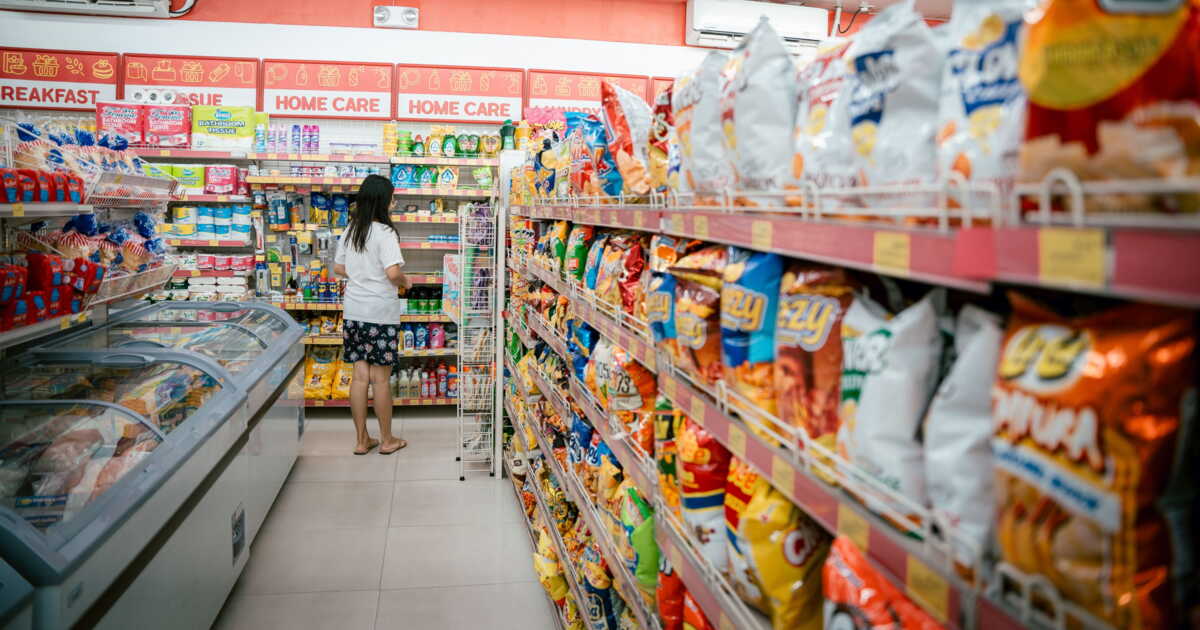
Like him, an increasing number of travelers are integrating the supermarket into their sightseeing, because far from being merely a place of consumption, it becomes a real space for observing locals’ daily life. Available products, the organization of the aisles, and the ambiance all provide clues to read a country through its habits.
From simple provisioning to the travel ritual
When Juliette, 28, began traveling, supermarkets were not part of her regular stops. The trigger came during a road trip in New Zealand. Over a month of travel, it was impossible to eat at restaurants every night: a stop at the supermarket became a necessity.
“At that time, it was really about buying food, it wasn’t a touristy thing”, she recalls. Very quickly, however, she noticed differences: “At the checkout, someone was bagging the groceries for me. I was almost embarrassed”.
Some years later, in 2024, curiosity took over: “In Bali, we passed by a supermarket and said to ourselves: ‘We must absolutely go see what products they have that are different from ours.’ And honestly, it’s silly, but I loved the experience.”.
Since then, it has become a habit: every trip includes a mandatory stop at the supermarket. “It really offers another glimpse of the local gastronomy because not every local can afford to eat at a restaurant, for example. It’s complementary”, she concludes.
A practice also guided by budget: trying local products in a supermarket is often much cheaper than dining out.
The supermarket as a mirror of society
For Jean-Pierre Poulain, a sociologist of food, the rise of this type of tourism makes sense. Indeed, supermarkets are taking on an increasingly important role in modern societies and thus enable a “cartography of consumption.”
“There are countries like the United Kingdom or the Netherlands where supermarkets account for 85% of household purchases, explains the sociologist. In Italy, it’s about 60% because there are still many small merchants”.
Beyond their importance in shopping habits, the products on the shelves also tell the story of the territory in which they sit. In Lovina, north of Bali, Juliette was surprised to find a supermarket with many imported products: “We really thought it must be a store for the wealthier part of the town, or for expatriates”.
According to Jean-Pierre Poulain, this kind of observation is far from trivial. The origin and diversity of products allow understanding the communities present in a city: “I can see products linked to migratory phenomena that show me both that the people living here want to consume things they were used to consuming, or that people have learned, through interactions or travel, to consume things that are exotic”.
Between the aisles, the deep values of a society
Adrien, 34, for his part, began this supermarket tourism when he was looking for typical and easily portable products to offer to his family and friends.
In the aisles, he quickly notices differences from one country to the next: “Here in France, we have a lot of products made in France. When you go to England, you look at origins; it’s much more international”.
Beyond these impressions, the way a supermarket is organized says a lot about consumption habits. The choice between national, local, or international products, as well as the selling points highlighted, varies by country.
In Japan, for example, some products emphasize control and standardization criteria, while in France the emphasis is often on origin and terroir. Elsewhere, it is the labels or certifications that dominate. So many different ways to define what constitutes a “quality product.”
Others aspects can still be observed, such as product availability, the breadth of assortments, or opening hours. In Malaysia, for instance, many shops stay open very late at night. That’s one of the elements that makes 7-Eleven the star store on social media when people talk about “grocery store tourism.”
The influence of social media
Today, it is these networks that give supermarket visits a new scale. On TikTok, Instagram, or YouTube, videos of products to test in stores like 7-Eleven in Asia rack up millions of views. Lava cakes, onigiri, croque-monsieur, or exotic-flavored drinks: there is something for every palate.
These videos transform the supermarket into a cultural stage. Food, as a universal language, provides a particularly effective gateway into discovering a culture.
So, on your next trip, take the time to wander these aisles: you may discover that unique snack that will always bring you back to that special moment of your vacation.