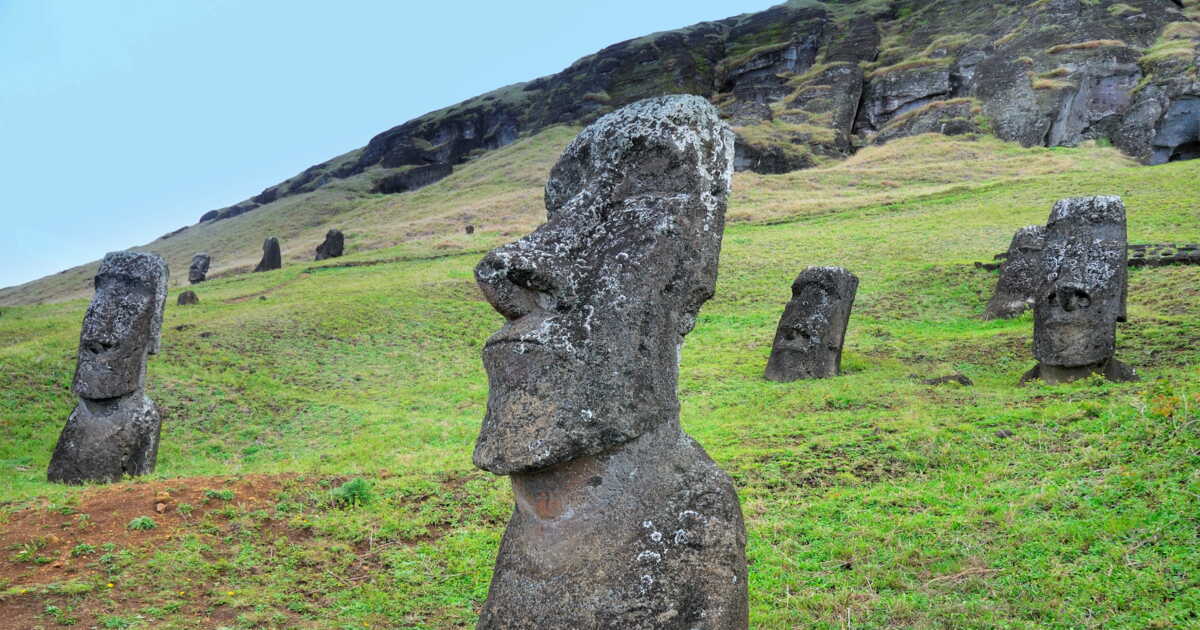
Easter Island, also known as Rapa Nui, is a captivating destination thanks to its enigmatic history and its unique cultural heritage. Nestled in the heart of the Pacific Ocean, the island attracts travelers from all over the world with its renowned Moai, those monumental statues that punctuate the volcanic landscapes. Visiting Easter Island means embarking on an adventure that blends discovery, exploration, and cultural immersion. To fully enjoy this singular place, here is a list of activities and sites not to miss during your visit.
1. Explore the Moai Quarry at Rano Raraku
Delving into Rano Raraku means immersing yourself in the technical and symbolic history of the Easter Island. This quarry of yellowish stones is the cradle of the famous Moai, sculpted directly from the volcano’s rock. Each hike from the parking leads to a unique vantage over the island’s sites, revealing unfinished statues frozen in time. The island journey here takes on an almost archaeological dimension, feeding the traveler’s imagination as they encounter these giants partially buried. Located near the Poike Volcano and accessible by the island’s bike, the area is well signposted with information panels, and access requires presenting a valid entry ticket for the entire park—a ticket of modest value yet essential for preserving the site.
2. Watch the sunrise at Ahu Tongariki
The sunrise at Ahu Tongariki, with its 15 Moai lined up facing the Pacific Ocean, remains one of the most striking moments of a trip to the island. The traveler’s excitement reaches a peak as the first light breaks, illuminating the statues and highlighting the grandeur of the site. This moment, often associated with Easter Day for its symbolic significance, offers a rare spectacle that is easily reachable by electric bike or car from Hanga Roa. On site, guided tours enrich the experience, while the marked hiking trails invite autonomous discovery. The subtropical climate ensures pleasant weather, especially during the best period from April to November.
3. Relax at Anakena Beach
At the sandy Anakena Beach, the island’s sole white-sand shore, the traveler can pause between cultural explorations. Located in the northern part of the island, it hosts the ancient village and the restored Moai of the Ahu Nau Nau, visible after a half-day of travel from Hanga Roa. The peaceful atmosphere, nearby food options under the palms, and the opportunity to swim in temperate waters provide an ideal setting for relaxation. Access is via an entrance ticket, already included in the overall passage price. Easily reachable by biking around the island, it’s a recommended stop to balance culture and leisure.
4. Discover the ceremonial village of Orongo
The ceremonial village of Orongo, perched high on the slopes of the Rano Kau volcano, unveils the intricate world of the Birdman cult. This island site, accessible via a pedestrian-friendly path for a hiking tour, offers a spectacular view of the southeast coast and the Motu Nui, Motu Iti, and Motu Kao Kao islets. The stone houses ruins, the information panels about ancient rites, and the inclusion of the site in the guided tours available in Hanga Roa enrich the experience. Plan for a half-day for this excursion, which is part of the complete tour accessible with a valid entrance ticket. The island climate, mild and changeable, adds to the atmosphere of this remote extremity.
5. Enjoy sunsets at Ahu Tahai
The site of Ahu Tahai, just a short walk from Hanga Roa, stands as one of the most accessible spots to witness an unforgettable sunset over the Pacific Ocean. The Moai, including one with reconstructed eyes, silhouette against a blazing sky, making this moment a must on any trip to the island. Whether walking there, riding an electric bike, or joining a guided tour, this starting or ending point perfectly captures the island’s peaceful ambiance. It also integrates easily into a comprehensive tour or a simple walk around the town.
6. Visit the Père Sébastien Englert Anthropological Museum
The Père Sébastien Englert Anthropological Museum, located in Hanga Roa, is a must-stop to understand the roots of Rapa Nui. It presents highly valuable artifacts tracing the history of the old village, the techniques used to construct the Moai, and the beliefs of the Pascuan people. This interpretive space, easily reachable on foot or by bike around the island, supplements the guided visits of the island’s sites by providing a scientific perspective. The entrance fee, usually included in the island price, sits within a commitment to high-quality educational experiences.
7. Venture to the summit of Rano Kau
The summit of Rano Kau is reached via one of the island’s most spectacular hiking trails. This trek toward the interior, often starting at dawn, allows visitors to observe a majestic crater where vegetation contrasts with volcanic rock. The island’s climate here is a touch cooler, making the walk pleasant even for a half-day outing. Along the way, the traveler discovers native flora, a trail accessible to various difficulty levels, and breathtaking views of the world’s edge that Easter Island represents. The ascent is included in many complete tours and guided visits.
8. Scuba dive at Motu Nui
For underwater enthusiasts, diving near Motu Nui, close to Easter Island, offers a rare experience. In the clear waters of the Pacific Ocean, the traveler can explore rich biodiversity, observe tropical fish, and, depending on conditions, encounter a submerged Moai. Local operators provide high-quality gear, and diving trips can be combined with land-based activities like on-foot hikes. This activity complements the island’s journey by presenting another angle on its mysteries, between submerged legends and pristine nature.
9. Discover Ahu Akivi
The Ahu Akivi, located inland, is notable for housing seven Moai facing the Pacific Ocean, a rare orientation on the island. This site of the island, associated with the legend of explorers sent by Hotu Matu’a, is ideally visited on foot or by bike around the island, via a marked accessible path. It offers an open setting that attracts photographers and fans of local legends. Access is included in the valid multi-day entrance ticket. The spot lends itself to a half-day visit, often combined with the nearby site of Puna Pau, where the red stone used for the Moai headdresses was quarried.
10. Explore Hanga Roa and the spirit of Rapa Nui
Hanga Roa, the capital and sole urban center of Easter Island, concentrates all essential services for the traveler: accommodations, cuisine on site, transportation, and quick access to the island’s sites. From this port town, near the Mataveri airport, one can embark on a hike, rent bikes or an electric bike, or organize guided tours.
The peaceful ambiance is reinforced by the proximity to the Pacific Ocean, the cultural information panels, and local artisans who keep a unique know-how alive. This is also where you can secure the best price for an entrance ticket, a flight ticket, or a complete island tour. Accessible via direct flights from the Chilean capital, Hanga Roa serves as the starting point for all on-foot or bike explorations.
11. Hike on the Poike volcano
The Poike volcano, on the east of the island, marks a major stop for lovers of outdoor hiking in pristine nature. Less frequented than other sites, it is reached via a parking hike at the site’s entrance, along an accessible path though demanding. The panorama of the southeast coast, the red stone formations, and the sense of complete isolation heighten the traveler’s excitement for solitude. The site, often explored on foot, can also be included in a complete island tour, with or without a guide. To access it, a multi-day entry ticket is required, a modest ticket that helps preserve this exceptional heritage.
The Easter Island is a voyage through time and culture. Between the mysterious Moai, the volcanic landscapes, and the living traditions of the Rapa Nui, every activity on the island offers an opportunity to learn and be amazed. Whether you are passionate about history, an adventure seeker, or simply curious, Easter Island provides a unique and unforgettable experience. Make the most of every moment on this singular island and respect its heritage so that future generations can discover it as well.
How long does it take to visit Easter Island?
Planning a trip to Easter Island requires a good estimate of the time to allocate on site. For a comprehensive discovery of the island’s main sites, it is recommended to allow around 4 to 5 days on the island. This period allows alternating between guided tours and autonomous exploration, on foot or by electric bike, following the hiking trails or starting from a more accessible point thanks to a vehicle.
A hike from the Poike parking offers an immersion into the island’s interior, along a accessible path that follows the southeast coast. Each day reveals a little more of the island’s unique atmosphere, from sunset over the Pacific Ocean to breaks in old villages and the discovery of the Puna Pau crater, famed for its red stone. Whether in a half-day or a complete tour, the high quality of the local infrastructure makes the experience smooth and enriching for any traveler.
Where is Easter Island located? Geographic discovery of a Pacific outpost
Easter Island, or Rapa Nui, lies in the very heart of the Pacific Ocean, more than 3,500 kilometers west of the Chilean capital, Santiago. Its subtropical climate and peaceful atmosphere contrast sharply with continental bustle. This volcanic island is among the most isolated inhabited territories on the planet, which has long fueled travelers’ imaginations. Situated at the crossroads of major oceanic tectonic plates, it stands as a distant landmark for enthusiasts of ancient civilizations and on-foot hiking through preserved landscapes. This exceptional location fully justifies its nickname of the “edge of the world.”
Which country does Easter Island belong to? A Chilean land with a unique identity
Although geographically distant, Easter Island politically belongs to Chile. It is administered as a special province of the Valparaíso region, with governance that recognizes its cultural heritage and territorial particularities. This situation gives travelers access to air tickets at the best price from the mainland, often departing from the Chilean capital, via direct flights to the Mataveri airport, the most distant airport on the globe. Once on site, the history of colonization and the close ties between Hanga Roa, the island’s sole town, and continental Chile unfold through the information panels and the testimonies of a people shaped by the duality between Polynesian traditions and state affiliation.
How to reach Easter Island? Itinerary to a world-ending isle
Joining the Easter Island requires planning your route in advance. The only access is by air, via direct flights from Santiago to the Mataveri airport, often offered at a price for your tickets that varies with the best time of year. Once there, bicycles, electric bikes, and rental vehicles allow you to explore the hiking paths, which can be walked in half-day segments or tackled as a complete island tour. This journey begins the moment you board: the traveler’s excitement is tangible, heightened by the destination’s rarity and the promise of immersion in a world apart.
This article was written with the help of artificial intelligence, then corrected, expanded and validated by the publication’s journalists.