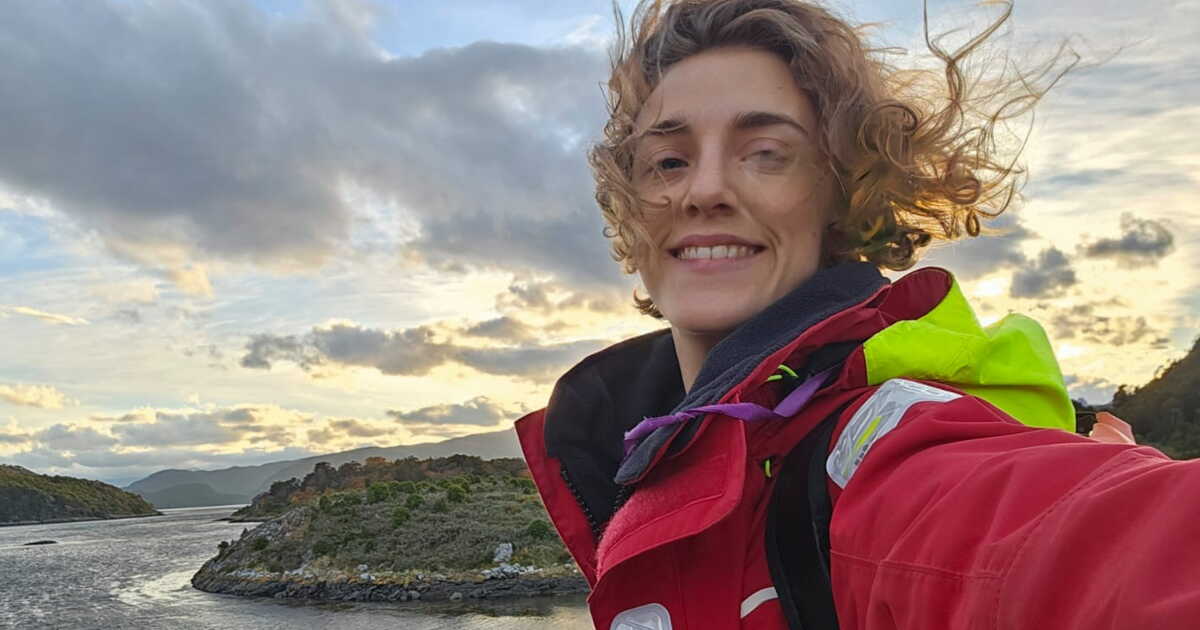
Angeles Rodriguez chose to live far from home for several months each year, in one of the most remote regions on Earth. Holding a PhD in Biology from the University of Buenos Aires, this 34-year-old biologist has made Patagonia her prime field of observation by becoming a guide for Australis, the Chilean expedition cruise company. From Wulaia Bay to Cape Horn, through a maze of fjords, glaciers and isolated islands, she accompanies travelers in the discovery of extraordinary nature.
A life in step with nature
What does life at the edge of the world look like? For Angeles Rodriguez, every day is unique. Between daily outings to accompany travelers in the field, on-board lectures, and assigning tasks to her team, the biologist divides her time among numerous missions. Two excursions are scheduled each day to allow travelers to explore the Tierra del Fuego archipelago, in the wake of the great explorers.
“I’ve always had a very strong connection with nature, and thanks to my training as a biologist, I bring a very particular approach to guiding”, explains her. Angeles wants above all to help passengers connect with the environment, teaching them to look closely at the world around them. “Too often, people are so excited to be in a place like this that they don’t know where to direct their gaze, nor what to pay attention to”, she adds.
Learning to Look
Across her expeditions, Angeles escorts travelers through some of Patagonia’s most spectacular landscapes. The Tuckers Islets, home to Magellanic penguins, the entrance to the Beagle Channel, and the discovery of the famous “Glacier Avenue” with its glaciers descending from the Darwin Cordillera, Cape Horn National Park and its lighthouse keeper, Wulaia Bay—a historic site that was one of the Yámanas’ largest villages—and the Magellan Forest. A beauty that overwhelms. So Angeles takes her time.
In Ainsworth Bay, the day begins with a walk through the subantarctic forest near the Marinelli Glacier. “I ask travelers to look at the glacier, this extraordinary natural phenomenon unfolding before their eyes. When they are truly present in the world before them, we can begin to reflect. Why does this cloud move around that mountain in such a way? What happens to the air? Is it warm or cold? How is this air linked to the glacier and the environment in general?”, asks Angeles.
And her job doesn’t stop at guiding on land. “Once back on board, we offer lectures on the history of the Magellan Strait’s discovery, on nature, glaciology or the different peoples of Patagonia”, she details. It’s an opportunity for the team to deepen certain topics but also to engage in conversations with passengers. “These are true moments of sharing and we have very interesting discussions”, she explains.
Protecting Patagonia from human activities
Yet the beauty of the landscapes cannot hide a darker reality. Patagonia is facing a large-scale threat: fish farms. A danger to local biodiversity in particularly sensitive natural areas. “A few years ago, a company attempted to establish such a farm in the Beagle Channel, which houses very rich marine ecosystems. Facing opposition from the Argentine and Chilean governments, the project was abandoned”, explains Angeles Rodriguez. Other farms are nevertheless still present elsewhere in the country.
The country is not spared from climate change either. Angeles observes this reality daily in her work. “Temperature changes affect the entire environment. Glaciers melt faster, and that also alters aquatic ecosystems”. This is also part of the messages she tries to convey to passengers. “We must strive to have as little impact as possible on the environment we visit. I remind them that we are guests here. We can observe, but we must leave no trace”, she insists.
An ever-new eye
Despite the years, Angeles does not tire of her working setting. “What strikes me most are always the whales. At each encounter with these giants of the sea, I feel the same emotion: when facing a creature of such size, you feel incredibly small”, the guide confides.
Observation of glaciers, which represents a major part of her journeys, also holds a special place in her heart. “I like to think each glacier has its own personality. They are all unique and, as they continually evolve, they never quite look the same from one visit to the next,” exults Angeles, before adding: “The most spectacular moments, however, remain the great calvings: when huge blocks of ice detach from the glacier and plunge into the water. Witnessing such a scene is always a striking experience.”
Emotions that, far from fading over time, still fuel her passion for these extreme territories. “This is a very special line of work, one in which you commit for the long term and build deep connections with this environment. It truly marked a turning point in my life”, concludes Angeles.
Discover the fjords and hidden trails of Patagonia
- How to get there: Access via Santiago, Chile or Buenos Aires, then flights to Punta Arenas or Ushuaia.
- Cruises operated by Australis, with zodiac excursions.
- Main itineraries: Sailing between Punta Arenas and Ushuaia, crossing the Beagle Channel, exploring Tierra del Fuego and Cape Horn.
This interview was made possible by the Chilean expedition cruise company Australis.