

A hands-on geography lesson and a major physical exercise. It is by paying with one’s body that one will best enjoy one of the most impressive mountainous landscapes of La Gomera: The Roques, four volcanic spires rising above semi-arid slopes dotted with shrubs and conifers.
In almost 6 hours of walking, this looped itinerary begins and ends at La Laja, fifteen kilometers from San Sebastián, the main town of La Gomera.
In almost 6 hours of walking, this looped itinerary begins and ends at La Laja, fifteen kilometers from San Sebastián, the main town of La Gomera.
Randonnée : la Laja, hameau niché dans un ravin
Beyond the last houses of this hamlet perched in a ravine, the path climbs steeply into the terrain toward the El Bailadero viewpoint.
Rapidement, la nature volcanique du terrain s’impose. Quelques dizaines de mètres plus loin se dresse, à droite du chemin, un haut mur naturel de pierre brun rouille.
Dans le langage local, on l’appelle un taparucha, une petite colonne de remontée de magma solidifiée et dégagée par l’érosion.
Filons verticaux et paysages volcaniques
Geologically, this is a dyke. Some have detached from the substrate, like this one. Others are enclosed in the rocks and form vertical veins, “rayant” the landscape.
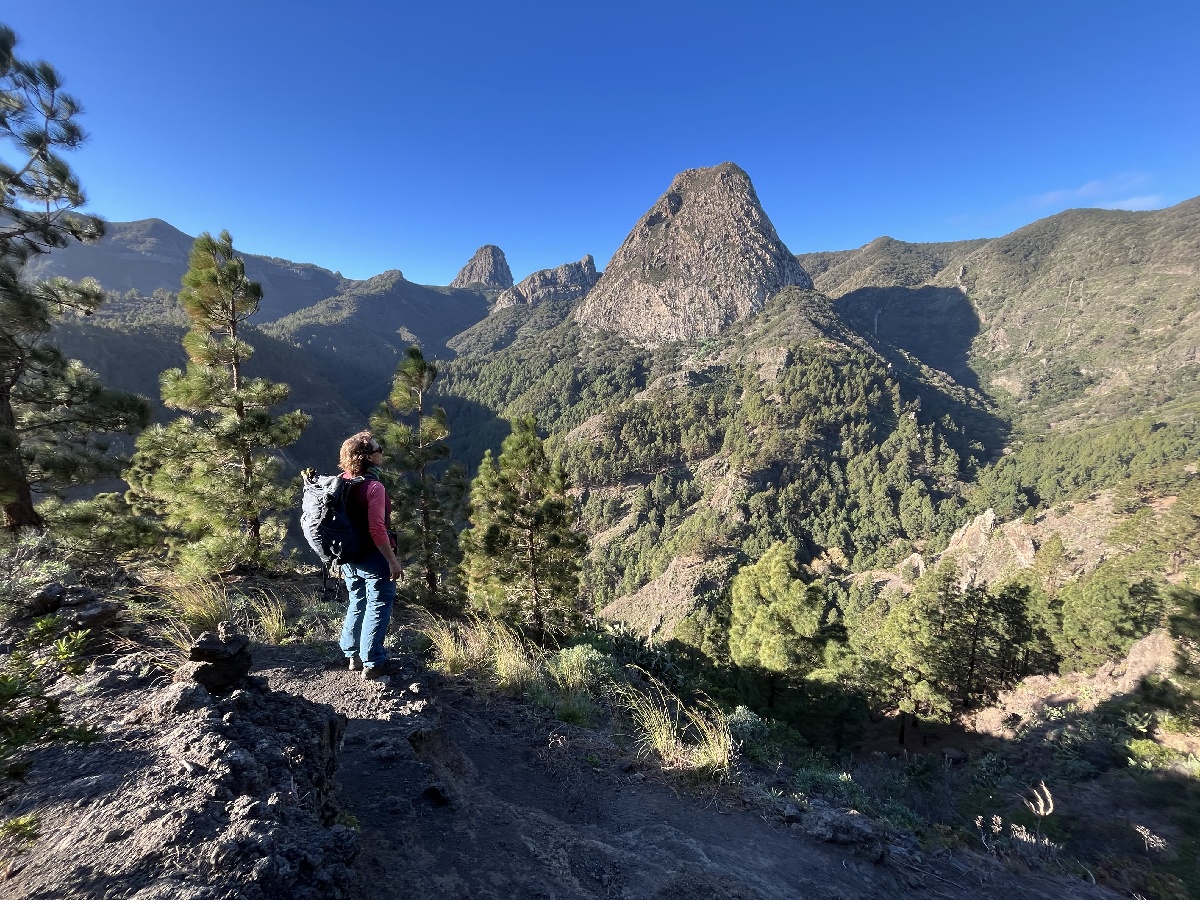
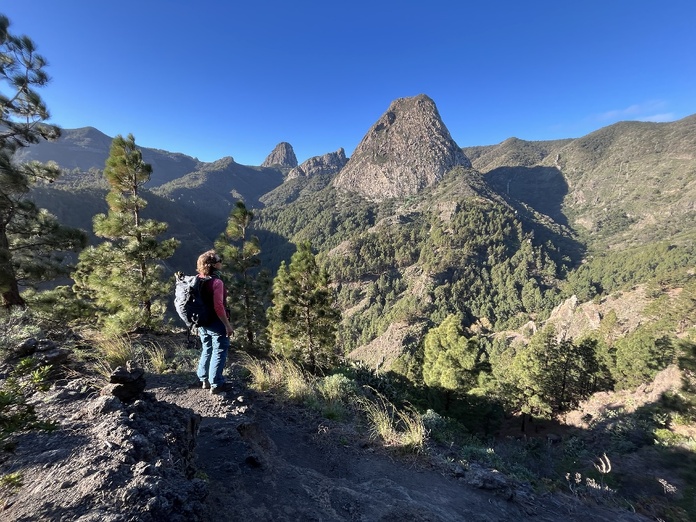
As the trail climbs — one sometimes has to orient oneself by the cairns, small piles of stones marking the route — the view opens onto the first roque.
This is a bullet-shaped, conical rock; it is Ojila. Perched at 1,171 meters above sea level, it is made of trachybasalt. A remnant of the island’s ancient activity as well, two million years ago, this sugarloaf is in fact an old and wide eruption chimney eroded by the wear of the softer rocks that surrounded it.
As the trail climbs — one sometimes has to orient oneself by the cairns, small piles of stones marking the route — the view opens onto the first roque.
This is a bullet-shaped, conical rock; it is Ojila. Perched at 1,171 meters above sea level, it is made of trachybasalt. A remnant of the island’s ancient activity as well, two million years ago, this sugarloaf is in fact an old and wide eruption chimney eroded by the wear of the softer rocks that surrounded it.
La Gomera : repos bienvenue à El Bailadero
This hike confirms the volcanic origin of La Gomera. The peaks and slopes were subsequently shaped by water erosion and covered with vegetation that varies according to exposure to winds and sun. After 2 hours and nearly 500 meters of cumulative ascent, fatigue begins to set in.
Into a silence barely disturbed by the ringing of sheep bells rising from the valley floor, the El Bailadero viewpoint, at an altitude of 1,050 m, offers a welcome rest.
All visible to the south, the four roques undoubtedly constitute one of the most beautiful viewpoints of the hike: Ojila, Agando, La Zarcita and Carmona stand out against the azure sky.
Into a silence barely disturbed by the ringing of sheep bells rising from the valley floor, the El Bailadero viewpoint, at an altitude of 1,050 m, offers a welcome rest.
All visible to the south, the four roques undoubtedly constitute one of the most beautiful viewpoints of the hike: Ojila, Agando, La Zarcita and Carmona stand out against the azure sky.
Vue sur le Teide, point culminant de l’Espagne
What follows is a fairly long trek through the humid forest before reaching the summit of the hike, at nearly 1,250 meters above sea level. The Teide peak, towering over the neighboring island of Tenerife, looms on the horizon. This active volcano, perched at 3,715 meters, serves as the backdrop to multiple panoramas of La Gomera. It is the highest point in Spain.
After another pause at the belvedere of the roque d’Agando, the highest of the four (1,251 meters above sea level), the route descends into the La Laja valley, a quick plunge into a forest of Canary pines that leaves behind the four most famous sugarloaf peaks of La Gomera.
After another pause at the belvedere of the roque d’Agando, the highest of the four (1,251 meters above sea level), the route descends into the La Laja valley, a quick plunge into a forest of Canary pines that leaves behind the four most famous sugarloaf peaks of La Gomera.