Summary
-
A World Full of Mysteries
-
An Unknown Ecosystem Beneath the Surface
-
Without Assistance, the Smallest Incident Can Be Fatal
-
In the Storm, the Sailboat Begins to Take on Water
-
The Click of Crustaceans
-
A 50-Branch Starfish!
-
Under the Ice, a High-Risk Mission
-
All Hands on Deck: Diver in Danger!
-
Keeping Krill Fishermen at Bay
-
Double Threat to the South
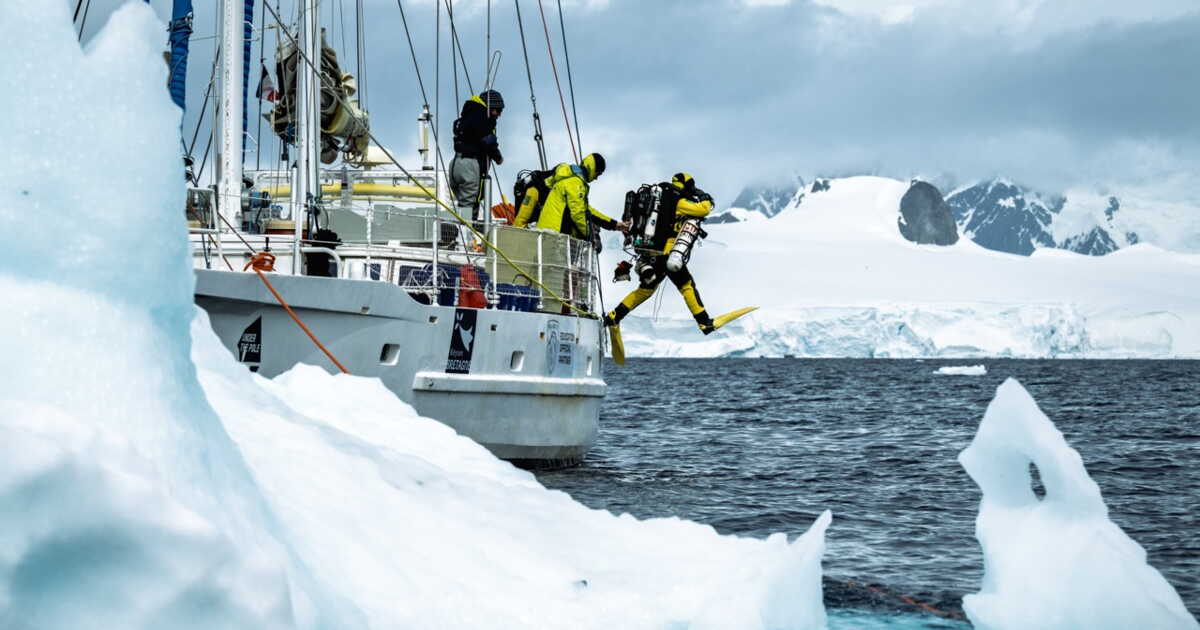
That may be a small step for Ghislain Bardout, but a giant leap for science. Clad like an astronaut in a heavy, thick yellow suit, the explorer leaps from the deck of the schooner Why to dive into the icy waters along the stark and pristine edges of the Antarctic peninsula. Accompanied by Italian biologist Lorenzo Bramanti, the 45-year-old Frenchman slowly sinks, with every kick of his fins, into the twilight glow of the Southern Ocean. The first meters are obscured by clouds of algae that blur the view.
Then the waters thin out, and at about a hundred meters depth, under the beam of the projectors, a magnificent reef gradually comes into view, multicolored as if painted by a child: bright orange sponges rising like crenellated towers on the rocks; lemon-yellow corals and pale pink gorgonians swaying with the current; shrimp and fish weaving through the countless crevices of these underwater thickets; clearings dotted with stars and sea snails, and a profusion of shells… The two divers have just discovered an underwater forest “richer in form and color than anything I could have imagined, recounts Ghislain Bardout, returning to the ship. Like a tropical coral reef, but buried under the ice.
A World Full of Mysteries
To study this unsuspected world, hidden in the chill of the Southern Ocean, fifteen adventurers set out in December 2025 from Ushuaïa (Argentina) and steered toward the Antarctic Peninsula, where the Why cruised for nearly three months. This expedition is part of Under The Pole, an initiative serving science and nature preservation launched in 2008 by engineer and explorer Ghislain Bardout and his wife Emmanuelle, a former crewmate of Jean-Louis Étienne. The two French have already dived in the Arctic and as far as the reaches of Polynesia, but this Antarctic odyssey is likely among their most extreme and ambitious ventures: to venture into icy underwater realms that no human has ever beheld, down to 130 meters depth, with no possibility of rescue…
An Unknown Ecosystem Beneath the Surface
Life in the mesophotic zone, located between 30 and 200 meters below the ocean surface, is full of mysteries. Remote-controlled robots do not offer good visibility of these places and struggle to collect samples. Moreover, only a handful of scientists dare to venture to such depths. “This marine territory has been neglected for decades, notes Lorenzo Bramanti, head of the research program. Even though it is certainly among the richest in species in the entire ocean…” For in cold or ice-covered regions, where sunlight barely penetrates the mesophotic zone—and where plants are thus scarce—remarkable marine animal forests flourish, as scientists call them: creatures like corals, gorgonians, and sponges attach to the substrate, forming labyrinths that serve as refuges, pantries, and nurseries for countless species of fishes, mollusks, and crustaceans. The “trees” here are not plant life; they are animals that feed on organisms drawn from water or captured by their polyps.
View this post on Instagram
Without Assistance, the Smallest Incident Can Be Fatal
Since 2021, as part of the DeepLife program supported by the United Nations, the Under The Pole team analyzes and compares these “forests” across different regions of the globe. But no one had yet attempted a dive as deep as this at the edge of Antarctica. Once the vessel is sealed in the world’s ice, the crew is left to their own devices. The slightest incident could prove fatal—a slip on a wet deck, a regulator freezing, or even a mere tear in a diving glove… “The same question keeps circling in my head: how to react if something goes wrong?, confides Ghislain Bardout, who oversees the expedition’s technical side—his wife handles navigation. But I cannot let myself be paralyzed: we must sustain life on board. In addition to the seven scientists-divers and their assistants, the crew includes an emergency physician, a cook, a mechanic, and a teacher responsible for teaching Robin, 13, and Tom, 9, the Bardouts’ sons.
In the Storm, the Sailboat Begins to Take on Water
The approach voyage from Argentine Patagonia itself was strewn with obstacles, featuring various malfunctions and fickle winds. They had to pass through the dreaded Drake Passage, where the Pacific and Atlantic Oceans meet. Four rough days of travel, culminated by a storm and waves five meters high. The Why, a 19-meter-long sailboat with an aluminum hull built to resist ice, began to tilt dangerously and even started taking on water. But just in time, Antarctica appeared on the horizon, with its seagulls and albatrosses circling the jagged coastal mountain chains, and its penguins, leopard seals, and humpback whales weaving between ice floes and icebergs.
There, in the bays of the Antarctic Peninsula, the sea is calm. The Why eases into sheltered waters. For the crew, it is time to descend into the unknown. Each dive feels like a spacewalk. For hours, they must meticulously check equipment (see boxed note), bailout bottles, gas mixes… To reach depths of 100 meters or more, ordinary air cannot be breathed: the deeper you go, the more oxygen and nitrogen become toxic. Hence the use of “recyclers.” These rebreathers operate in a closed circuit (air is not expelled into the water but recycled) and automatically adjust the oxygen, nitrogen, and helium ratios with each breath according to the pressure, the helium helping to prevent nitrogen narcosis. The problem: using recyclers is a high-risk endeavor. A misloaded cartridge or a faulty sensor and the diver can die within minutes.
The Click of Crustaceans
During the three months of the expedition, the Why’s team will conduct 115 individual dives, each lasting about three hours. Yet in each case, only a portion of that time—twenty to fifty minutes—will be devoted to exploring the marine animal forests. The majority of the gas reserve must be preserved for the ascent, which is very slow to respect decompression stops. The divers will spend hours motionless in the sea, as if suspended, waiting for the opportunity to move to the ‘upper level’ in waters near 0 °C. “The cold is our biggest challenge, admits Ghislain Bardout. It wears you down completely.”
During the research, calm and focus are essential. Every minute under the water is precious. In the first 60 meters, iceberg scouring has often ground the reefs. Deeper down, magnificent “virgin forests” carpet the slopes and sheer walls. Every square millimeter is occupied by colonies of animals in pink, lavender, or peach tones, illuminated by the projectors from 35 meters away. Aside from their own breath, the divers hear only the clatter of crustacean claws, sometimes interrupted by a detonation: an iceberg cracking above, in a great roar.
Do these ocean forests truly offer protective properties for their inhabitants comparable to what our forests do on land? To what extent do they dampen currents? What microclimate is created inside? And which species exactly find shelter there? To answer these questions, a protocol was established to study seabed locations off the western edge of the Antarctic Peninsula.
A 50-Branch Starfish!
A particularly rich site near Anvers Island was meticulously scanned. The divers take photographs and videos to map the reef square meter by square meter. Using hydrophones, they record the nuances of underwater symphonies. Other devices measure current gradients and temperature variations. The deep-water explorers also trap suspended particles in sediment collectors and collect samples of remarkable organisms, such as this 50-armed starfish, or this crustacean that has taken up residence on a sea slug, which carries it through the “forest”… Finally, the scientists collect water samples to search for DNA traces, thereby revealing the full spectrum of life forms inhabiting this vibrant world.
On board the Why, Lorenzo Bramanti and his assistants spend hours sorting the samples. The quarterdeck table, beneath the deck, serves as a makeshift lab: among the diving gear lies a jumble of microscopes, pipettes, and Petri dishes. Robin and Tom, the Bardouts’ sons, help the researchers by packing and labeling the precious finds—between homework and climbing to the mast to admire the panorama… “We can already demonstrate that Antarctic marine forests are structured very differently from those found off Spitsbergen (Norway) or the Canary Islands,” says Lorenzo Bramanti. There, robust black corals and hydrozoan polyps—related to jellyfish—provide the framework for forests. Here, the “bushes” are dominated by bryozoan colonies (moss animal-like beings). And in the samples, the Italian biologist has discovered a striking number of “alliances” between tree-like creatures and their tiny tenants, whether worms or mollusks. In short, the struggle against cold seems to tighten the ties within the reef community. “These symbioses deserve to be studied in depth,” he insists. “Especially since many species are likely new to science…”
Under the Ice, a High-Risk Mission
A few weeks into the expedition, a second research vessel, the Malizia Explorer, joins the team. It brings supplies, equipment, and… ideas. French researcher Léa Olivier, from the Alfred Wegener Institute in Germany, is notably investigating the effects of climate change on ocean physics. Through live satellite broadcasts, the two crews also share their experiences on social media, highlighting the importance of Antarctic ecosystems: a thousand classrooms across Europe connect…
As the mission progresses, provisions run low and fatigue builds. The divers’ bodies endure the cold. Under their watertight, hermetic suits, they wear multiple layers of warm clothing and a system of electrically heated patches. “But the bare skin of the face starts to hurt as you descend, notes Ghislain Bardout. Then it goes numb…” Occasionally, despite all precautions, the electronics fail. Regulators frost over. Water seeps in. Some divers even experience electric shocks. Others, like Ghislain, suffer burns where the heating has overtaxed itself…
All Hands on Deck: A Diver in Danger!
And one day, the scare arrives: during a ascent, after reaching a 20-meter depth, a researcher entangles his gear in the line of a signal buoy. His diving partner cuts the cable, but the surge immediately drives the scientist toward the surface, unable to react. All-hands-on-deck on the Why: such a sudden pressure drop can cause paralyzation or even death! “We quickly sent our colleague back under water with a different breathing apparatus, to bring him to a depth where he would be safe”, recounts Ghislain Bardout. Relief: the plan works, the sea itself acting as a decompression chamber. After two and a half additional hours in the ocean, the diver returns to the boat without sequelae. “Fortunately, he did not panic, says Ghislain Bardout. And the team did not either. Our years of experience saved the day!”
Keeping Krill Fishermen at Bay
Towards the end of February, snowstorms hit the two ships, signaling the arrival of austral winter. The time to depart had come. And on March 2, 2026, in Ushuaïa, the pioneers’ epic ends: for the first time, researchers have plunged to vertigo-inducing depths to explore themselves—and not through robots—the underwater forests of the twilight zone of the Southern Ocean, across ten reefs, including one beyond the polar circle. The data they gathered for the DeepLife program, they hope, will aid in the preservation of this mysterious universe. To date, only the Antarctic continent is sanctuarized, since a treaty signed in 1959, reinforced by the Madrid Protocol of 1991, which designates it as a “nature reserve dedicated to peace and science”. Not its coastal waters. Yet, as Ghislain Bardout asserts,
“This underwater world is in danger”.
Indeed, the Southern Ocean is warming at a rapid pace, and its waters are acidifying. A phenomenon that weakens the skeletons and calcified shells of mussels, corals, and bryozoans living here. In the dimness of the cold waters, most organisms grow very slowly and have adapted to stable conditions. Some take decades, even centuries, to recover from environmental disturbances. A rise of just one degree Celsius in seawater could prove fatal…
Double Threat to the South
Another threat: the enormous trawlers, mainly from China, Russia, and Norway, approaching the Antarctic to harvest colossal quantities of krill to fuel the aquaculture industry. Yet these tiny crustaceans form the first link in the Southern Ocean’s food chain: the marine forests, along with seals, whales, and penguins, depend on them for survival. “There is an urgent need to create a protected marine area, insists Emmanuelle Périé-Bardout. The climate change and all these human intrusions could radically transform the Antarctic’s marine forests, even before we can truly understand them.” And until their mysteries are solved.
The Right Gear
These highly trained scientists cannot immerse themselves for three hours in such frigid water and descend to these depths weighed down by around a hundred kilograms of specialized equipment, which includes:
A “SPACIAL” SUIT
A neoprene suit alone is not enough to endure this cold. Under the watertight suit, multiple layers of insulating fleece are worn.
HIGH-TECH HEATERS
These heating patches fixed to the body help maintain warmth. But moisture means there is a risk of small electric shocks.
A HIGH-END REBREATHER
Rebreathers deliver precisely the amount of oxygen the diver can tolerate, depending on water pressure. To address potential system failures, bailout bottles must be carried.
FROST-RESISTANT REGULATORS
Breathing apparatus valves are designed to withstand the cold.
TORCH LIGHTS
These are essential for safety. Each diver has several at hand.
For more information: a book titled Subantarctica, to be published in October by Ulmer, will recount in detail and with images the adventures of Under The Pole’s Antarctic explorers.
➤ Article published in GEO magazine no. 569, “Recharging in Auvergne”, July 2026.
➤ Do you love GEO? Then to stay informed, discover our subscription plans to receive GEO monthly at home with ease.