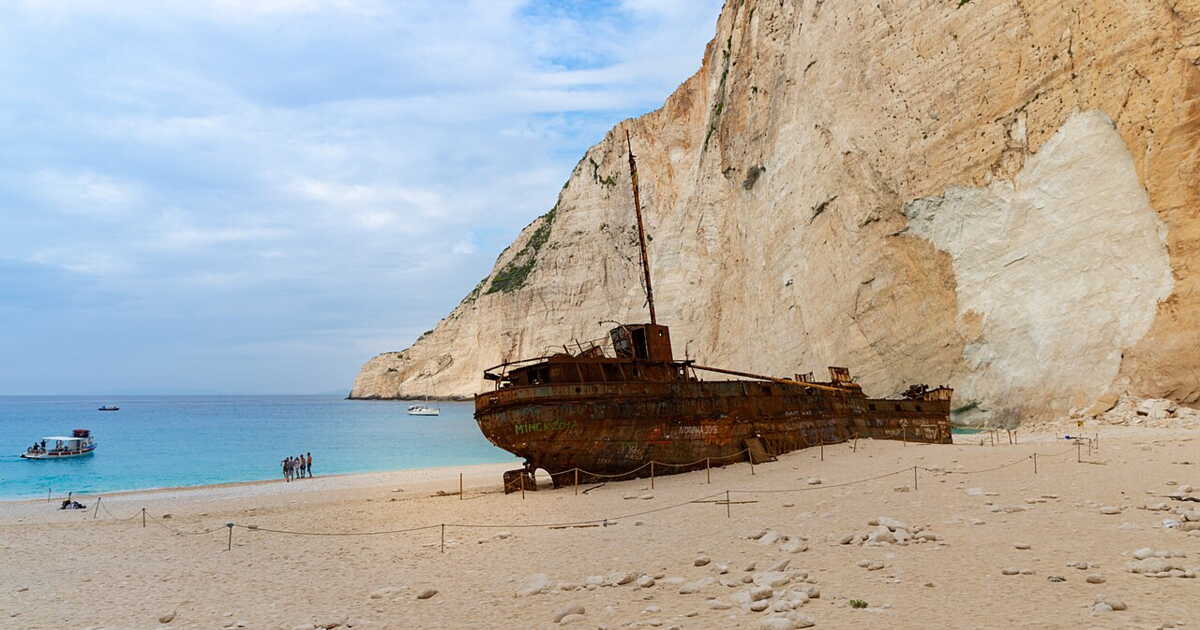
Navagio Beach, situated on the western coast of Zakynthos Island in Greece, is routinely ranked among the world’s most beautiful beaches. This small, secluded cove, framed by towering white limestone cliffs and bordered by intensely blue waters, has even become a emblem of Greek tourism. This fame is not solely due to the island’s natural wonders.
In October 1980, the Panagiotis, a cargo ship carrying contraband cigarettes, ran aground on the beach. Forty years later, the wreck remains. Yet, driven by the force of the waves and the weather, it has been heavily eroded. To protect it, the authorities chose a surprising solution: widening the beach. The cost of the operation is estimated at 3.9 million euros.
Extending the Beach by 30 Metres Toward the Sea
This ambitious project, based on a study carried out gratis by the National Technical University of Athens (NTUA), aims to add 45,000 m³ of gravel and sediments to push the shore about 30 metres further into the sea. The materials will be transported by barge and deposited along the coastline and on the seabed.
According to the project’s technical description cited by the Greek information site eKathimerini, “backfilling with appropriate sediments constitutes the gentlest form of intervention from the viewpoint of coastal engineering and will help protect the wreck from the action of large waves during winter storms.” Once the wreck is safeguarded, the Zakynthos municipality plans to proceed with its restoration for 2.5 million euros.
A Controversial Project on a Site Still Threatened
Is this solution a lasting one? Asked by the German daily Westdeutsche Allgemeine Zeitung (WAZ), Manolis Vasilakis, a geology professor at the University of Athens, doubts it. The researcher believes this intervention represents a major modification of a natural site and questions the relevance of such expenditure to transport tens of thousands of tonnes of gravel that will be swiftly carried away by the sea.
It is also worth noting that facing the risk of landslides and rockfalls, and after several accidents involving tourists, access to the beach and the boat approach are regularly restricted during the tourist season. In 2026, access to the cove will remain forbidden until October 31. Visitors can only admire the wreck from an elevated platform or at a distance from the sea.