

TourMaG – Could you introduce Slow Village?
Baptiste Bonnichon: Slow Village is a group based in Angers. Today, the group owns 14 establishments spread across France, in some of the country’s most beautiful locations, as we like to say, including 11 that bear the Slow Village brand.
Slow Village is a concept of nature-focused hotels with a premium positioning. Our approach, inspired by slow tourism, is to create living spaces and holiday destinations where people can reconnect with time, with nature, with the land, and with the terroir of the places where we operate.
To achieve this, we pursue a highly committed sustainable approach and we rely on the European Eco-label.
Also to read: Bon Air Club aims to invent a new generation of outdoor “base camps”
Baptiste Bonnichon: Slow Village is a group based in Angers. Today, the group owns 14 establishments spread across France, in some of the country’s most beautiful locations, as we like to say, including 11 that bear the Slow Village brand.
Slow Village is a concept of nature-focused hotels with a premium positioning. Our approach, inspired by slow tourism, is to create living spaces and holiday destinations where people can reconnect with time, with nature, with the land, and with the terroir of the places where we operate.
To achieve this, we pursue a highly committed sustainable approach and we rely on the European Eco-label.
Also to read: Bon Air Club aims to invent a new generation of outdoor “base camps”
Slow Village: a discerning selection of implantation sites
TourMaG – You recently selected certain locations to set up campsites, notably Belle-Île-en-Mer, Île de Ré, and the Lot. Why did you choose these destinations for your investments?
Baptiste Bonnichon: We have a particular approach in our acquisitions: we always own and operate the establishment. We are very selective about the destinations we choose.
Today, Slow Village is present in Brittany, at Brignogan, on a magnificent beachside site on a hill. We are also in Pornic, in a very natural site, in Les Ponts-de-Cé, in the Loire Valley near Angers, and in Vendée near Saint-Gilles-Croix-de-Vie.
Finally, we also have sites at Biscarrosse, Oléron, Saint-Martin-de-Ré and La Couarde on Île de Ré as well as in the Périgord where we have two establishments: near Sarlat, in the Céou valley, and near Les Eyzies, close to Saint-Léon-sur-Vézère, in the Périgord Noir. Finally, in Gers, we have a site at Lamothe-Goas, but also in the Cévennes park as well as in La Roche-sur-Yon, near one of France’s most beautiful villages.
When we acquire existing establishments, we strive to stay within this charter of very beautiful places, with low density for the placement of our accommodations.
We always position ourselves next to a tourist point of interest, accessible on foot or by bike, in places that are either atypical or unique. For example, Belle-Île-en-Mer is an exceptional Breton island, well known for hiking and trail running (the Belle-Île trail exists). The site is close to the harbor, walkable, in a natural area, with the beach accessible on foot.
Île de Ré is also a place our guests love because it is preserved, with a very eco-responsible approach and many cycling routes. Already present at Saint-Martin-de-Ré, the second site at La Couarde allows us to be present in another part of the island. The beach is accessible on foot, we are 100 meters from the sea, between the salt marshes of Île de Ré and the beach. It is quite an exceptional site.
The third is the Mas de Saboth estate in the Lot valley. It is a hilltop site with an exceptionally beautiful view over the Lot, between Cahors and Saint-Cirq-Lapopie, a magnificent small village of the department. It is always with this vision in mind when we intend to establish ourselves in a region.
Baptiste Bonnichon: We have a particular approach in our acquisitions: we always own and operate the establishment. We are very selective about the destinations we choose.
Today, Slow Village is present in Brittany, at Brignogan, on a magnificent beachside site on a hill. We are also in Pornic, in a very natural site, in Les Ponts-de-Cé, in the Loire Valley near Angers, and in Vendée near Saint-Gilles-Croix-de-Vie.
Finally, we also have sites at Biscarrosse, Oléron, Saint-Martin-de-Ré and La Couarde on Île de Ré as well as in the Périgord where we have two establishments: near Sarlat, in the Céou valley, and near Les Eyzies, close to Saint-Léon-sur-Vézère, in the Périgord Noir. Finally, in Gers, we have a site at Lamothe-Goas, but also in the Cévennes park as well as in La Roche-sur-Yon, near one of France’s most beautiful villages.
When we acquire existing establishments, we strive to stay within this charter of very beautiful places, with low density for the placement of our accommodations.
We always position ourselves next to a tourist point of interest, accessible on foot or by bike, in places that are either atypical or unique. For example, Belle-Île-en-Mer is an exceptional Breton island, well known for hiking and trail running (the Belle-Île trail exists). The site is close to the harbor, walkable, in a natural area, with the beach accessible on foot.
Île de Ré is also a place our guests love because it is preserved, with a very eco-responsible approach and many cycling routes. Already present at Saint-Martin-de-Ré, the second site at La Couarde allows us to be present in another part of the island. The beach is accessible on foot, we are 100 meters from the sea, between the salt marshes of Île de Ré and the beach. It is quite an exceptional site.
The third is the Mas de Saboth estate in the Lot valley. It is a hilltop site with an exceptionally beautiful view over the Lot, between Cahors and Saint-Cirq-Lapopie, a magnificent small village of the department. It is always with this vision in mind when we intend to establish ourselves in a region.
TourMaG – The current market is dominated by campsites or nature hotels with fewer than 300 places. Is that the establishment size you target as a priority?
Baptiste Bonnichon: Yes, we focus on sites that range between 100 and 300 places. There is a real opportunity because, among the 7,500 campsites in France, 80% are still run or owned by independents.
It is with these owners, who wish to sell their campsite, that we source our projects. These are stories we write on small, human-sized sites with a very familial dimension. It is these sites that we look at and enjoy taking over.
Baptiste Bonnichon: Yes, we focus on sites that range between 100 and 300 places. There is a real opportunity because, among the 7,500 campsites in France, 80% are still run or owned by independents.
It is with these owners, who wish to sell their campsite, that we source our projects. These are stories we write on small, human-sized sites with a very familial dimension. It is these sites that we look at and enjoy taking over.
European Eco-Label: all sites certified this year
TourMaG – You mentioned sustainability earlier, beyond the aesthetic aspects of the places. How does that translate in practice?
Baptiste Bonnichon: Yes. First, when choosing locations, there is an ecological and environmental prism. We always study, during our acquisitions, all risks. It is a way to examine the ecological dimension. What risks does a site face: submersion risk, rising waters over time for the site’s longevity, fire risk, etc. That is the initial analysis we perform.
Next, we analyze the biodiversity present on the site and how we can best preserve it. We conduct biodiversity analyses progressively across all sites in the group.
Finally, once we have acquired the site, we rely on the European Eco-label. It is the only environmental label that remains public, issued by the European Commission. It represents 67 stringent criteria in operating models, but these elements are fully integrated into our system and linked to our operational processes.
They compel us in a concrete way to meet a broad set of environmental criteria applicable to tourism. We are the first hotel group in France to systematically use the European Eco-label across all our sites.
We launched a wave of certification across all our sites. The eco-labeling of all our sites will be completed this year. We aim for 100% of our properties to be eco-labeled.
What is particularly interesting about the Eco-label is that we must renew it every two years. At each renewal, we are required to improve, which places us in a continuous improvement process regarding the environmental dimension.
Baptiste Bonnichon: Yes. First, when choosing locations, there is an ecological and environmental prism. We always study, during our acquisitions, all risks. It is a way to examine the ecological dimension. What risks does a site face: submersion risk, rising waters over time for the site’s longevity, fire risk, etc. That is the initial analysis we perform.
Next, we analyze the biodiversity present on the site and how we can best preserve it. We conduct biodiversity analyses progressively across all sites in the group.
Finally, once we have acquired the site, we rely on the European Eco-label. It is the only environmental label that remains public, issued by the European Commission. It represents 67 stringent criteria in operating models, but these elements are fully integrated into our system and linked to our operational processes.
They compel us in a concrete way to meet a broad set of environmental criteria applicable to tourism. We are the first hotel group in France to systematically use the European Eco-label across all our sites.
We launched a wave of certification across all our sites. The eco-labeling of all our sites will be completed this year. We aim for 100% of our properties to be eco-labeled.
What is particularly interesting about the Eco-label is that we must renew it every two years. At each renewal, we are required to improve, which places us in a continuous improvement process regarding the environmental dimension.
TourMaG – concretely, what kinds of work do you undertake in the campsites you purchase?
Baptiste Bonnichon: The Slow Village approach and concept means we do not run camping; we operate as a full-nature hotel experience, even though the underlying asset remains a campsite.
We pursue a far more nature-centered approach, with a focus on the quality of our accommodations. Compared with more traditional camping groups, we do not use white PVC accommodations (or they only remain temporarily until we renew them).
(or they stay only as long as we renew them gradually).
When we invest in a new site, we transform a very large portion, 50 to 70% of the accommodations, to install lodgings that meet the Slow Village standard.
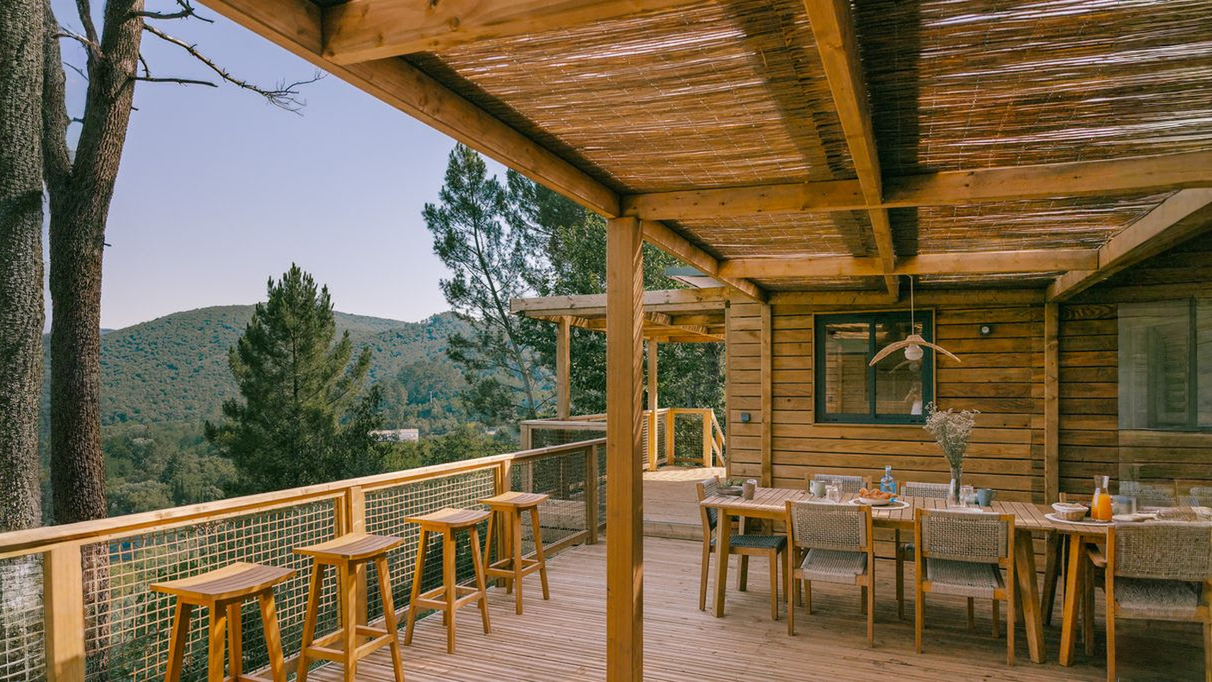
This entails hotel-grade quality criteria, wooden cladding in a cabin-like style, an eco-friendly approach, large outdoor terraces, and a substantial vegetative density to offer a significant nature experience.
Then, we recreate or enhance the heart of life so that it aligns with Slow Village standards, including a modern, design-focused restaurant. The menu adheres to our standards for local production and local suppliers. We operate all of our restaurants; we are not in management. All our chefs are trained in the Slow Village culinary method, from the perspective of catering and supplier selection.
Regarding activities, the Slow Club stands in opposition to what is typical in classic club camping. Our Kids Club is heavily inspired by the Montessori method, with upcycling activities, building tipis in nature, exploring biodiversity, creating herbariums, or discovering the animals that inhabit the site to better know and protect them.
We establish educational farms at each of our sites to reconnect children and families with the rural, agricultural, and animal dimensions.
Finally, unlike many campgrounds, the heart of our concept is not a swimming pool with giant water slides. We always prioritize a water feature. For example, at Biscarrosse, one of our largest sites, there is no pool because the lake is 50 meters away, and our guests love it. In Lamothe-Goas, there are rivers right next to us, and we have recreated a natural swimming lagoon with ecological filtration, without pouring a single cubic meter of concrete, with a strong commitment to the quality of infrastructure.
Baptiste Bonnichon: The Slow Village approach and concept means we do not run camping; we operate as a full-nature hotel experience, even though the underlying asset remains a campsite.
We pursue a far more nature-centered approach, with a focus on the quality of our accommodations. Compared with more traditional camping groups, we do not use white PVC accommodations (or they only remain temporarily until we renew them).
(or they stay only as long as we renew them gradually).
When we invest in a new site, we transform a very large portion, 50 to 70% of the accommodations, to install lodgings that meet the Slow Village standard.
This entails hotel-grade quality criteria, wooden cladding in a cabin-like style, an eco-friendly approach, large outdoor terraces, and a substantial vegetative density to offer a significant nature experience.
Then, we recreate or enhance the heart of life so that it aligns with Slow Village standards, including a modern, design-focused restaurant. The menu adheres to our standards for local production and local suppliers. We operate all of our restaurants; we are not in management. All our chefs are trained in the Slow Village culinary method, from the perspective of catering and supplier selection.
Regarding activities, the Slow Club stands in opposition to what is typical in classic club camping. Our Kids Club is heavily inspired by the Montessori method, with upcycling activities, building tipis in nature, exploring biodiversity, creating herbariums, or discovering the animals that inhabit the site to better know and protect them.
We establish educational farms at each of our sites to reconnect children and families with the rural, agricultural, and animal dimensions.
Finally, unlike many campgrounds, the heart of our concept is not a swimming pool with giant water slides. We always prioritize a water feature. For example, at Biscarrosse, one of our largest sites, there is no pool because the lake is 50 meters away, and our guests love it. In Lamothe-Goas, there are rivers right next to us, and we have recreated a natural swimming lagoon with ecological filtration, without pouring a single cubic meter of concrete, with a strong commitment to the quality of infrastructure.