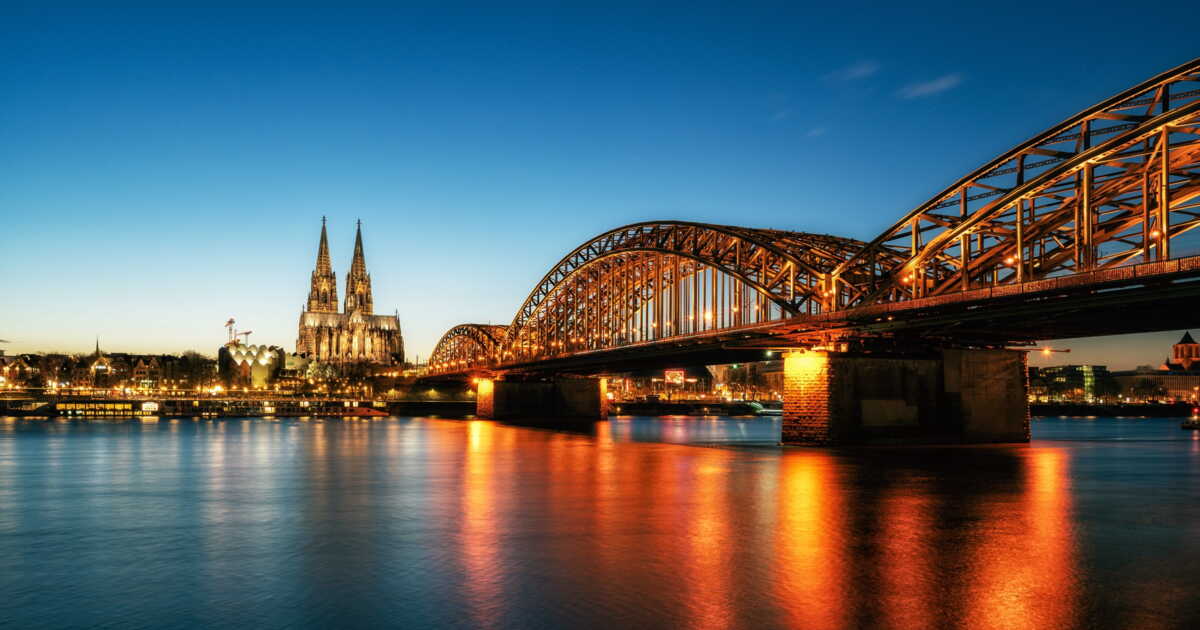
An ancient city perched on the banks of the Rhine, Cologne charms with the diversity of its atmospheres and the richness of its heritage. Between iconic monuments, lively neighborhoods, and varied cultural experiences, it offers a particularly dense field of discovery for visitors.
1. Discover Cologne Cathedral
The Kölner Dom, or Cologne Cathedral, stands as the city’s major architectural landmark and a privileged starting point for any exploration of Rhineland heritage. UNESCO World Heritage-listed, this Gothic cathedral is distinguished by its twin towers reaching beyond 150 meters, making it one of Europe’s most impressive religious edifices.
Its monumental façade, richly sculpted, illustrates the excellence of medieval German craftsmanship, while the interior houses the relics of the Magi, a central element of Cologne’s worship and spiritual identity. Visitors can also access the observation platform after climbing a staircase of more than 500 steps, offering a panoramic view of the city, the Rhine and the surrounding area.
2. Strolling through Cologne’s Old Town
The Altstadt, or Cologne’s Old Town, forms a historic core organized around cobbled lanes, traditional houses with colorful facades, and lively public squares that bear witness to the city’s medieval and mercantile past. This district, carefully restored after the destructions of World War II, concentrates emblematic sites such as the Alter Markt and the Heumarkt, true crossroads of local social life.
These spaces provide a setting for architectural discovery, but also for experiencing regional culinary practices, notably through tasting Kölsch, Cologne’s signature pale beer, served in traditional breweries where service follows a well-established ritual.
3. Crossing the Hohenzollern Bridge
The Hohenzollernbrücke, Cologne’s main rail bridge, has gradually become a popular symbol of modern love, recognizable by the multitude of padlocks left by couples from around the world. This unofficial custom has transformed the structure into a landmark of affection as much as a functional crossing. Offering a clear view of the Cologne Cathedral and the Rhine, the bridge also serves as a pedestrian-friendly route, especially enjoyed at sunset when the light highlights the lines of the river and the surrounding buildings.
4. Explore Cologne’s Museums
Cologne asserts itself as a major cultural hub in Germany, offering a remarkable density of museums that reflects the diversity of its artistic, historical and industrial heritage. The internationally renowned Museum Ludwig stands out for its collection of modern and contemporary art, including major works from Pop Art, Expressionism and Surrealism, thereby strengthening the city’s position within the European network of leading cultural institutions.
Nearby, the Chocolatemuseum (Schokoladenmuseum) traces the history of cacao and its processing, integrating economic, technical and sensory aspects, making it a popular stop for gastronomy enthusiasts and family visits. In addition, the Roman-Germanic Museum (Römisch-Germanisches Museum) offers an immersion into Cologne’s ancient history, highlighting its central role during the Roman era through archaeological objects, mosaics, and urban remains.
5. Enjoy a Rhine River Cruise
To explore Cologne from a perspective complementary to land-based sightseeing, a Rhine cruise provides a structured and accessible option, combining urban strolls with river relaxation. These excursions, offered in different formats (short trips, guided cruises, dinners on the water), allow you to discover the riverfront architecture from another angle, including major landmarks such as the cathedral, the historic bridges, and the port’s modernized districts.
Venturing a little away from the center, this journey also offers a reading of the Rhineland landscape, marked by the alternation of natural and industrial zones. This mode of discovery thus combines gentle mobility, heritage appreciation and a recreational pause.
6. Savor Cologne’s Local Gastronomy
Cologne’s cuisine reflects a strong regional rooting, combining Rhineland culinary traditions with the conviviality typical of local breweries. Among the emblematic specialties, Himmel un Ääd — a blend of mashed potatoes and apple sauce, often served with black pudding — illustrates the straightforward yet structured nature of the region’s popular gastronomy.
The sausages accompanied by sauerkraut, frequently offered in traditional establishments, extend this regional rooting into a rustic cuisine that showcases staple ingredients prepared with care. For an authentic experience, it is recommended to visit a typical brewery, where Kölsch, the light local beer served in small glasses, accompanies simple dishes such as Halve Hahn, a rye bread and aged cheese specialty.
7. Dive into Cologne’s Nightlife
Cologne’s nightlife stands out for its diversity and local rooting, blending alternative venues, independent cultural spaces and dynamic music scenes. Neighborhoods such as the Belgisches Viertel, with its contemporary bars, lively cafés and hybrid galleries, or Ehrenfeld, known for its live music clubs, its independent concert spaces and cosmopolitan atmosphere, concentrate a varied offering that caters to different visitor profiles.
Whether you want to dance, attend a concert, participate in an artistic event or simply share a convivial moment over a drink, Cologne offers a structured, accessible, and ever-evolving setting. This urban buzz complements a city that coherently blends heritage, museum offerings, regional gastronomy and a living contemporary culture.
What to Do in Cologne at Night? A Cultural and Social Nightlife
Cologne in the evening offers a range of activities beyond the clichés of Rhineland revelry. The city hosts a dense theatre and music scene, with the Opera, the Philharmonic, and numerous small independent stages. The Rhine banks come alive with restaurants and bars where it is pleasant to dine outdoors or stroll.
For a local experience, a visit to a traditional old-town brewery allows you to taste Kölsch in its home environment. Finally, nighttime cruises provide another way to approach the city, enjoying the illuminations and the river vantage point.
What to Do Around Cologne? Discovering the Rhineland Beyond the City
Exploring the surroundings of Cologne broadens the view to the rich heritage of North Rhine-Westphalia. Within an hour’s drive, Bonn, the former federal capital, charms with its museums and its banks along the Rhine. Farther east, the wine villages of Mittelrhein invite strolls punctuated by medieval castles.
The Eifel nature park also offers a breath of fresh air, ideal for hiking or cycling. Finally, industrial history enthusiasts can visit the Zollverein coal mine in Essen, listed as a World Heritage site.
What to Do in Cologne in 2 Days? A Balanced Itinerary Between History, Art and Relaxation
The first day could begin with a visit to the cathedral, a UNESCO-listed Gothic masterpiece, followed by a stroll through the old town and along the Rhine. In the afternoon, the Ludwig Museum, renowned for its modern art collection, could be followed by a Kölsch tasting, the local beer. The second day could include a visit to the Roman-Germanic Museum, a stop in the Belgian Quarter for its relaxed atmosphere, and a moment of relaxation at Claudius Therme.
What to Do in Cologne with Children? A City Suited for Family-Friendly and Educational Tourism
The Odysseum science museum, dedicated to science and discovery, offers interactive exhibits suitable for young audiences. Cologne Zoo, one of the oldest in Europe, attracts with its animal diversity and educational installations. A stroll along the Rhine or a short boat cruise nicely rounds out the programme.
For a playful break, the Stadtgarten city park offers well-equipped playgrounds. Finally, many cafés and restaurants provide spaces for children. Cologne thus proves perfectly suited for families, combining accessibility, safety and cultural richness in an educational yet relaxed setting.
This article was drafted with the help of artificial intelligence, then revised, supplemented and validated by the newsroom journalists.