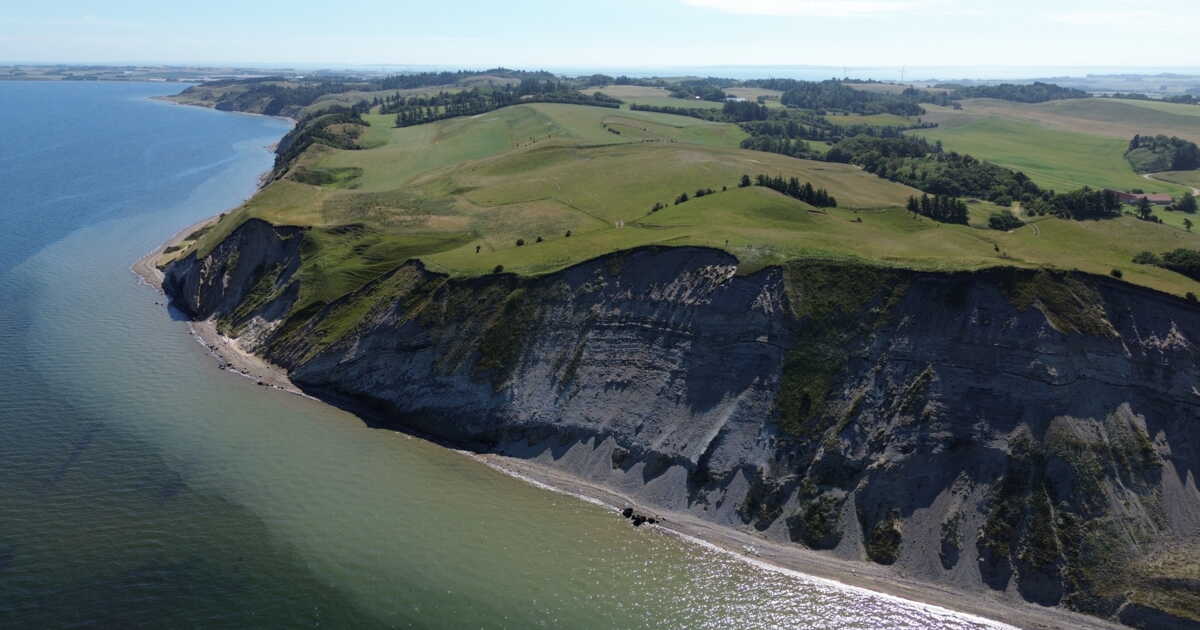
Two Danish coastal cliffs, where paleontologists have unearthed fossils of prehistoric animals dating back 55 million years, are due to join UNESCO’s World Heritage List at the end of July.
The two cliffs of Hanklit and Knudeklint, overlooking the Limfjord in the northwest of Denmark, have long been known for their fossils “exceptionally well preserved” of primitive insects, birds, and more than 80 species of fish, including ancient ancestors of the mackerel and the herring.
Remarkably well-preserved fossils dating back 55 million years
“It’s quite unique”, notes Jan Audun Rasmussen, a researcher and curator at the Mors Museum, and co-author of the UNESCO bid. “These fossils allow us to highlight the evolution of many lineages of fish and birds”, he told AFP.
Fifty-five million years ago, Denmark was submerged under water, and the Limfjord’s clay-rich, oxygen-poor seabed formed a time capsule for fish, birds and turtles which, after dying, sank to the seafloor.
“There was no oxygen for the invertebrates, those small animals that lived on the seabed and fed on the carcasses of dead animals” explained Audun Rasmussen at the foot of Hanklit, the towering 60-meter cliff. This environment was conducive to an “excellent” preservation of fossils, he said.
UNESCO and the International Union for Conservation of Nature (IUCN) have recommended listing them as a World Heritage site. The 196 member states of the UN organization are set to review the nomination this week in Busan (South Korea).
A natural laboratory to better understand climate warming
Beyond a glimpse into a distant past, Hanklit and Knudeklint could also offer lessons for the future, in the face of warming. The rock layers of the cliffs bear witness to a spectacular climate-warming event about 56 million years ago — one of the greatest climate catastrophes in Earth’s history — during which a massive release of greenhouse gases raised global temperatures by 5 to 8 degrees Celsius.
“Obviously, warming leads to many changes in animals” says Laura Jane Cotton, of the Danish Natural History Museum.
The fossils from the Limfjord cliffs — including specimens dating from the time of that event and from the subsequent period — provide researchers with the “best analogue of modern warming”. “It’s a clearer snapshot of that environment at that precise moment”, she tells AFP. “Even if we cannot say exactly which species went extinct and when, we can get a sense of the species that disappeared very suddenly from that environment”, the specialist notes.
Si cette candidature est approuvée, les falaises de Hanklit et de Knudeklint, situées sur les îles de Mors et de Fur dans le fjord, deviendraient le cinquième site naturel du Royaume du Danemark à bénéficier du statut de patrimoine mondial de l’Unesco — dont l’un se trouve au Groenland. Les discussions concernant une candidature ont débuté dès 2010.
La région est prisée des chasseurs de fossiles amateurs, et les “trésors” que sont Hanklit et Knudeklint sont tous deux protégés depuis des décennies par la législation danoise.
Thomas Olesen, chef de projet pour la commune locale de Skive, estime qu’une reconnaissance de l’Unesco donnera un coup de pouce bienvenu au tourisme, en particulier sur la petite île de Fur, qui n’abrite que 700 habitants. “Espérons que cela aura un effet très positif sur l’économie locale”, déclare M. Olesen, depuis le sommet de la falaise de Knudeklint, haute de 30 mètres.