Whether you pursue dreams of spirituality, are drawn by nature, or are captivated by history, Kyoto stands as a promise, ready to answer your calls for escape.
1. Explore Kinkaku-ji, the Golden Pavilion
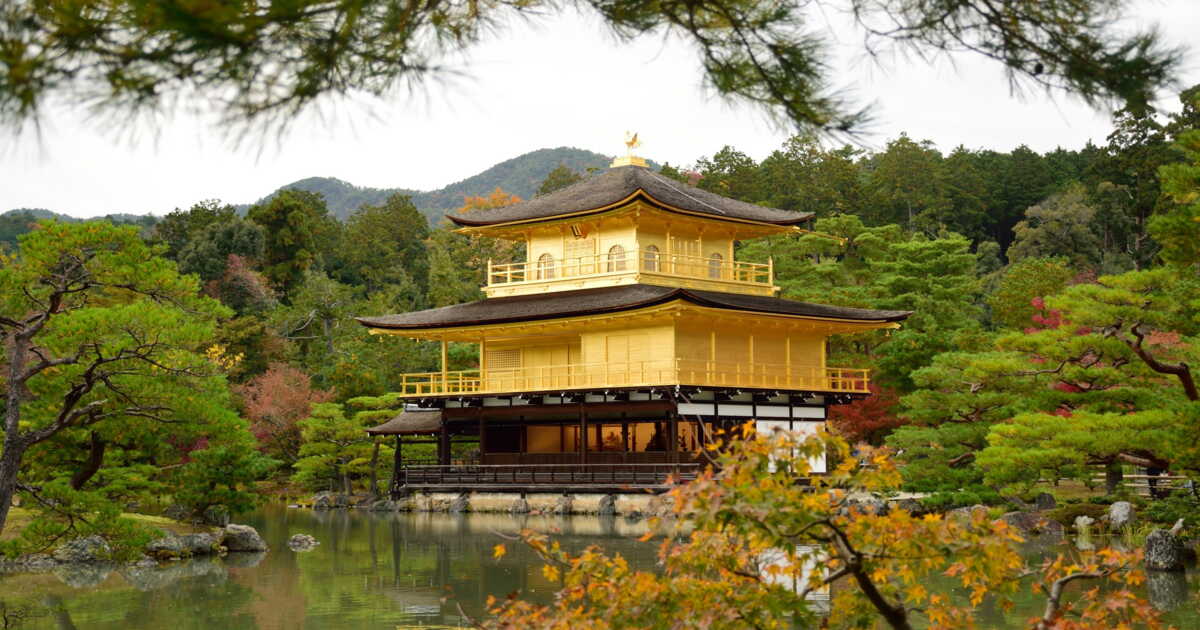
Located in the north of Kyoto, the Kinkaku-ji, or Golden Pavilion, ranks among the must-see sites of Japanese heritage. This Buddhist temple, clad in sheets of pure gold, is distinguished by its refined architecture and its harmonious integration into a traditional landscape garden designed according to the principles of contemplation. Beside a mirror-like pond, the pavilion reflects its lines with striking accuracy in the water, producing a remarkable visual effect in every season, whether the autumn red maples, the cherry blossoms in spring, or the winter snow.
The stroll around the site allows appreciation of the overall spiritual and visual journey, punctuated by symbolic rocks, discreet bridges, and carefully orchestrated viewpoints. The Kinkaku-ji thus stands as a consummate example of aristocratic retreat architecture in medieval Japan, combining visual harmony, Buddhist spirituality, and universal cultural value, offering visitors a moment of pause in a setting that is both structured and soothing.
2. Discover the historic district of Gion
Gion, Kyoto’s iconic district, remains one of the last living strongholds of the oldest Japanese traditions, particularly those connected with the refined world of geishas. At the crossroads of intangible cultural heritage and preserved architecture, its cobbled lanes, lined with machiya, traditional wooden houses, form an authentic backdrop where time seems suspended. You may occasionally encounter maiko (apprentice geishas) in sumptuous kimono, between tea houses where subtle arts such as traditional dance, the shamisen music, or the tea ceremony endure.
At nightfall, red lanterns and soft lighting transform the atmosphere into a discreet theater, conducive to respectful observation of these age-old rituals. More than a mere tourist spot, Gion embodies Kyoto’s living memory, a window onto preserved Japan, where every detail, from the curve of a roof to the echo of a step on the stones, tells a heritage that is continually in motion.
3. Visit the Fushimi Inari-taisha and its thousands of torii
The Fushimi Inari-taisha, one of Kyoto’s most iconic Shinto shrines, is distinguished by its thousands of vermillion torii forming a sacred corridor through the forest of Mount Inari. Dedicated to Inari, the deity of rice, fertility, and commerce, this site draws pilgrims as well as travelers seeking spiritual immersion and striking photography. Each torii gate, often donated by individuals or companies, bears witness to a devotion—either personal or collective—creating a symbolic progression as you ascend.
The winding path, punctuated by small shrines, fox statues, and panoramic pauses, stretches for several kilometers and offers a sweeping view of Kyoto from higher vantage points. Between silent sacrality and a contemplative walking experience, the Fushimi Inari-taisha emerges as a rite of passage—an intersection of nature, belief, and aesthetics—inviting a sensitive reading of the Japanese landscape in all its depth.
4. Admire the Zen gardens of Ryoan-ji
The Ryoan-ji, a Zen temple located in the northwest of Kyoto, is globally renowned for its dry garden (karesansui), an exemplary expression of Japanese sobriety in aesthetics and of mastered emptiness. Composed of fifteen rocks arranged on a bed of carefully raked white gravel, this garden does not reveal its keys to reading immediately: it invites a prolonged observation, a silent contemplation of impermanence, simplicity, and balance.
Situated before the wooden veranda, the visitor faces an open work, whose meaning is not dictated but left to individual interpretation. The temple’s surroundings, surrounded by green moss, a calm pond, and austere buildings, reinforce this impression of detachment and contemplation.
5. Participate in a traditional tea ceremony
To begin the tea ceremony in Japan is to enter one of the most purified expressions of the traditional Japanese culture, and Kyoto, the historic cradle of this art, remains the perfect place to grasp its significance. In the ancient tea houses, nestled in preserved districts like Gion or Uji, each gesture, from placing the bowl to preparing the matcha, adheres to codified rules handed down for centuries.
More than a moment of tasting, it is an esthetic and spiritual experience, founded on the principles of simplicity (wabi), tranquility (sabi), and respect and harmony. The silence, posture, and objects used all contribute to creating a time-space suspended where one savors much more than just tea.
How many days does it take to visit Kyoto? Finding the right rhythm for exploring Japan’s cultural capital
A three-to-five-day stay allows a balanced discovery of its major sites, such as Kyoto’s temples, the Gion district, and the zen gardens, while taking the time to immerse oneself in the contemplative atmosphere that defines the city. Less oriented toward speed than Tokyo, Kyoto requires a slower itinerary, suited to walking, the season, and the succession of ritual and natural spaces. For those wanting to go beyond the emblematic sites and venture toward Arashiyama or Fushimi, extending the stay is recommended.
What to do around Kyoto? Explore landscapes and villages of Kyoto Prefecture, traditional Japan
Two hours by train away, the village of Miyama preserves thatched-roof houses set in a landscape of rice paddies. Further south, Uji offers immersion in tea culture, with its designated heritage and plantations. To the north, Amanohashidate, one of the “three most beautiful landscapes of Japan,” makes for a remarkable coastal excursion. These surroundings reveal a lesser-known face of the region, full of living traditions, less-visited temples, and harmonious scenery. All of these are opportunities to broaden your understanding of Japan beyond the classic circuits.
What to do in Kyoto in the evening? A city that extends its refinement beyond dusk
Evening strolls in Gion, the geisha district, immerse you in old Japan, while Ponto-chō’s street hosts traditional restaurants tucked into wooden, riverfront houses. Kyoto’s temples, like Kiyomizu-dera, on certain autumn or spring evenings, offer exceptional illuminations, extending the spiritual experience into a nocturnal setting. For a more contemporary angle, the art galleries, bars, and literary cafés of Kawaramachi allow exploration of another facet of the city, distinctly creative yet still anchored in elegance.
What to do in Kyoto when it rains?
When rain visits Kyoto, it becomes an opportunity to discover the city differently. Museums, such as the Kyoto National Museum or the Kyoto International Manga Museum, provide ideal cultural shelter. The covered galleries of temples like Sanjūsangen-dō allow you to explore sacred art without getting wet. For a local immersion, Nishiki Market overflows with flavors to sample under a roof, while a tea ceremony in a traditional parlor offers a typically Japanese moment, dry and serene.
What to do in Kyoto with children?
Kyoto is a family-friendly city, with many activities suited for kids. The Kyoto Railway Museum, with its locomotives, simulators, and interactive spaces, makes for a captivating visit. Kyoto Aquarium offers a discovery of marine life that will please younger visitors. For an outdoor moment, the gardens of the Imperial Palace provide space to relax and play. Finally, workshops such as making Japanese pastries or handcrafted paper offer a creative introduction to local culture.
What to do in Kyoto when it’s hot?
On hot days, Kyoto offers refreshing alternatives. A stroll along the Kamogawa River or through Arashiyama’s bamboo groves lets you enjoy shade and a bit of coolness. The Zen gardens, such as Ryoan-ji, provide calm, cool spaces. To quench your thirst, traditional cafés serve kakigōri (shaved ice) and iced matcha drinks, perfect for recharging out of the heat.
This article was drafted with the help of artificial intelligence, then corrected, completed, and validated by the editors of the editorial team.