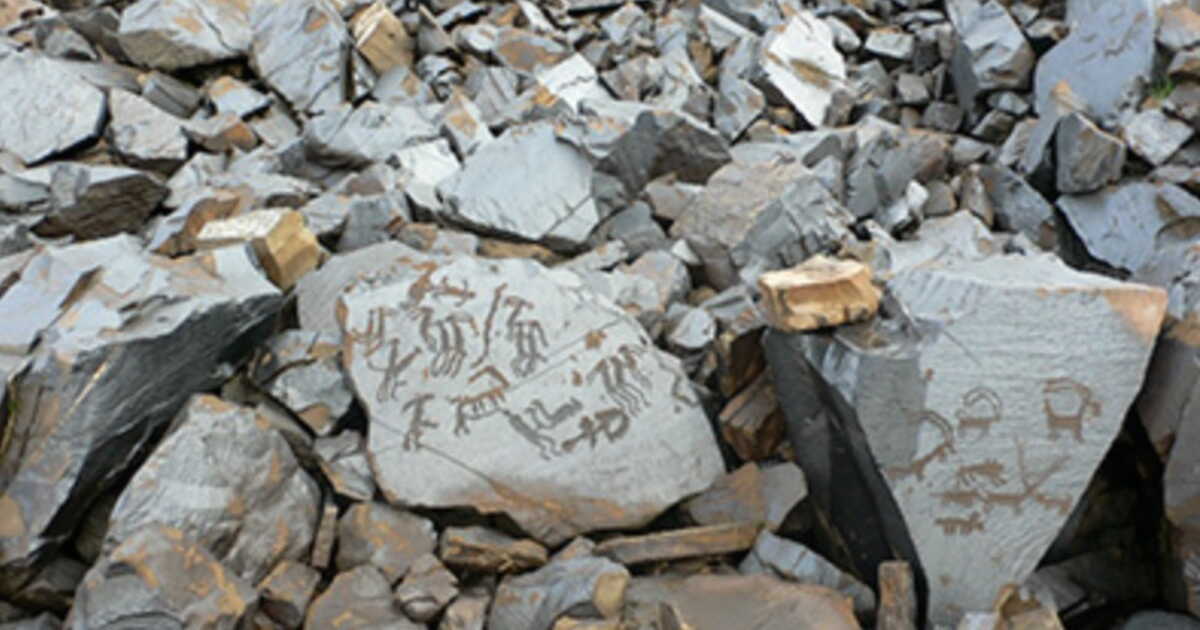
Lost in the Tian Shan mountains, in Kyrgyzstan, Saimaluu Tash holds a real treasure: nearly 90,000 petroglyphs carved on around 10,000 rocks. Some date back to the Bronze Age, about 4,000 years ago, bearing witness to a ritual occupation that lasted for nearly three millennia. Hunts, wars, animals, and scenes tied to the Sun’s cult follow one another on the blocks of volcanic basalt. But to discover this open-air art gallery, one must first tackle a particularly demanding route, accessible only a few weeks each year.
A 4,000-Year-Old Art Gallery
Saimaluu Tash, whose name means “Embroidered Stones” in Kyrgyz, sits more than 2,000 meters above sea level, in a glacial valley isolated within the Tian Shan. The site is regarded as one of the largest and most remote high-altitude petroglyph complexes in the world. The earliest engravings appear to have emerged in the Bronze Age, before later populations continued the work in the Iron Age, then during the era of the early Turkic peoples, up to around 900 CE.
The thousands of carvings etched into the basalt offer a rare glimpse into nomadic societies whose material traces are sometimes hard to trace. Notably visible are hunters, animals such as ibex, scenes of conflict, and depictions associated with the Sun. These images were presumably linked to the beliefs and ritual practices of the peoples who frequented the valley.
Before Islam arrived in Central Asia in the 8th century, Tengriism held a central place in the region’s beliefs. This tradition accorded a central role to the forces and spirits of nature, particularly through shamanic practices. Saimaluu Tash would thus have served as a place of worship for about 3,000 years, before gradually fading into oblivion.
The site was rediscovered only in 1902 by the Russian military cartographer Nikolai Khloudov. Archaeological investigations, however, did not truly begin there until the late 1940s. Since then, its isolation has paradoxically helped preserve it: looting and vandalism have remained limited, while the thick winter snow cover protects the rocks from significant temperature swings.
A Spectacular Site Yet Accessible Only for a Few Weeks
The discovery of Saimaluu Tash is well earned. From the Tian Shan’s mountains, the path winds over rocky terrain and notably crosses a temporary snow bridge. This access gate largely determines whether the site can be reached. Too early in the season, the petroglyphs are still buried under snow; too late, the passage may have melted away. The window during which the complex is accessible typically lasts about six weeks, from July to September.
After nearly three hours of walking, the first carved blocks come into view. For Altynai Kudaibergenova, a guide based in Bishkek, the ancient inhabitants would already have undertaken a true expedition to reach this sacred place. “Ancient peoples had to carefully plan their journey and face all kinds of difficulties to come here, year after year, for centuries”, she told CNN. “They had to travel along trails that skirt steep slopes and over ice-plateaus that linger in the shade and refuse to melt under the midsummer sun.”
The guide also notes the site’s particular position, set in a pass that links the Ferghana Valley with the interior of the Tian Shan. “It is the largest petroglyph site in Central Asia, left by different peoples across four millennia”, she says. Even today, Saimaluu Tash’s isolation remains part of the experience. Here there are no crowds or major tourist infrastructures, only the roughly 10,000 carved rocks sprinkled along the valley’s slopes. A tranquility that could become rarer as Kyrgyzstan grows more accessible as a tourist destination.