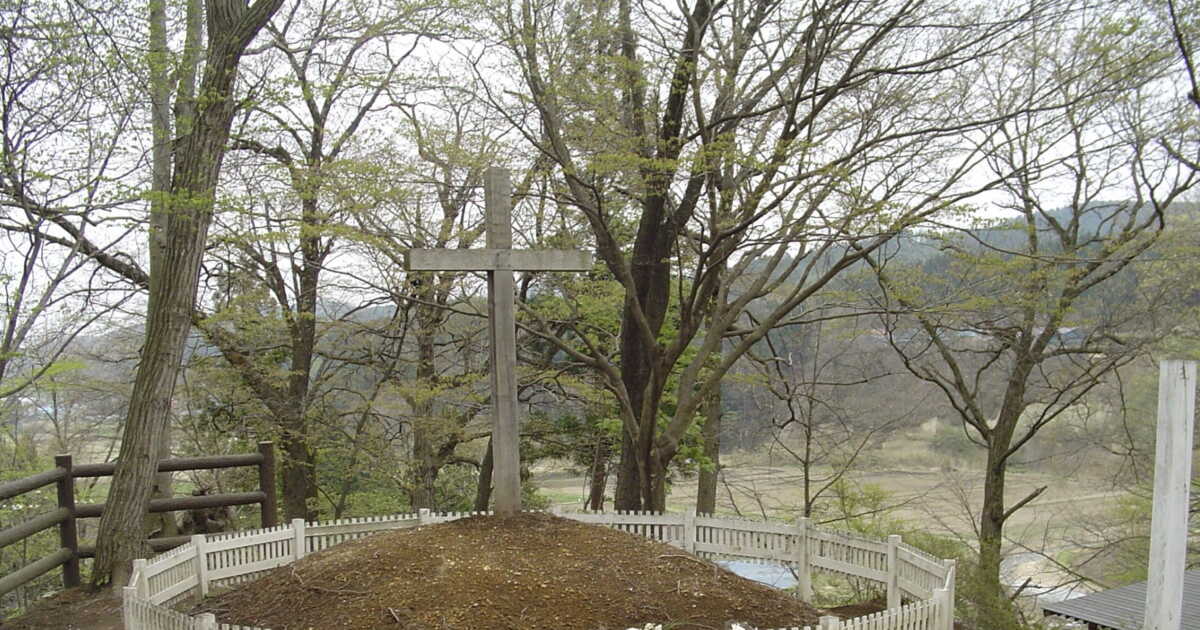
In the wooded mountains of Aomori Prefecture, in northern Japan, a small village draws the curious with a story that is, to say the least, perplexing. In Shingo, two burial mounds are presented as the tomb of Jesus Christ and that of his brother Isukiri. A legend without historical basis, but one that the locals have nurtured for decades through a museum and an annual festival. Here, the mystery matters less than the tradition that has grown around it.
A Legend Born from Mysterious Manuscripts
Arriving in Shingo, nothing suggests that the village is linked to one of Christianity’s central figures. The landscapes are those of quiet rural Japan, between rice fields, farmhouses, and forests. Then a blue sign in English points toward the “Tomb of Christ,” the tomb of Christ.
According to local tradition, Jesus would not have died crucified in Jerusalem. After an initial stay in Japan, he would have returned to Judea before escaping crucifixion. His brother Isukiri would have taken his place on the cross, while Jesus embarked on a second voyage toward the archipelago. He would have settled in Shingo, where he supposedly lived to the age of 106, founded a family, and had three children.
This story rests on the “Takenouchi Documents”, manuscripts whose existence and authenticity are highly contested. They would have been found in 1935 by Kiyomaro Takenouchi, a religious leader who claimed to have identified the tomb of “Iesu Kirisuto”, the name given to Jesus Christ in Japan. The originals are said to have disappeared during World War II, leaving only copies.
The nearby museum presents reproductions of these documents and various items related to the legend. The museum director, Hidenobu Kadogishi, tells CNN that “the tomb of Christ himself has always been here, but nothing allowed a proper explanation”. In 1996, the village therefore created the museum to tell this story to visitors.
On the hillside, two mounds surrounded by small white fences are topped with large wooden crosses. One would be the burial site of Jesus, the other would hold his brother’s ear.
Nevertheless, no reliable historical evidence proves that these are the tombs of Jesus and Isukiri. Japanese professor Ryosuke Okamoto, a theologian and tourism expert at Hokkaido University, reminds CNN: “There is no reliable historical evidence that these are the tombs of Jesus and his brother.” He also notes that Isukiri does not appear anywhere in the Bible.
In Shingo, the Mystery Has Become a tradition
While the legend draws attention, it is not the core of a Christian religious practice. Each year, the village hosts Kirisuto Matsuri, or Christ Festival, on the first Sunday of June. Established in 1964, the event blends local traditions with homage to the two tombs.
The ceremony is led by a Shinto priest, who offers prayers and presents sacred branches called tamagushi. Artists then perform a shishimai, a traditional lion dance, before kimono-clad women interpret Nanyadoyara, a local folk dance around the burial mounds.
Visitors are invited to join the dance. This year, about 1,000 people participated in the festivities, a record for the event. Among them were locals from the region as well as foreign visitors drawn to this singular story.
For mayor Kazutomo Sato, the objective is not to determine whether Jesus actually lived in Shingo. “Don’t overthink it,” he tells CNN. By setting aside the question of truth, the tomb of Christ is here, and we pay homage to it. It’s our reality, and it’s something we have protected as a tradition handed down by our ancestors.”
Professor Ryosuke Okamoto likewise sees the legend’s survival as independent of its historical veracity. “The legend survives not because everyone believes it to be historically true. It survives because people value the place, the festival, and the connection they maintain with previous generations,” he told American media.
This story also contributes to giving Shingo, a village of about 2,000 residents, greater visibility, a situation familiar to many rural areas in Japan facing demographic decline. For Okamoto, the tomb mainly represents “visibility and a memorable story that allow a village to present itself to the outside world”.
Yet the site remains only a waypoint on the broader tour of the region. Nearby are the Oirase Gorge and Lake Towada, while the port city of Hachinohe is reachable in under three hours from Tokyo by high-speed train. In Shingo, the supposed tomb of Jesus thus remains less a Christian pilgrimage site than an extraordinary local story that over time has become a means for the village to safeguard its traditions and to make itself known to the wider world.