Among the canola fields, about a hundred freight wagons linger in the mild air of May. Spanning several tracks, these trains form convoys over 500 meters long, packed with fertilizers, fuels, and manufactured goods. Among them, a few passenger trains push through and stop here as well, at Mockava.
A 1,200-kilometer Route
This hamlet of 50 inhabitants in southern Lithuania houses the Baltic region’s first station for trains arriving from Poland, eight kilometers away. We are in the Suwałki Corridor, a strategic border zone between Lithuania and Poland: it is the sole land access that connects the Baltic states to the European Union. To the west lies Russia’s Kaliningrad exclave; to the east, Belarus under Alexander Lukashenko, close to Vladimir Putin. Suddenly, passenger trains disgorge travelers in astonishment — the Mockava stop isn’t indicated on itineraries. Yet it is essential because passengers must change trains. A relic of the Russian Empire, then the USSR, the rails in the Baltic states use a gauge of 1.52 meters, compared with 1.435 meters in the rest of Europe.
Those 85 millimeters change everything! Indeed, trains coming from neighboring Poland can no longer run on the rail networks of Lithuania, Latvia, and Estonia… even though these countries have been part of the European Union since 2004. Passengers are therefore asked to transfer. Goods, meanwhile, are transferred from one train to another using cranes, and petroleum products are pumped from one tanker wagon to another.
These operations can take up to ten hours, but they should soon belong to the past. Beginning in 2030, a high‑speed line with European gauge is set to connect Poland to the three Baltic states. Its name: Rail Baltica. A 1,200-kilometer route (870 of which run through the Baltic states) that will enable travel from Warsaw, the Polish capital and starting point of Rail Baltica, to the terminus in Tallinn, the Estonian capital facing the Gulf of Finland, in under seven hours — versus twenty today. This colossal project, with a total cost estimated at 24 billion euros and primarily funded by the European Union, involves building new tracks and adapting existing lines. “Until now, trains connected the Baltic states to the Russia. The aim is to create a north–south axis toward Europe”, explains the French engineer Émilien Dang, technical director of Rail Baltica. The line was slated for inauguration in 2026, but the project, plagued by delays and rising costs, is expected to be delivered in 2030. The project was conceived in the 1990s for passenger and freight transport between the Baltic states and the rest of Europe. But in recent years it has taken on a strategic dimension. “Since Russia’s invasion of Ukraine in 2022, the line’s primary objective is military mobility”, Dang adds.
A Track Designed Also for Military Freight
In coordination with NATO, the Rail Baltica rail infrastructure, of which 300 kilometers of tracks are currently under construction, is being adapted to allow the passage of military convoys wider, longer, and heavier than civilian trains.
But this line will also enable travelers to discover the landscapes, culture, and heritage of the Baltic States, lands little known at the far northeast of continental Europe. Thus, after Mockava Station, the line continues through Lithuania, home to 2.89 million inhabitants and the largest of the three Baltic States (65,300 square kilometers, just smaller than the Auvergne-Rhône-Alpes region). A land set with lakes, small villages with wooden churches, and boreal forests (one third of the country is forested).
After about thirty kilometers across the countryside, Rail Baltica reaches Marijampolė (35,000 inhabitants), the first major Lithuanian city from the border. Its most beautiful monument: its station. With its crenellated tower and colorful stained glass, the building, erected in 1923, recalls a neo-Gothic castle, but its décor is mainly marked by the Modernist Art Deco influence that also pervades other buildings in the city.
From Marijampolė, Rail Baltica heads toward the former capital of Lithuania, Kaunas, about sixty kilometers to the northeast. Before arriving at the central station, the train traverses one of the oldest railway tunnels still in service in Eastern Europe, built under the Russian Empire in 1862, then crosses the Neman River. Kaunas is worth a stop. Just outside the station, one is swept up by its vitality. Fringed with linden trees, café terraces, booksellers, and galleries, Laisvės Alėja (“the Avenue of Freedom”), a 1.6-kilometer pedestrian thoroughfare, is the city’s beating heart. Kaunas is home to about 35,000 students (out of 300,000 inhabitants, more than 10% of the population). It is here, at Vytautas Magnus University, that Emilija Pundziūtė-Gallois teaches political science. “In February 2025, our electrical lines, which had until then been connected to Russia, were finally linked to the European grid,” the researcher explains. “We still need rail to free ourselves from our dependence on Moscow.” A notification on her cell interrupts: “There is a drone above my children’s high school in Vilnius, they must take shelter.” In recent months, incursions by Ukrainian drones, either misdirected or jammed by Russia, have multiplied in the Baltic States. Once down, they are often hard to locate. “We’ll find them at mushroom season,” Lithuanians joke.
The Baltic peoples share a priority with Latvians and Estonians: to break free from any ties to their Russian neighbor, including culturally. Before a concert in a Kaunas theater, violinist Barbora Valiuk tastes the traditional šaltibarščiai, a cold beet soup made with kefir.
Vilnius, Green Capital
“Today in Lithuania, we can no longer play Russian music. I can’t even teach Tchaikovsky’s Piano Concerto in D major to my students” says the violinist, lamenting this loss even as she understands the political reasons.
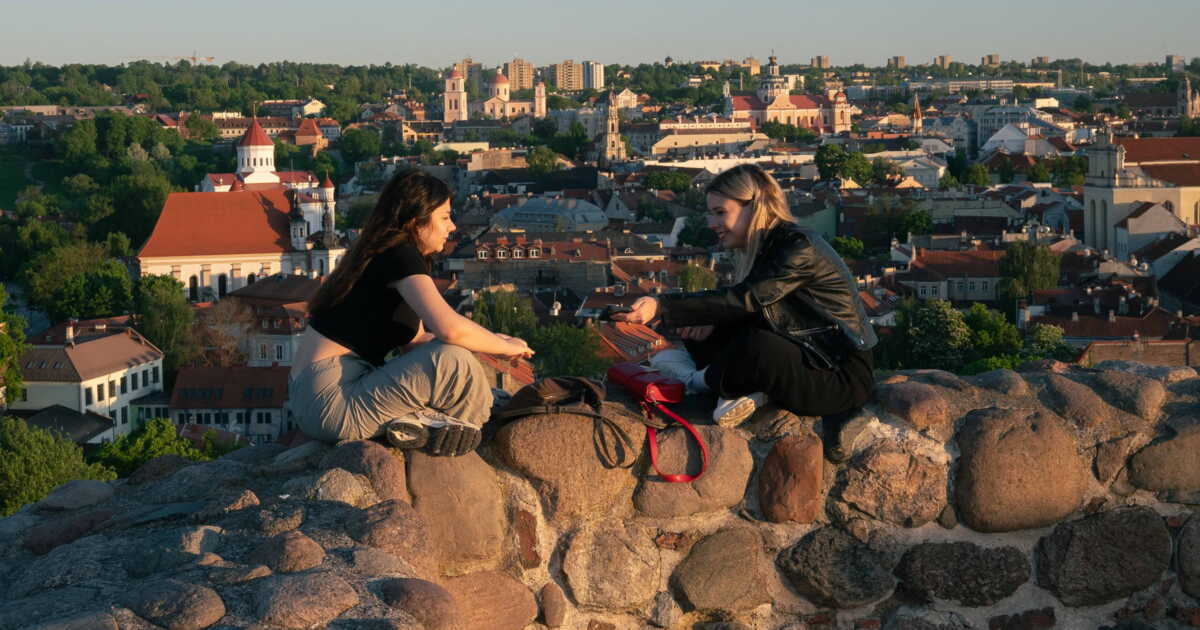
From Kaunas, a branch of Rail Baltica veers east to join Vilnius, about a hundred kilometers away. Surrounded by hills (including the country’s highest point, Aukštojas, a modest 294 meters tall), the Lithuanian capital, two-thirds of which is natural space, was designated the European Green Capital in 2025. Its parks, the Neris riverbanks, and its charming baroque center make it a haven of peace. Yet signs across the city reveal another reality. A modern building is draped with a gigantic poster reading: “Putin, The Hague awaits you”, a reference to the International Criminal Court, which has jurisdiction, among other charges, for war crimes. Ukrainian flags flutter on city buses. Many Lithuanians are convinced that the Baltic states will be Moscow’s next target. To oppose its powerful neighbor, Lithuania has anchored itself more than ever in the Western economy. It is in Vilnius that Vinted, a clothing resale specialist and one of Europe’s leading digital stars, was founded in 2008.
Returning to Kaunas, the main Rail Baltica route heads north toward the border with Latvia. On this stretch, bulldozers and excavators are at work to construct the future high-speed line. The rail will pass not far from the Hill of Crosses, near Šiauliai. This 19th-century pilgrimage site, entirely covered by an intricate tangle of hundreds of thousands of crosses and rosaries of all kinds, is one of the country’s most visited sites and a 20th-century symbol of resistance to communist atheism. From there, the train will travel about forty kilometers through cereal fields and meadows to the Latvian border, which, being in the Schengen area, is not marked by border posts. The Latvian side presents the same agricultural landscape, in the Zemgale plain, Latvia’s grain basket.
Art Nouveau in Majestic Splendor
When arriving in Riga, the contrast is striking. The station is undergoing a major extension in glass and aluminum. The roof shape echoes the vast metal arches of the Central Market, one of Europe’s largest, located just a few dozen meters away. Originally, this building, constructed by the Germans during World War I, served as a hangar for zeppelins. Today, it hosts the Baltic specialties, but also dishes from other former Soviet republics. In the stalls they even cook a plov (pilaf rice with vegetables, meat, cumin, coriander, and turmeric) worthy of the eateries of Samarcanda in Uzbekistan!
The project for Riga’s new station had to be UNESCO-protected, as the entire central area is on the World Heritage List. Ornate balconies, lavish woodwork, old Riga fascinates with the exuberance of its Art Nouveau buildings. Some were designed in the early 20th century by the Russian architect Mikhail Eisenstein (father of Sergei Eisenstein, the famous director of the Battleship Potemkin). Among his masterpieces, 10 Elizabetes Street, built in 1903, is known for its blue-and-white façade, glazed bricks, and giant carved faces. A stunning showcase for Jugendstil, the German-Baltic version of Art Nouveau. Walking through the Latvian capital, one can easily imagine its prosperity in the era of the Russian Empire, when it stood as an equal to Saint Petersburg.
A Tunnel Under the Baltic?
It’s a bit of a crazy project: linking Helsinki, the Finnish capital, to Tallinn, Estonia, by an underwater railway connection, thus extending Rail Baltica. The journey could then be made in thirty minutes, compared with two to three hours today by ferry. To do this, a 103-kilometer-long tunnel would have to be dug under the Baltic Sea (double the length of the Channel Tunnel). This would make it the longest underwater railway tunnel in the world! But the cost, between 13 and 20 billion euros, is a restraint for the two countries. A similar project is being pursued by Finnish entrepreneur Peter Vesterbacka. The businessman, seeking European private investors, dreams, beyond the tunnel, of constructing, along the route, an artificial island served by the train in the Gulf of Finland, intended to house residents and students.
Today, 40% of Riga’s population is Russian-speaking (compared with 25% nationwide — the highest proportion in the Baltic states). A surprisingly discreet presence: no Cyrillic signs, very few Russian restaurants… But within Rail Baltica, a company owned by the three Baltic railways and headquartered in Riga, suspicion remains. “Europe did not want to work with the Russian-speakers of Latvia, fearing their proximity to Moscow and the risk of espionage, says Federico Antoniazzi, a railway engineer dispatched by France to Rail Baltica. Yet they are the ones who, since the Soviet era, have rail expertise. It was necessary to seek personnel in other European countries.”
Beyond Riga lies the most spectacular stretch of the route. Before reaching Estonia, some 120 kilometers farther north, the line will run along the Baltic Sea, between dunes and pine forests. One of the Baltic states’ least densely populated areas. The train will stop at Vangaži station, gateway to Gauja, the country’s oldest national park and one of the largest in the Baltic states. A paradise for hikers and heritage lovers, with its wooded valleys, lakes, and medieval castles.
Bears, Lynx, and Capercaillie
Remote from major arteries, this park is a well-kept secret. Thus, in this corner, Rail Baltica’s route, between a natural park and preserved coastal zones, has sparked controversy. On the other side of the border, in Estonia, in the Luitemaa nature reserve, biologist Mati Kose rages: the Rail Baltica route was “chosen to be as short as possible, without regard for nature.” With its forests, peat bogs, and coastal meadows, this region hosts a largely preserved environment… for now. Because building the high-speed line is likely to jeopardize local wildlife: bears, lynx, and also capercaillie. “Even the Soviets paid more attention to nature” protests Mati Kose, pointing to marshes that must be drained to make way for the tracks. In response, Rail Baltica officials cite the construction of ecoducts, bridges spanning the tracks to allow animals to cross without the risk of collision. Several have already been built. Fully vegetated, they are rich in shrubs and water features to attract animals. Not reassuring Terje Mitev, who runs an organic farm in southern Estonia along the line: “No animal uses them, plus humans are not allowed to use them. It’s absurd!”, she exclaims. In summer, Terje sells her artisanal ice creams in Pärnu, a seaside resort that will be served by Rail Baltica and which has the quaint charm of 1930s resort towns, with cruise-ship hotels and kiosks lined along the beach.
Off the Pleasant Tallinn, the Russian Ghost Fleet
For Priit Pruul, spokesperson for the Estonian railways, this line will be a springboard for tourism: “Travelers will be able to easily traverse the three Baltic states during a single trip, he says. Residents will also be able to better discover their own region.” Here is Tallinn, the terminus of the line. The new Tallinn Central Station, designed by the English firm Zaha Hadid Architects, is under construction in the Ülemiste high‑tech district, where about 400 companies are based. With its glassy office towers, this smart city illustrates the Baltic states’ rapid leap into a market economy. Estonia, birthplace of Skype and Bolt, is a cradle of startups aided by favorable taxation. In the center, old railway wastelands have become a bohemian district named Telliskivi. The warehouses have been transformed into boutiques, restaurants, and concert halls. Near the port, the old power plant hosts exhibitions.
Beyond its famous colorful houses and renovated churches, Tallinn has become one of the most exciting cities in northern Europe. A revival that contrasts with a remnant of the past: Linnahall. With its spectacular concrete architecture, this former Soviet-era palace of culture and sports, built in 1980 for Moscow’s Olympics, lies abandoned. Some would like it demolished, others defend it for its aesthetic value or its memorial dimension. In the evenings, its steps, overgrown with vegetation, come alive with improvised DJ sets. The atmosphere is gentle, carefree. In the distance, the Baltic Sea has become a nerve center of geopolitical tensions. Offshore, among ferries and freighters, lies the Russian ghost fleet, ships used by Moscow to clandestinely transport oil despite the sanctions.
This is the Baltic States’ paradox: the proximity of the war in Ukraine gives the region a renewed vigor and a desire to live even more intensely than before. By further shrinking distances to the rest of Europe, Rail Baltica should amplify this momentum.
➤ Article appeared in GEO magazine no. 572, “The Azores, nine islands, nine worlds to explore,” October 2026.
➤ Do you love GEO? Then to make sure you don’t miss anything, discover our subscription options to receive GEO every month at your home with ease.