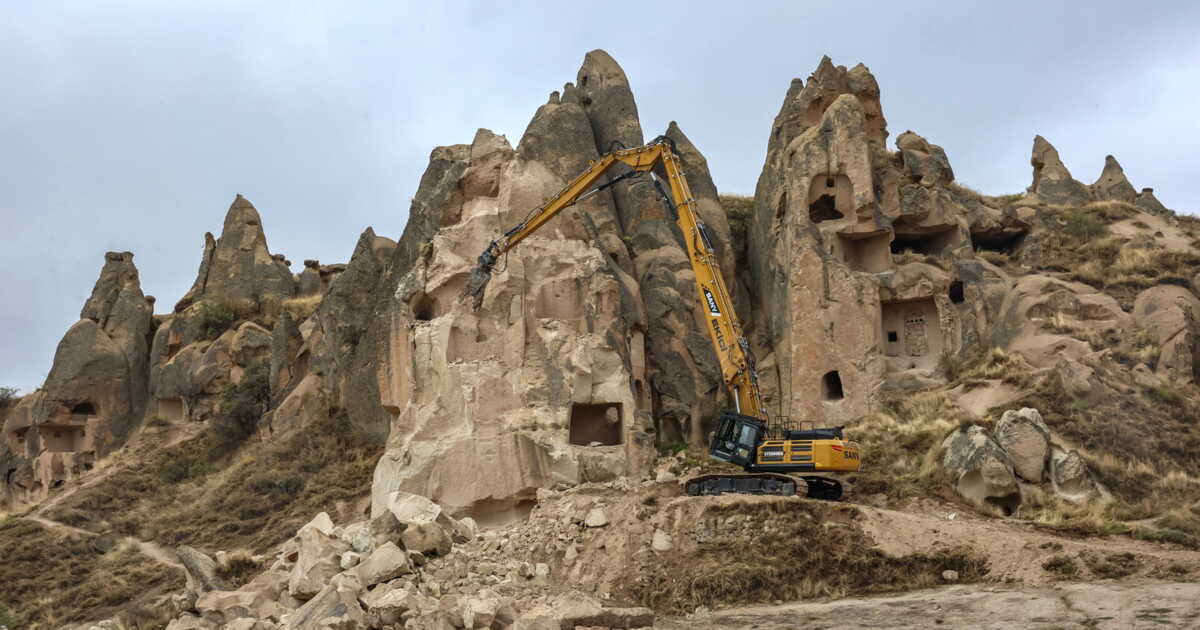
Three people, including a foreign national, were killed and five others injured when a rock column collapsed on Thursday at a UNESCO World Heritage site in Cappadocia, in central Turkey.
The site, which draws visitors from around the globe, hosts formations known as “fairy chimneys” formed by ancient volcanic activity. They are now destabilized by both natural processes and over-tourism.
A deadly rockfall in broad daylight
The bodies of three individuals, including one foreign national, were recovered beneath the stones, Nevşehir governor Huseyin Kok said. Five others were injured, authorities added, one of whom remained in hospital on Thursday evening.
The incident occurred at 15:15 local time (12:15 GMT) following “a rockfall caused by a landslide in the town of Göreme”, the governor specified.
An investigation has been opened by the Nevşehir prosecutor’s office and is due to begin Friday morning. The nationality of the foreign victim has not been specified.
Images from the Turkish news agency IHA showed a vast plume of dust rising beside a parking area, as well as the body of a victim trapped beneath a massive rock.
Bulldozers and rescuers, equipped with powerful flashlights, were at work well after nightfall, sometimes quieting the machines in hopes of catching the calls of potential survivors beneath the enormous blocks that had broken away from the cliff. “Our teams pulled back after determining that it was no longer necessary to continue the operations”, the governor said shortly after 7:30 p.m., implying that the toll was final.
A World Heritage site fragile under the pressure of tourism
The site has been on the UNESCO World Heritage list since 1985. It was also popularized by the on-site film “Winter Sleep” by Turkish director Nuri Bilge Ceylan, Cannes’ Palme d’Or winner in 2014.
“In a striking landscape shaped by erosion, the Göreme valley and its surroundings host rock-cut sanctuaries (…), troglodyte villages and underground towns, vestiges of a traditional human settlement whose beginnings date back to the 4th century”, the UN agency writes on its site.
But UNESCO also describes a place that would require serious, coordinated management. “Over-tourism and certain acts of vandalism have been reported and some incompatible constructions have been introduced”, it laments. Conservation plans and protection measures exist, but the situation calls for an integrated regional plan with “adequate financial, political and technical support”, the agency adds.
Studies completed in 2003 proposed that the site’s development respect natural zones “as they were declared in 1976”. In September of last year, local authorities took stock of the resumption of restoration work in 2024.
“Cappadocia is a very important destination, but it also has very fragile rock formations”, admitted the head of the site’s managing body, Aydoğan Cem Aslanbay, to the Daily Sabah newspaper. “We are doing everything we can to prevent further degradation.”
He noted that the site attracts roughly 4.5 million visitors each year and generates about $2.5 billion in revenue, drawing tourists from around the world, including hot-air balloon enthusiasts who can soar over this extraordinary landscape.
In 2024, a similar rockfall had occurred without any casualties.