
It sits far from the coast, in the heart of the Centre region, between mountains, valleys and old border lands. The country comprises hundreds of villages, and the Aldeias de Portugal network alone brings together more than 130 of them. Twelve of them form, however, a distinct ensemble: The Historic Villages of Portugal.
Castles perched on rocks, houses built of granite and schist, cobbled streets, celebrations handed down through generations: Each of these twelve villages has its own character and offers an invitation to slow down and rediscover travel in its purest form.
Castles perched on rocks, houses built of granite and schist, cobbled streets, celebrations handed down through generations: Each of these twelve villages has its own character and offers an invitation to slow down and rediscover travel in its purest form.
What is a “Historic Village”?
While there are hundreds of charming small towns across the country, only twelve exceptional locales form this unique network. Born in the 1990s, this initiative rests on a high standard: preserving a rare architectural, archaeological and landscape heritage, while reviving the soul of these lands of history.
Each village had to prove the value of its heritage — its key role in defending frontiers or in the founding of the kingdom —, the presence of listed monuments, the preservation of its stone architecture, as well as the vitality of its oral and gastronomic traditions.
It is precisely these high standards that today ensure that every stone, every castle and every alley tells a living chapter of Portugal’s history. For travelers, it is the absolute guarantee of a cultural and human immersion of priceless value.
Today, these twelve jewels — Almeida, Belmonte, Castelo Mendo, Castelo Novo, Castelo Rodrigo, Idanha-a-Velha, Linhares da Beira, Marialva, Monsanto, Piódão, Sortelha et Trancoso — embody the excellence of sustainable tourism. The network is moreover the first in Portugal to obtain the international Biosphere Destination certification, and three of its villages (Castelo Rodrigo, Castelo Novo and Sortelha) have been distinguished among the Best Tourism Villages by the World Tourism Organization.
For hiking and trekking enthusiasts, the Great Route of Historic Villages (GR22) connects these twelve stops along a circular route of nearly 600 kilometers in the heart of preserved nature.
Six faces to discover among the twelve jewels
Each of the twelve destinations in this selective network certainly deserves a visit. But to inspire the design of your itineraries, we have chosen to highlight six of them. While all share the nobility of stone and the memory of centuries, each offers a distinct identity — from the majesty of granite to the softness of schist, including Jewish heritage and medieval legends.
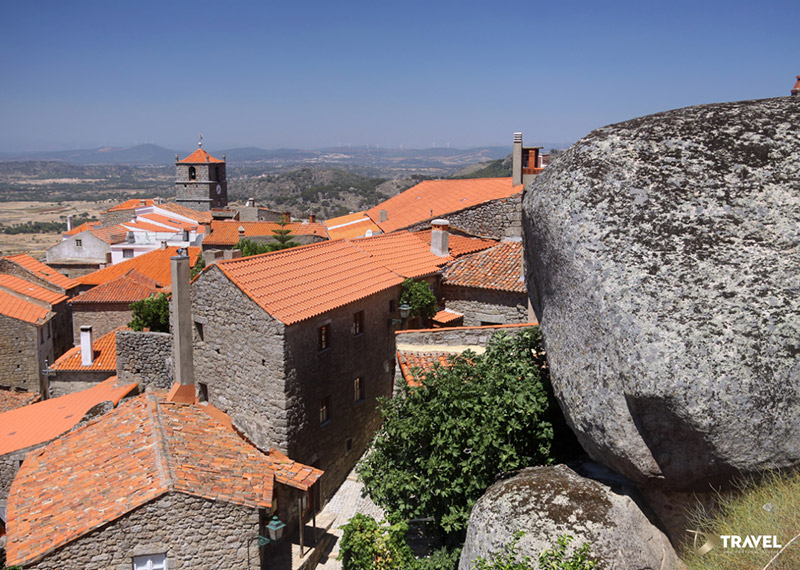
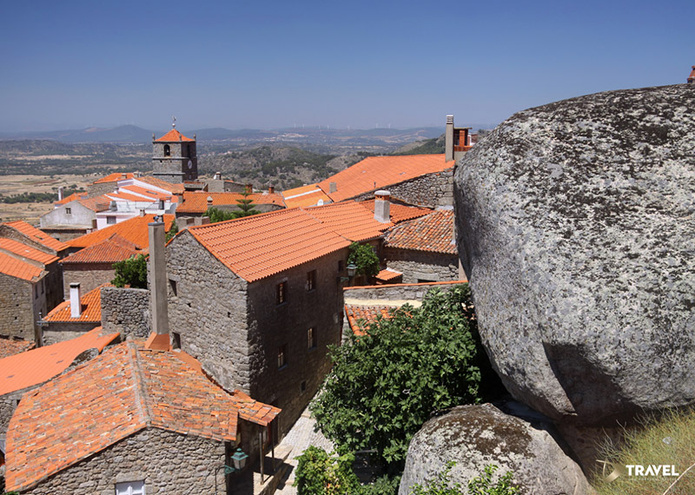
Monsanto, the stone as a home. In Monsanto, the boundary between nature’s craft and human work blurs into a dizzying spectacle. Clinging to its imposing granite colossus, the village seems directly carved into the mountain: here, the houses nestle among vast rock chaos, where a centuries-old rock becomes a wall, a lintel or a roof.
Wandering its steep lanes is to live a magical, timeless journey. Crowned in 1938 as “the most Portuguese village of Portugal” — a title symbolized by the famous silver rooster that dominates the Tower of Lucano — Monsanto keeps a proud and untamable soul. Up at the very summit, the majestic remains of its medieval castle offer a breathtaking panorama, embracing the endless horizons of Beira Baixa. A grand and mythical stop, where stone tells the living history of Portugal.
For centuries, in the intimacy of the alleys and behind the discreet façades of the old quarter, families kept alive in secret the flame of their faith, passing prayers and rites from generation to generation. Rediscovered at the end of the 20th century, this community now beats at the heart of the village. Visiting the Bet Eliahu synagogue, the Jewish Museum or wandering through the old quarter offers a human and historical experience of rare intensity.
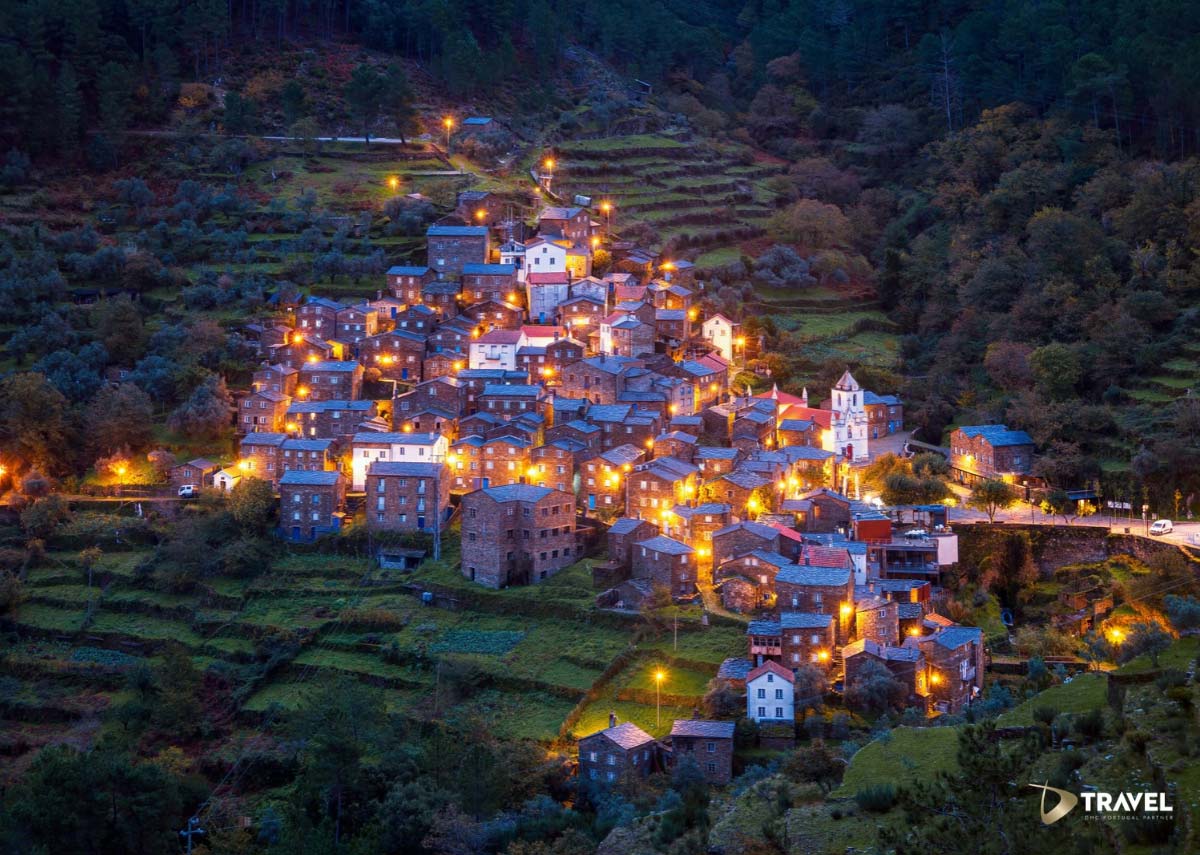
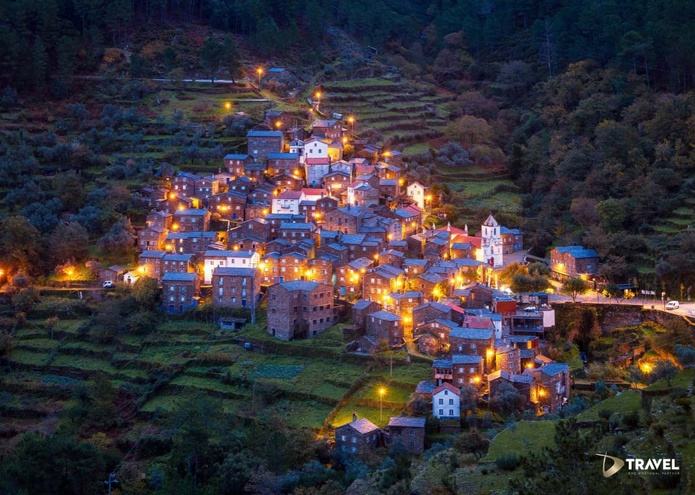
Piódão, the cradle village. In the heart of the Serra do Açor, Piódão appears as a living painting. Clinging to the mountainside, its dark schist and slate houses are arranged amphitheatrically, one above the other, following the steep relief. Their doors and windows painted in a vivid blue bring a unique touch of freshness, while at the center stands the white façade of the Nossa Senhora da Conceição church.
The nickname “cradle village” makes sense at dusk. When the sun sets and the small lights in homes turn on one by one, Piódão lights up like a Nativity scene set on a grand scale. It is reached by a beautiful winding road that snakes through the region’s spectacular landscapes.
Marialva, the medieval town suspended in time. Proudly perched on top of a massive granite spur, Marialva rises as a true fairy-tale setting. A former fortified town that once watched over the Beira borders, it now offers a striking journey through the centuries.
Entering its stone gates reveals the ruins of its castle, its carved pillory, and its peaceful medieval lanes. Ideally situated, Marialva marks the perfect transition between the terraced vineyards of the Douro Superior and the Côa valley, famed for its UNESCO-listed rock engravings. A characterful stop that adds a great deal of elegance to a regional itinerary.
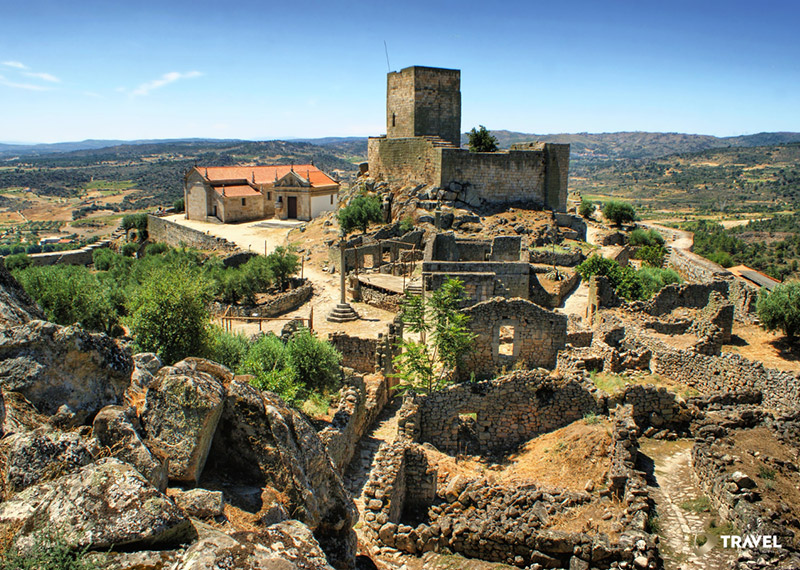
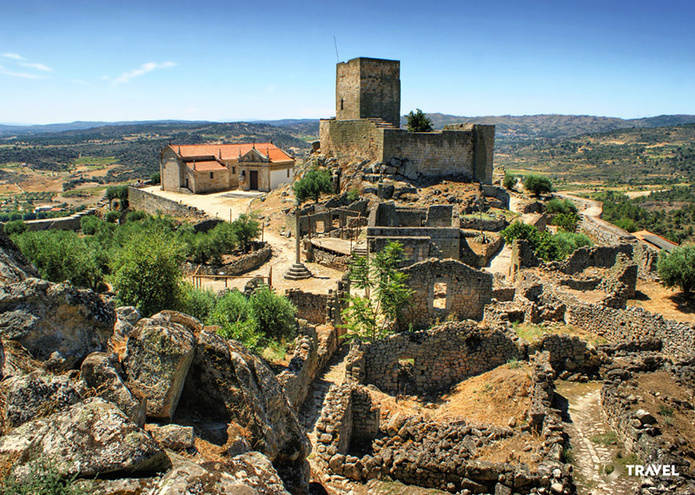
Sortelha, the medieval jewel beneath the rampart. Set at more than 700 meters above sea level, Sortelha is one of the best-preserved medieval ensembles in the country. Surrounded by an intact oval wall, the village unfolds a labyrinth of cobbled lanes dominated by its rock-built castle.
Each stone here seems to carry a story, just like the Cabeça da Velha rock, sculpted by erosion whose profile resembles a face gazing toward the horizon. Distinguished by the UN World Tourism Organization as one of the world’s prettiest villages, Sortelha offers a true time-out, where the ruggedness of granite meets the serenity of the mountains.
Linhares da Beira, the cathedral of wind and heritage. Clinging to the western slope of the majestic Serra da Estrela, Linhares da Beira stands as a genuine open-air museum. Dominated by the proud towers of its medieval castle, this village with a glorious past preserves the soul of Portugal’s early kingdom. Strolling its lanes, one admires granite architecture of rare finesse, where Gothic and Manueline houses testify to centuries of nobility and autonomy.
But Linhares also lives in the present: a paragliding capital, the village offers visitors the magical sight of colorful sails tracing elegant arabesques above the valley. Between the imprint of history and the breath of freedom, it is an essential stop that never fails to amaze.
The art of tailor-made travel: the key to a successful journey


Elisabete João
(+351) 91 333 94 79
[email protected]
www.dtravel.pt
(+351) 91 333 94 79
[email protected]
www.dtravel.pt
 |
 |
 |
>> Dtravel in the DESTIMAG Directory