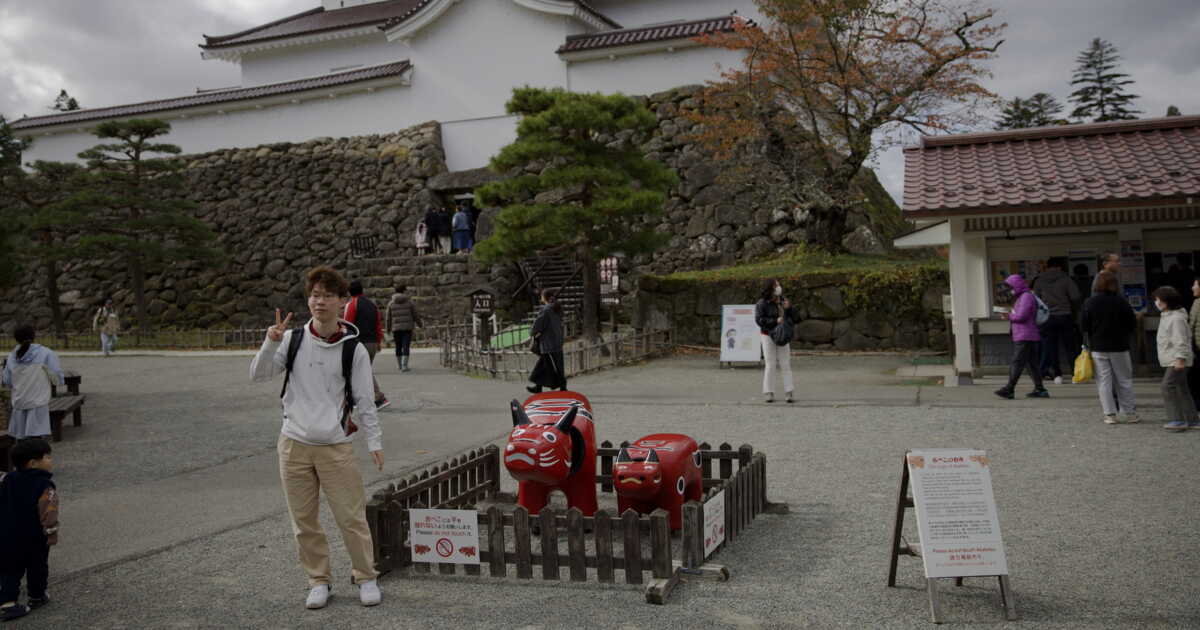
A Sunday in early November. Aizuwakamatsu, a town of about 110,000 residents about an hour by train from Kōriyama, the major railway hub of Fukushima Prefecture, is in the thick of momijigari. In other words, the autumn foliage season, with maple trees especially taking center stage for a few weeks, outshining the cherry blossoms for a moment. Visitors, nearly all Japanese, have come to unwind in the region’s hot waters and to admire the red-hued trees that cloak the mountainsides.
As soon as they step out of the station, though, another silhouette of an even more brilliant red awaits them: a lacquered cow, gleaming, with a generous form and a long neck extended forward like a turtle ready to snatch a fly. Very respectable ladies pause to pat its rump, as if it were an idol deserving a few liberties. Others seize the moment for a selfie in front of the figure. They’re not done posing, because in Aizuwakamatsu, the red cow is everywhere.
A Legend Born in a Temple
The story begins in Yanaizu, a village at the end of a valley, a little to the west. According to one of the most popular versions of the legend, a temple, destroyed by an earthquake in 1611, was to be rebuilt atop a cliff. But the timber arriving by the river would have to be hauled up a very steep slope. A herd of red cows appeared as if by magic to help the workers transport the material.
Some versions even trace the tale back to the founding of the temple in 807. What is certain is that the inhabitants gave these providential animals the name akabeko (aka means red in Japanese, and beko, cow in the local dialect). And today, a statue of the beast watches over the temple grounds.
From Toy to Talisman
How this akabeko moved from a piece of local folklore to a national symbol is still debated. What is known is that, around the same seventeenth century, the many samurai in the region were encouraged to craft papier-mâché figurines representing the animal to earn a supplemental income… a craft that quickly became a regional specialty.
In 1713, a smallpox epidemic strikes Aizu. The tradition says that children who possessed an akabeko were spared. The black dots painted on its body evoke the scars left by the disease: the cow would, in a sense, take the illness upon itself for its owner. The red, a protective color in Japanese tradition, completed the symbolism. The craft has remained artisanal: Japanese paper glued to a wooden mold, then hand-painted. A distinctive feature that completes the irresistible charm of the akabeko: its long turtle neck is suspended from the rest of its body by a cord, giving it a nodding motion reminiscent of the dogs that nod their heads in the back of cars.
Why Japan Loves Its Mascots
That charming breed of characters you instantly want to adopt has become a specialty in Japan. They are called here yuru-kyara, or “laid-back characters.” There are believed to be more than 3,000 in the country, by one estimate. Their mission: to embody a region, its products, its legends, and to entice people to visit. The case study is Kumamon, the black bear from Kumamoto who won the Yuru-kyara Grand Prix in 2011. According to local authorities, sales of products bearing his image multiplied elevenfold in 2012, for at least 29 billion yen (about 160 million euros at current rates). The affable bear from Kyushu, the southernmost of Japan’s major islands, managed to become recognizable across the entire archipelago.
The akabeko has not reached Kumamon’s level of popularity. But its pedigree is far more tangible. No agency drew it up, unlike the bear. It existed centuries before regional territories began to seek mascots to present to the public. And whereas many of its peers have somewhat artificial histories created for the occasion, the akabeko can rightly boast of being among the yokai, those magical creatures that populate Japanese folklore (such as the kitsune, the fox messenger of the deity Inari, or the tanuki, mischievous and shape-shifting raccoon dogs).
A Star That Invites Itself Everywhere
In any case, in Aizuwakamatsu it is impossible to escape the charms of the red cow. In the most serious lacquer shops of the region, where the main specialty is displayed—plates, sake cups, or elegant lunch boxes with sumptuous decorations—trinkets bearing the akabeko motif (and at much more affordable prices) sit near the cash register. Fifteen minutes’ walk from the center’s shops, at Tsuruga Castle, the cow is still there. In the park, where dozens of onlookers crowd along the promenade that circles the moat in search of the red leaves, everything is arranged to allow posing beside it with the perfect background: tenshu (the main keep of a Japanese castle) or the red maple leaves, you only have to choose.
The akabeko also travels on city buses, decorates barriers and storm drains across the town, and appears on storefronts of pastry shops and sake merchants. The cow even enjoyed a collaboration with beloved children’s characters: Hello Kitty and the very kawaii (cute) puppy Cinnamoroll, spotted in shops dressed as a local cow. A cocktail of cuteness made possible by a well-tuned mechanism: the gotouchi (literally “local” editions) launched by Sanrio (the company behind Hello Kitty and Cinnamoroll) to boost the colors of each prefecture. The akabeko has also adapted to other, less saccharine worlds, notably in the manga realm: a Naruto edition of the red cow, produced by the AN-IPPON line of Dai Nippon Printing, is already sold in North America as the first milestone of a broader project to export crafts from all 47 prefectures.
This turning point changes the very nature of the object. From a lucky charm placed on a shelf, the akabeko has become a mascot you carry with you, share on social networks, and rediscover for its retro look and its bobbing neck. Figures confirm it: the Meisei Kikaku wholesaler has sold more than 100,000 capsule coin banks since 2023, followed by around 36,000 resin stickers in just two months. As for Akabeko Land, a shop that sells only merchandise featuring the cow, after opening outlets on Mount Iimori (the eastern hill near the station, famous for its Sazaedo pagoda) and in Nanokamachi (the Taishō-era historic street a stop away from the station), it opened in August 2026 a store in front of the station to welcome travelers as soon as they disembark from the train.
Cute Enough to Bite
According to another Japanese quirk that treats all things kawaii as edible in both senses, the akabeko also appears as a whole range of sweets: “Mamebeko” chocolates in Tirol-shaped cow form, manju (little buns with red bean paste), lollipops, fruit pastes…
The logic follows that of omiyage, the edible gift one brings back from any trip, even a simple weekend, for family and colleagues. Offering a box bearing the akabeko implies telling, without a word, where you’ve just returned from. Because every Japanese person instantly understands what lies behind the symbol. It’s not certain that your office neighbor or mother-in-law will identify the keepsake, but it will be an excellent way to talk about your journey as well!