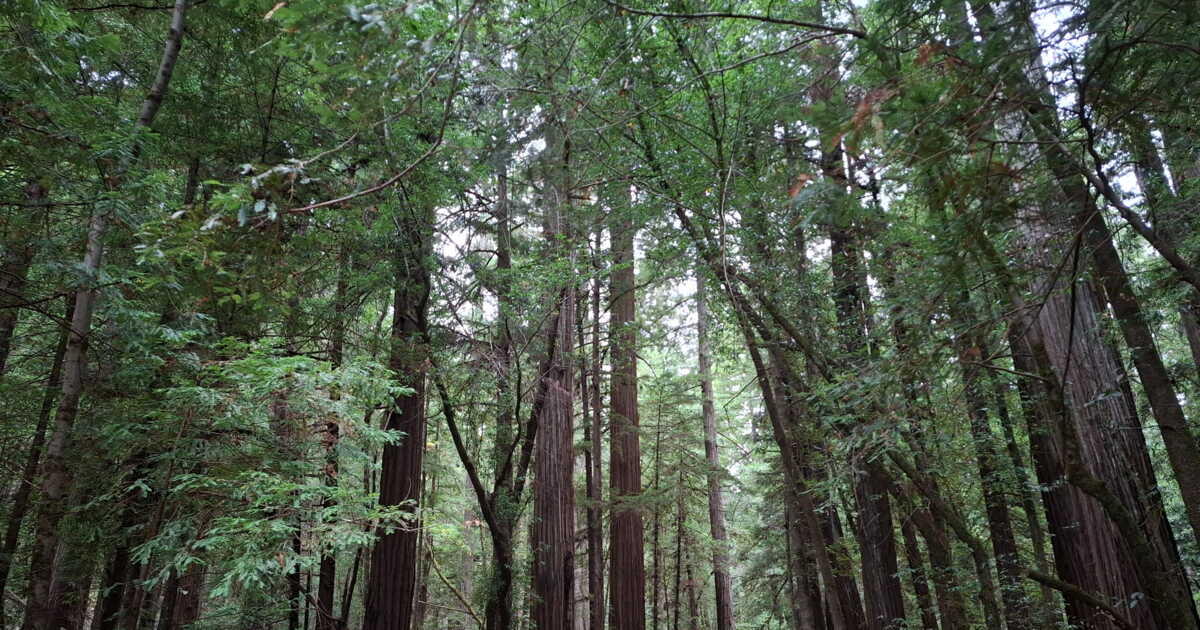
As you pass through California, take a moment to step away from the city’s frenetic pace. North of the Golden Gate across the bay that lends its name to the bridge bridging it, a multitude of natural wonders await. The sunlit vineyards of Sonoma or Napa counties, of course, and the charms of towns such as Petaluma, certainly. But also the austere verticality of the coastal redwoods, an endemic species of the Pacific coastline of North America, which carpets the fog-swept valleys.
Silence falls as soon as you enter Armstrong Redwoods State Natural Reserve in Sonoma County. The city noises fade and vanish among the colossal trunks of the local giants: the coastal redwoods, silent witnesses to the area’s history — from Indigenous customs to the rise of Silicon Valley’s titans, through the Hispanicization and then Americanization of California. Explanatory panels and clearly marked paths guide the walker among the trees: don’t wander off, you would threaten the local species.
A Millennium of History Before Humans
Before becoming a reserve, these woods were first a inhabited territory. Not even two centuries ago, the sequoia clearings welcomed Indigenous populations. Kashaya Pomo, South Pomo, and Coast Miwok would gather there to trade, play, dance, and sing. Under the trees, dwellings were built with the thick bark of the sequoias, sufficiently insulating to keep the heat. The youngest learned the gestures that would allow the group’s know-how to be perpetuated: weaving baskets, shaping flint, working the materials offered by the forest.
Then California’s face changed. At the end of the 19th century, timber operators began to tackle the vast sequoia forests that covered the region. It was in this context that Colonel James B. Armstrong of Ohio settled in California, giving his name to the park’s oldest giant, a 93.9-meter-tall behemoth born 1,400 years ago.
Facing the scale of tree felling, the colonel and his family bought land and positioned themselves as early local guardians of these forests. Armstrong died in 1900, but his battle continued. His family and friends carried on with the efforts to protect the woods. Armstrong Woods eventually became a county park in 1916, before joining the California State Parks system in 1934. The Armstrong State Redwood Reserve today protects about 326 hectares of forest. It constitutes the largest stand of first-generation redwoods accessible to the public in Sonoma County, and offers a unique glimpse into what the great forests that once covered the region looked like.
Parson Jones, the Reverend Friend of Trees
At Armstrong Redwood, history is written in the trees: the tallest of these woods, the Parson Jones Tree (94.5 meters), bears the name of Reverend William Ladd Jones, known as Parson Jones, a missionary pastor of the Congregationalist Church. He served in the gold-bearing Sierra regions, the sequoia forests around Eureka and the San Francisco Bay. For many years he was a neighbor and friend of James Armstrong and his two daughters. The tree that bears his name will outlive him, by far! It is around 1,300 years old.
In the Fog, Life
Today the coastal redwood, Sequoia sempervirens, is the largest living thing on Earth. Its endemic natural range is reduced to a narrow stretch along the Pacific Coast, from southern Oregon to central California, rarely more than 80 kilometers from the ocean. Here the coast’s characteristic fog becomes vital: it regularly envelopes the trees, limits the forest’s drying, and brings moisture to an ecosystem that many animal and plant species depend on.
The roots of Sequoia sempervirens reach close to the surface underground, but also extend for dozens of meters around the trunk, intertwining with those of neighboring trees. This subterranean architecture gives them stability against winds and helps capture surface water. When fog condenses on the branches, the water drips to the ground and joins the forest litter, that thick layer of organic matter made up of needles, leaves, bark, and plant debris. Moss, lichens, and roots then help hold and redistribute this precious moisture.
Millennia later, the redwood has proven its capacity to adapt. History shows the species has weathered many climate shifts. After a fire, a storm, or the felling of a tree, the immense root system can sprout new shoots around the stump. Look around you: these young trees sometimes form nearly perfect circles, fairy rings. What might appear to be a cluster of distinct trees is in fact the vegetative offspring of a single individual. An entire forest can thus carry the physical memory of a vanished tree.
Just a few meters above the walker, another scene unfolds. A large portion of animal life concentrates in the canopy, sometimes more than 60 meters above the ground. The cry of a raven breaks the stillness, followed by the hammering of a woodpecker or the rustling of a gray squirrel. Red tree voles also move among the heights and feed especially on the needles of Douglas firs. Down below, a black-tailed deer may cross the undergrowth, while a banana slug glides between the damp leaves. Gray foxes, pumas, raccoons, coyotes, acorn woodpeckers, and Steller’s jays also roam the forest, but often far from human eyes.
At Armstrong Redwood, the fog soaks the branches, the roots surge from the soil, lichens retain the moisture, and fallen trees give rise to new life. The visitor, for his part, is only a passing guest. Let it remain so.