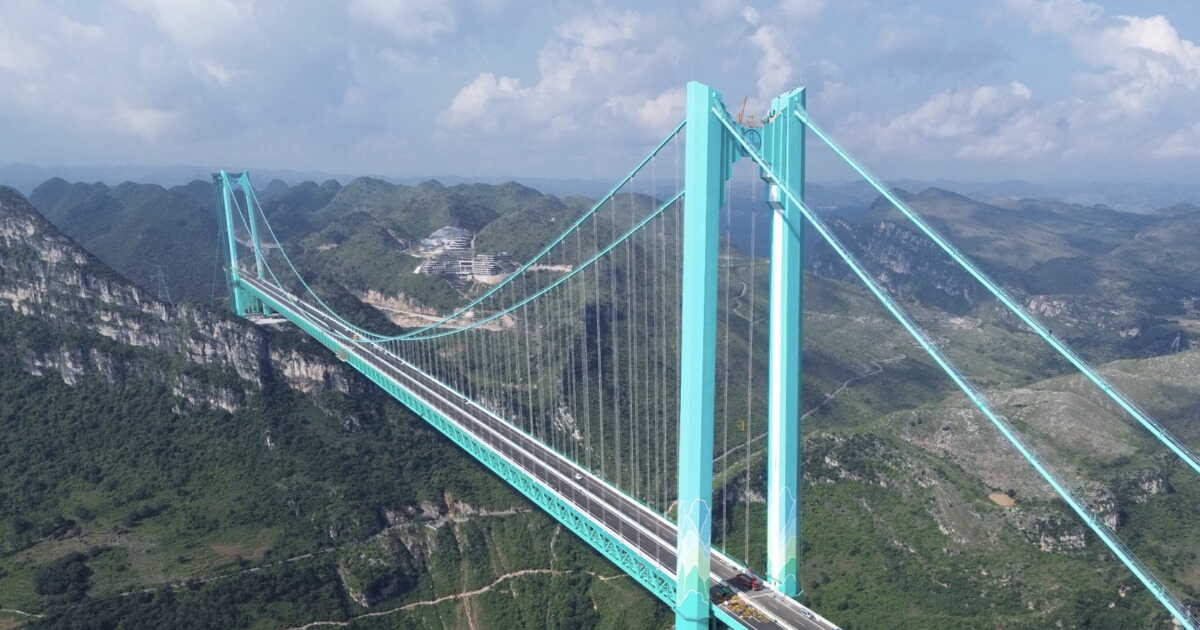
Thrill-seekers, this destination might interest you! In China, a colossal feat of engineering has become a tourism hotspot in its own right. Bungee jumping, glass walkways and hotels with views of the void now attract visitors to a mountainous region long kept off the major tourist circuits. Inaugurated in September 2025, the Huajiang Grand Canyon Bridge has already welcomed millions of curious visitors. But behind this craze, a question arises: how can an engineering marvel be transformed into a sustainable economic engine for local residents?
A vertigo-inducing bridge turned into a tourist attraction
In Guizhou Province, southwest China, the Huajiang Grand Canyon Bridge towers above the Beipan River by 625 meters. According to Guinness World Records, it is the world’s highest bridge. Stretching nearly 2.9 kilometers, this suspended structure on blue-green pylons was designed to facilitate travel in a region with particularly rugged terrain.
Before its construction, crossing the canyon could take about two hours. Thanks to this new road infrastructure, the journey now takes only two minutes. But motorists are not the only ones to benefit from this technical feat. Since its opening, the bridge has also drawn visitors who came specifically to admire it.
According to figures provided to CNN by local authorities, around 3.3 million visits were recorded between September 2025 and August 2026. The tourist facilities allow visitors to discover the structure from unusual angles. Glass observation platforms overlook the canyon, while an exposed walkway beneath the deck lets visitors walk along the structure hundreds of meters above the ground.
Adventure enthusiasts can also throw themselves into the void, tethered by a bungee cord. In one jump, a participant falls for seven seconds before the rope pulls them back upward. A spectacle that attracts both thrill-seekers and spectators, smartphones in hand.
The site’s success signals a shift in the use of China’s large infrastructures. Long envisioned primarily to facilitate transport, they are becoming attractions capable of generating tourist travel on their own. A boon for China, which aims to attract more visitors.
Economic Benefits for the Surrounding Villages
At the foot of the bridge, the influx of visitors opens up new prospects for locals. Lin Guoquan took that bet by returning to Guizhou after several years working as a cook in other Chinese provinces. He transformed old family houses, including his grandparents’ home, into tourist accommodations. His establishment grew quickly. “When we opened, we had only nine rooms. Now we have 52, and we still don’t have enough rooms to accommodate all our guests”, he told CNN.
Footfall at the bridge can reach sizeable levels during holiday periods. During the nine days of the Chinese New Year, in February 2026, the bridge’s visitor reception area logged more than 300,000 visits. This surge benefits the lodging providers in neighboring villages, including Lin Guoquan. The entrepreneur also relies on social media to attract customers. On Douyin, the Chinese equivalent of TikTok, his videos about his village earned him more than 100,000 followers. “Many people book rooms at my establishment after watching my videos. They ask me for travel advice”, he told CNN.
To accompany this growth, digital infrastructure had to evolve as well. The operator China Mobile, together with technology company Huawei, developed the mobile network in this mountainous area to meet the needs of visitors and tourism professionals. “What people see is this imposing physical bridge,” explained to CNN by Zhou Jianguo, a member of Huawei’s Strategy and Business Development division in China. “Yet a bridge in the digital world is just as necessary, and that is our communications network.”
Higher up in the canyon, the Onaemont luxury hotel offers another way to enjoy the site. Its 83 rooms overlook the bridge directly, while its restaurants and panoramic pool encourage visitors to prolong their stay. For Cao Luyao, the hotel’s marketing communications manager, the aim is precisely to shift habits among visitors. “Tourists no longer just come to see the bridge; they can spend the night nearby.”, she told CNN.
It remains to be seen whether this craze will translate into durable benefits. A study by Li Linna, associate professor at Beijing Normal University, focusing on 295 tall bridges in Guizhou, shows that their average contribution to improving district accessibility has declined with the expansion of the highway network. Gains fell from about 8% between 2010 and 2015 to nearly 5% between 2015 and 2020.
For the researcher, the challenge now is to determine where to build new structures and what needs they should satisfy. The Huajiang Bridge illustrates a possible path: beyond transport, infrastructure can also attract travelers, create jobs, and raise awareness of remote territories. But sustaining this momentum will depend on the ability of local players to transform a spectacular curiosity into a durable tourism activity.