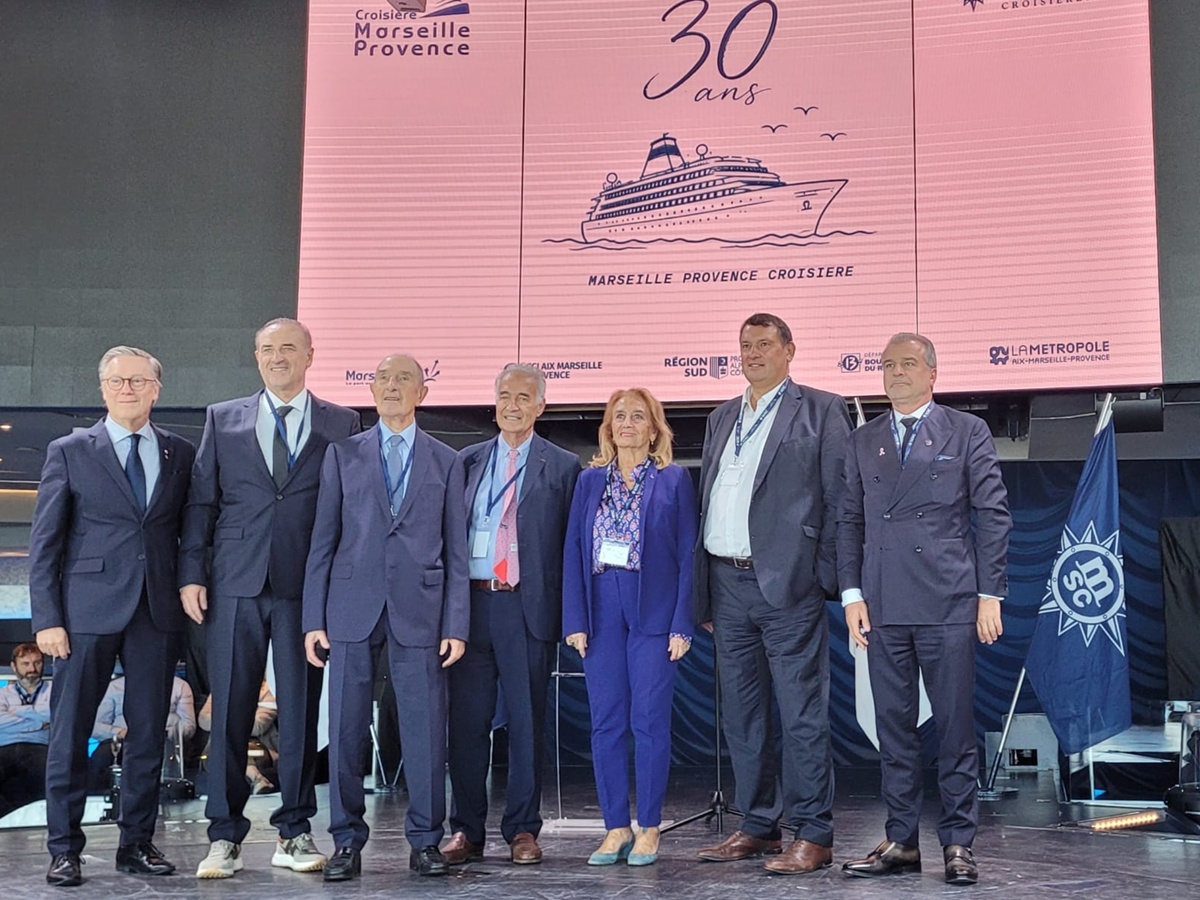
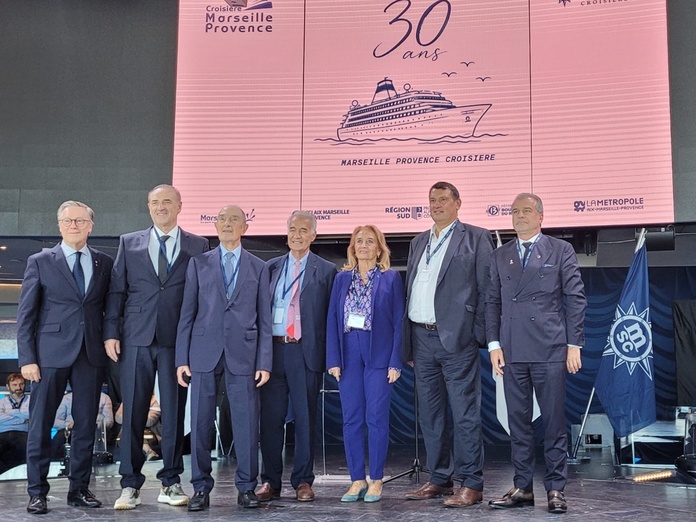

He received a standing ovation. While “90 years knock at his door,” Jacques Truau, founder-president of the Club of Marseille Provence Cruise, which became in 2023 Marseille Provence Croisière, was present alongside Jacques Hardelay and Jean-François Suhas, respectively president and deputy president of the association, on Monday October 12, 2026 aboard the MSC Meraviglia, to celebrate the 30th anniversary of the “Club.”
A project he carried forward with his teams and partners for nearly twenty years, at a time when only a few in the early 1990s could see, as he did, the potential of Marseille as a “cruise destination.”
“In his work Terre des Hommes, Antoine de Saint-Exupéry wrote that a man faces an obstacle, measures it when he stands before it. And that to master or reach it, he must create a tool… Hence the birth of the Club de la Croisière,” thus introduced Jacques Truau.
It must be noted—with context—that at the start of the 1990s, the Port of Marseille-Fos was undergoing a period of profound social turbulence, marked by the crisis of the port-handling reform.
In that challenging context, a few players perceived the potential of a still-nascent activity in the Mediterranean: cruising. Thus, in 1993, when Marseille was barely hosting 11,606 passengers, fourteen institutional and professional actors signed the Cruise Charter.
The Cruise Club, Jacques Truau’s Bold Bet
Three years later, in 1996, the Marseille-Provence Chamber of Commerce and Industry, the City of Marseille and the Port Authority of Marseille joined forces to create the Cruise Club, driven by its founding president, Jacques Truau.
The bet was far from won, because convincing international cruise lines, developing infrastructure, professionalizing the welcome, and gradually uniting the entire region around this new activity all had to be accomplished.
But behind the scenes, Jacques Truau was already at work. Since 1994, he was trying to persuade Pippo Costa, CEO of Costa Croisières and son of the company’s founder, to call at Marseille. “When I suggested Marseille as a base, at a time when he had some Mediterranean cruise development projects, he told me: ‘But coming to Marseille, Mr. Truau, you must not even think of it! Never, even if you offered me free cruises, I would not set foot in Marseille’ ,” recalled the honorary president of Marseille Provence Croisière.
A few months later, however, while passing through Marseille, Pippo Costa saw the city evolving… in the right direction. “Dominique Vlasto, the tourism deputy at Marseille city hall under Jean-Claude Gaudin, had the brilliant idea of redoing the quay pavements and dressing the restaurant terraces in deep blue,” continued Jacques Truau.
A proof for Costa Croisières that the city was working toward its rehabilitation.
Thus, in May 1996, the Costa Romantica inaugurated seven-day Mediterranean cruises from Marseille (a month earlier, Royal Caribbean International’s Splendour of the Seas had already docked at the port). “Every Saturday, when the Costa liner came into Marseille at four o’clock in the morning, we had to walk the docks to ensure that no obstacle—still more obstacles—would paralyze the calls,” added Jacques Truau.
Marseille Provence Croisière: A Site for Collective Construction
In 1997, MSC Cruises joined Marseille, while in 1998 Norwegian Cruise Line docked at the Léon Gourret pier for eleven calls on the head line route.
“At the time, cruising did not yet occupy the place it now holds in the maritime and tourist economy of our territory,” stressed Hervé Martel, chairman of the board of the Grand Port Maritime de Marseille. “It was necessary to unite energies, make a port, a city, and a chamber of commerce work together, but also bring together companies, tourism professionals, and all the economic players of the area. It was necessary to pool skills and build a shared ambition.
Thirty years later, that ambition has borne fruit. It has allowed the club to become, over the years, much more than a promotional tool. It is a place of dialogue, coordination, and collective construction, where port, tourism, economic, industrial, and institutional logics converge,” he summarized.
For the history of Marseille Provence Croisière is intrinsically linked to that of the port and its transformation. To currently welcome more than 2.6 million passengers annually, major investments had to be made, notably the creation of successive welcome infrastructures, up to the inauguration of the Marseille Provence Cruise Terminal (MPCT).
On the J4 quay, opposite the MUCEM, a provisional passenger terminal will soon be put into service while awaiting a durable terminal not before 2028.
Also note the renovation of the Forme 10, the provision of free shuttles inside the port for excursion passengers, and, more closely, the shore power connection for ships at berth (CENAQ), with four years’ lead time ahead of European directives.
The Ecological Transition, A Colossal Project
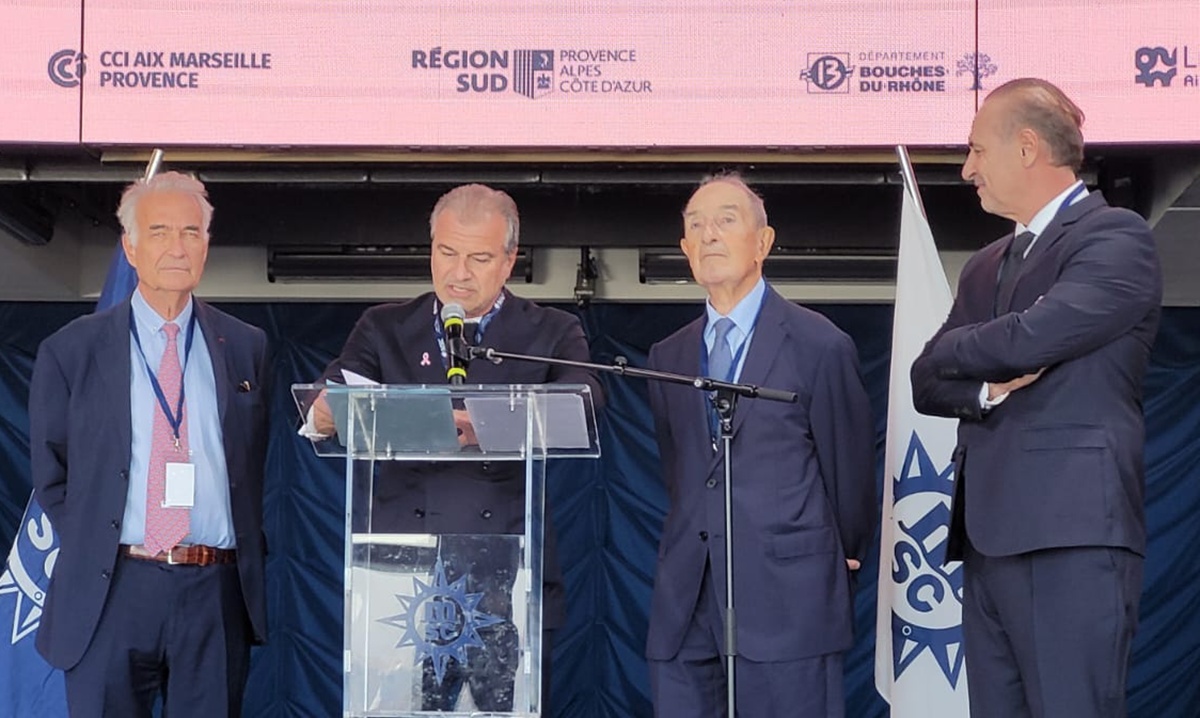
A project that, like the ecological transition of cruising, has been the flagship issue of Marseille Provence Croisière’s second president, Jean-François Suhas.
Under his presidency, from 2015 to 2025, Marseille Provence Croisière inaugurated a new format, the Blue Maritime Summit, which brought together international players in the sector around the energy and environmental transition.
This momentum led notably to the Blue Charter, then to the Mediterranean Sustainable Cruise Charter and to the Durable Stopovers Commitments. “The commitments made in recent years and the investments carried out show that a profound transformation is possible when all stakeholders move forward together. Our responsibility today is to continue this momentum and ensure that cruise development is fully compatible with the environmental and societal expectations of the territory,” reminded the current deputy president aboard the Meraviglia.
During his ten years at the helm, the port’s pilot had to confront many detractors, starting with the City Hall, which withdrew its subsidies from the association, denouncing an polluting industry.
Today, the new president of Marseille Provence Croisière, Jacques Hardelay, does not lose hope for a rapprochement with the City. “There is a renewed dialogue, because our stance is somewhat different, largely thanks to the on-shore electrical connection.
Previously, the discussion focused only on pollution. That issue masked everything else. Now that pollution is largely under control with shore power, we can talk about everything else: the economic impact on the city, how to manage passenger flows, and above all how to build something together,” he said.
Achieving 100% Clean Stopovers by 2030
The association’s third president – which currently brings together 104 members – intends to evolve the cruise sector’s development model, based on its “Horizon 2030” plan and its three priorities: environmental commitment, territorial integration, and competitiveness.
“Our objective is clear, precise and ambitious: to achieve 100% clean stopovers by 2030. This objective is primarily for the residents of Marseille, but also for the women and men who sustain our territory,” he emphasized.
Yet despite ecological performance targets, “our vision has changed profoundly,” the president continued. “As you may have seen, we have almost tripled the number of passengers in 13 years (in 2013, Marseille reached one million cruise passengers, ndlr), but the number of stopovers rose only 50% because the ships have grown much larger.”
This realization guided the evolution of the Club’s strategic roadmap. “For the first time in our history, we deliberately chose not to set any numerical attendance targets.
As I often say, our absolute priority is no longer to do more cruises, but to do better. That means better distributing passenger flows to encourage longer stays ashore during port calls and preserving the quality of life for the people of Marseille. It also means working to integrate decarbonized mobility, such as electric buses for excursions; but also to maximize local added value rather than simply increasing quantity.”
The latest example of this strategy: the opening of a flight link between Marseille and New York in 2027, operated by United Airlines. “An example of successful collaboration with the airport and evidence that we are pursuing quality, with the ambition of having a new terminal at J4 in 2028, which would attract cruises of even higher quality,” stated Jacques Hardelay.
If today the provisional J4 terminal can handle 200 passengers, the aim is to accommodate a thousand. “Thanks to the Marseille-New York link, shipowners are showing interest in J4, with this arrival opposite the MUCEM, but only if we can welcome 1,000 passengers. All of this is being put in place,” adds the president of Marseille Provence Croisière.
Lu 2832 fois
Note
Comments
New comment :
In the same section :
<
>
>
Wednesday 28 October 2026 – 11:00 Variety Cruises : Steve Reynolds (ex-Discover Qatar) takes the helm
|
Wednesday 28 Octobre 2026 – 08:01 Tourism: Guadeloupe seeks to better share cruise profits [ABO]
|